Lecture 13: Locked Linkages
TL;DR
Locked linkages and trees exist in rigid origami structures and can be proven to be locked using tension and compression forces.
Transcript
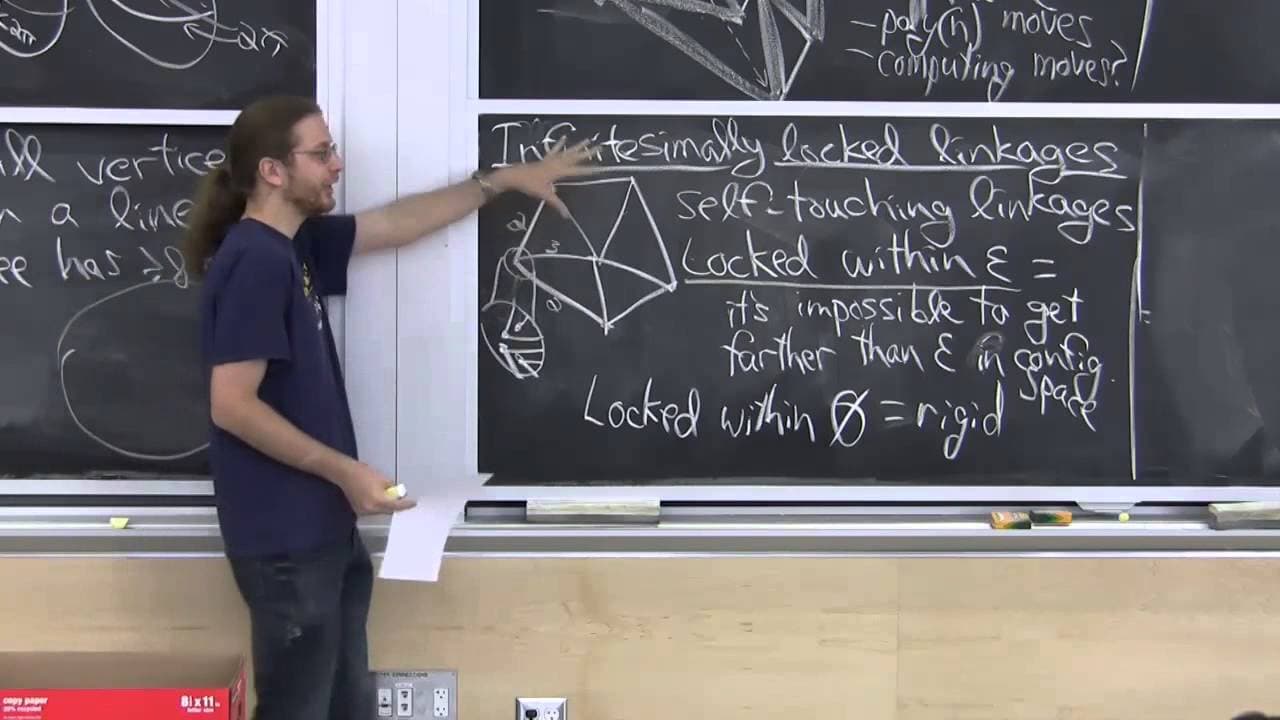
PROFESSOR: All right, let's get started. So today we're continuing the theme of locked linkages. Last time we talked about the Carpenter's Rule Theorem, which brought together all of the rigidity theory and tensegrity theory we had built, essentially, and showed that there were no locked 2D chains, paths or cycles, as graphs. And in general you can... Read More
Key Insights
- 🔒 Locked trees in 2D have been extensively studied and can be proven to be locked using the Carpenter's Rule Theorem and the rules.
- 🔒 Linear locked trees have been extensively analyzed to determine their rigidity and locked state.
Install to Summarize YouTube Videos and Get Transcripts
Explore YouTube Video Summarizer or Get YouTube Transcript Extractor
Questions & Answers
Q: How can the Carpenter's Rule Theorem be applied to determine if a graph is locked?
The Carpenter's Rule Theorem states that there are no locked chains in 2D, but there are locked trees. It can be applied by analyzing the connections and degrees of vertices in the graph.
Q: What are the key insights from studying locked linkages and trees?
- The Carpenter's Rule Theorem proves that there are no locked chains in 2D, but there are locked trees.
- Algorithms like mimicry of proofs and energy methods can be used to determine if a linkage is locked.
- Linear and orthogonal locked trees have been extensively studied and can be analyzed using the rules to determine if they are rigid or locked.
Q: What are the implications of locked trees in the field of origami?
Locked trees in origami structures can provide insights into the rigidity and stability of the final folded shape. By analyzing the locked state of trees in origami, researchers can design more stable and structurally sound foldable objects.
Summary & Key Takeaways
-
Locked linkages consist of open chains, paths, or cycles that cannot move due to their geometry.
-
Locked trees are a special case of locked linkages where there are branching points with a maximum degree of 2.
-
Several algorithms can be used to determine if a chain or tree is locked, including mimicry of existing proofs and energy methods.
Read in Other Languages (beta)
Share This Summary 📚
Summarize YouTube Videos and Get Video Transcripts with 1-Click
Try YouTube Summary with ChatGPT & Claude or YouTube Transcript Generator
Explore More Summaries from MIT OpenCourseWare 📚



Summarize YouTube Videos and Get Video Transcripts with 1-Click
Try YouTube Summary with ChatGPT & Claude or YouTube Transcript Generator