L08.4 Means & Variances
TL;DR
Expectation and variance for continuous random variables are calculated using integrals, following similar principles as in the discrete case.
Transcript
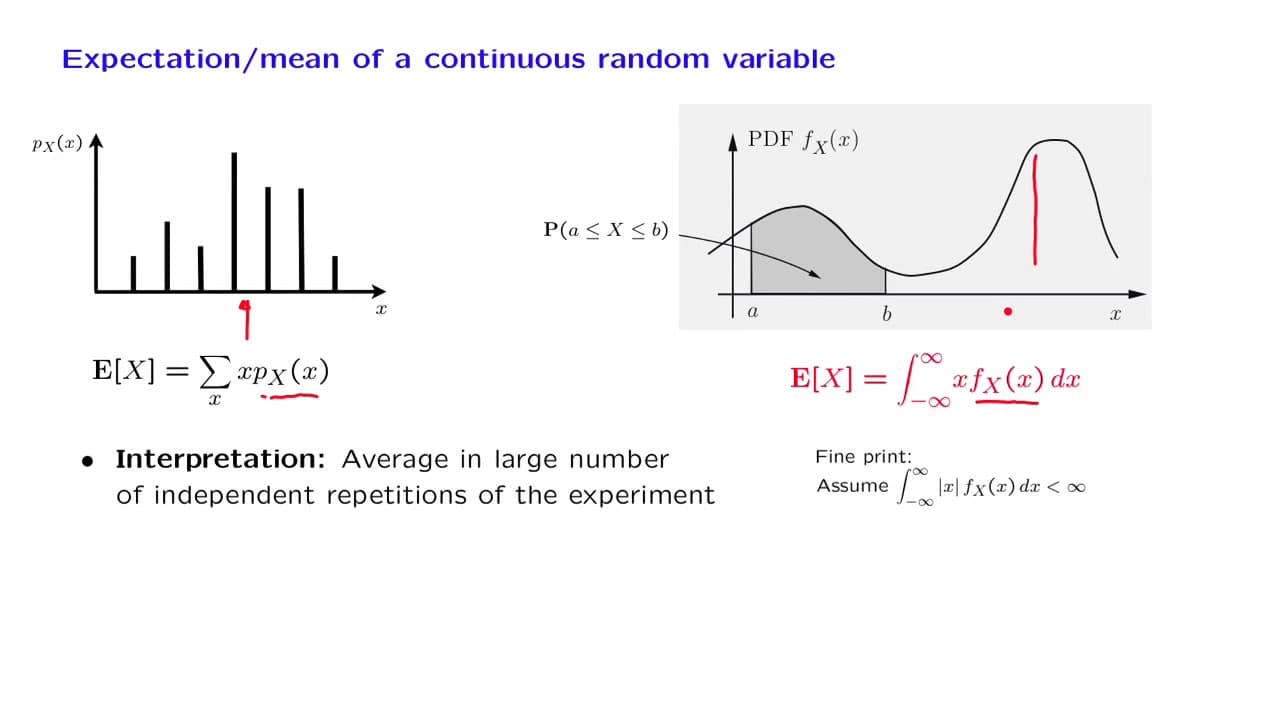
We now start with our agenda of developing continuous counterparts of everything we have done for discrete random variables. Let us look at the concept of expectation. In the discrete case, we have defined expectation as a weighted average of the values X of the random variable, weighted according to their corresponding probabilities. In the contin... Read More
Key Insights
- 💼 Expectation for continuous random variables is calculated using integrals, similar to the weighted average calculation in the discrete case.
- 🌥️ The intuition for expectation remains the same in both discrete and continuous cases, representing the average of values in a large number of repetitions.
- 📏 Variance and standard deviation are defined and calculated using the expected value rule with integrals.
- 🥹 Linearity holds for continuous random variables, allowing for the separation of terms when calculating expectations of linear functions.
- ❓ Assumptions about the integrability of the absolute value of the random variable are necessary for the expectation to be well-defined.
- ❓ Expectation represents the center of gravity of the probability distribution.
- 🚱 Non-negative random variables have non-negative expectations, and random variables inside an interval have expectations within the same interval.
Install to Summarize YouTube Videos and Get Transcripts
Explore YouTube Video Summarizer or Get YouTube Transcript Extractor
Questions & Answers
Q: How is expectation calculated for continuous random variables?
Expectation for continuous random variables is calculated by taking a weighted average over the possible values of the random variable, weighted according to the corresponding value of the density function. This is done by replacing summation with integration.
Q: What is the intuition behind expectation in the continuous case?
The intuition for expectation in the continuous case is similar to the discrete case, representing the average of values expected to be seen in a large number of independent repetitions of the experiment. It can also be thought of as the center of gravity of the probability distribution.
Q: Are there any assumptions or conditions for the expectation to be well defined in the continuous case?
Yes, for the expectation to be well defined, we need to assume that the integral of the absolute value of the random variable, weighted according to the density, gives a finite result. This assumption ensures that the expectation is mathematically well-defined.
Q: How does linearity apply to continuous random variables?
Linearity holds for continuous random variables as well. If we have a function of the random variable X, linearity allows us to separate the expected value of the function into separate terms and apply the expected value rule using integrals.
Summary & Key Takeaways
-
In the continuous case, expectation is defined as a weighted average over the possible values of a random variable, weighted according to the corresponding value of the density.
-
The intuition for expectation remains the same as in the discrete case, representing the average of values expected to be seen in a large number of independent repetitions of the experiment.
-
Variance, standard deviation, and linearity properties also apply to continuous random variables.
Read in Other Languages (beta)
Share This Summary 📚
Summarize YouTube Videos and Get Video Transcripts with 1-Click
Try YouTube Summary with ChatGPT & Claude or YouTube Transcript Generator
Explore More Summaries from MIT OpenCourseWare 📚



Summarize YouTube Videos and Get Video Transcripts with 1-Click
Try YouTube Summary with ChatGPT & Claude or YouTube Transcript Generator