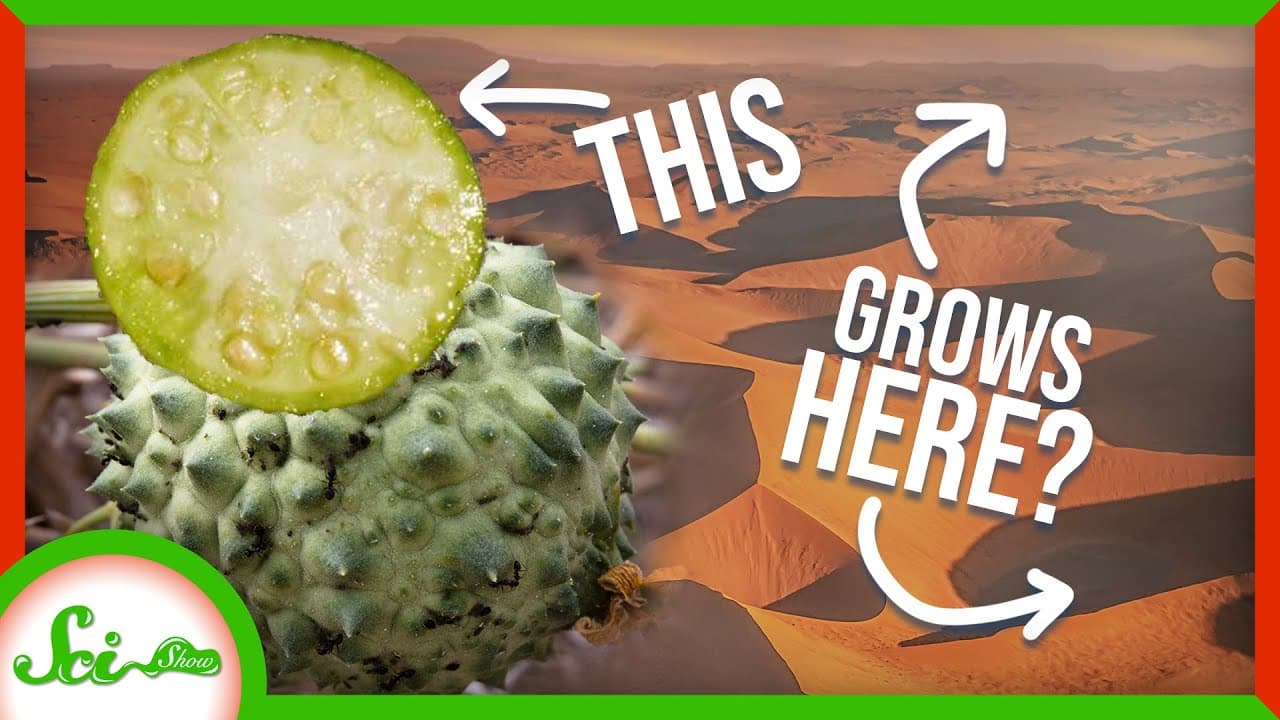
This Melon Builds a Whole Ecosystem in the Desert
TL;DR
The Namib desert is an extreme environment with unique adaptations, such as the nara melon forming an ecosystem.
Transcript
Thanks to Brilliant for supporting this episode of SciShow. Go to Brilliant.org/SciShow to learn how you can take your STEM skills to the next level! [♪intro♫] It’s not easy to live in southern Africa’s Namib Desert. It’s one of the oldest and driest deserts in the world, and many of the plants and animals that survive there have bizarre adaptation... Read More
Key Insights
- 🌱 The Namib Desert is a challenging environment with minimal rainfall and scarce nutrients, making it difficult for plants to survive.
- 👻 The nara plant in Namib Desert creates sand mounds to capture moisture and organic matter, allowing it to flourish and produce melons.
- 🌱 The nara plant has remarkable adaptations like deep roots, fog harvesting, and no leaves, enabling it to live for over a century.
- 😋 The nara plant supports a diverse ecosystem in the desert, providing shade, water, and food for various species.
Install to Summarize YouTube Videos and Get Transcripts
Explore YouTube Video Summarizer or Get YouTube Transcript Extractor
Questions & Answers
Q: What are some of the extreme conditions in the Namib Desert?
The Namib Desert faces challenges like hyper-arid conditions, minimal rainfall, strong winds, and nutrient-poor sandy soil, making it one of the harshest environments to survive in.
Q: How does the nara plant create a stable habitat in the desert?
The nara plant builds sand mounds called hummocks to anchor itself and capture moisture and nutrients, allowing it to thrive and produce melons in the desert.
Q: How do the adaptations of the nara plant benefit other creatures in the Namib Desert?
The nara plant provides shade, water, and food for at least 26 vertebrate species like jackals and antelope, along with supporting microbial communities beneath it, creating a more hospitable environment in the desert.
Q: Why can't scientists replicate the growth of nara melons outside the Namib Desert?
Scientists believe that the unique adaptations and highly specific niche of the nara plant may not be replicable outside the desert, leading to difficulties in growing them outside their natural habitat.
Summary & Key Takeaways
-
The Namib Desert is one of the driest and oldest deserts, with extreme conditions like minimal rain and scarce nutrients for plants.
-
The nara plant in Namib Desert thrives by creating sand mounds called hummocks that capture moisture and organic matter.
-
The nara plant has incredible adaptations like deep roots, fog harvesting, and no leaves, living over a century and supporting diverse wildlife.
Read in Other Languages (beta)
Share This Summary 📚
Summarize YouTube Videos and Get Video Transcripts with 1-Click
Try YouTube Summary with ChatGPT & Claude or YouTube Transcript Generator
Explore More Summaries from SciShow 📚


Summarize YouTube Videos and Get Video Transcripts with 1-Click
Try YouTube Summary with ChatGPT & Claude or YouTube Transcript Generator