Products
Features
YouTube Video Summarizer
Summarize YouTube videos
Web & PDF Highlighter
Highlight web pages & PDFs
Chat with PDF
Ask any PDF questions with AI
Ask AI Clone
Chat with your highlights & memories
Audio Transcriber
Transcribe audio files to text
Glasp Reader
Read and highlight articles
Kindle Highlight Export
Export your Kindle highlights
Idea Hatch
Hatch ideas from your highlights
Integrations
Obsidian Plugin
Notion Integration
Pocket Integration
Instapaper Integration
Medium Integration
Readwise Integration
Snipd Integration
Hypothesis Integration
Apps & Extensions
Chrome Extension
Safari Extension
Edge Add-ons
Firefox Add-ons
iOS App
Android App
Discover
Discover
Ideas
Discover new ideas and insights
Articles
Curated articles and insights
Books
Book recommendations by great minds
Posts
Essays and notes from readers
Quotes
Inspiring quotes collection
Videos
Curated videos and summaries
Explore Glasp
Glasp Newsletter
Weekly insights and updates
Glasp Talk
Interview series with great minds
Glasp Blog
Latest news and articles
Glasp Use Cases
Learn how others use Glasp
Build & Support
Glasp API
Access Glasp's API for developers
MCP Connector
Connect Glasp to Claude & ChatGPT
Community
Glasp Reddit Community
Students
Student discount and benefits
FAQs
Frequently Asked Questions
AboutPricing
DashboardLog inSign up

The Most Common Mistake with Moles!
148.5K views
•
April 17, 2014
by
Tyler DeWitt
YouTube video player
The Most Common Mistake with Moles!

TL;DR

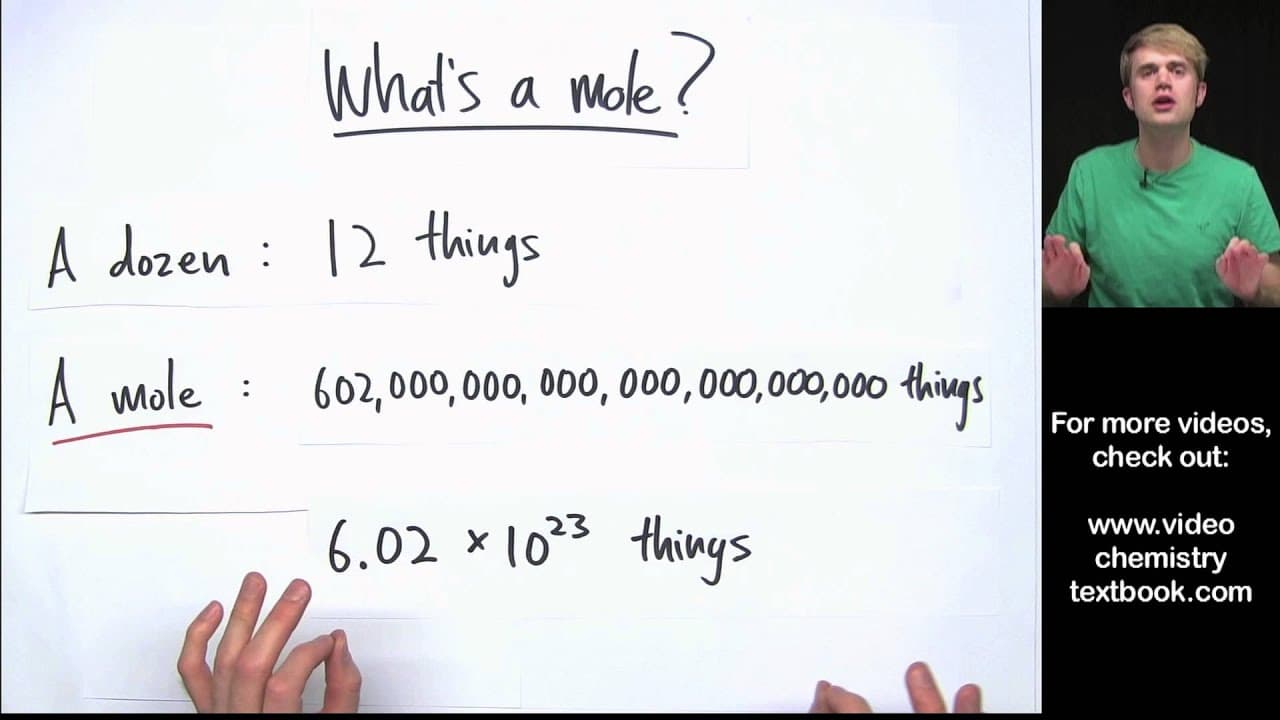
A mole in chemistry contains 6.02 x 10^23 molecules, serving as a unit of measurement.

Transcript

here's a question that can be a little bit tricky and it's a good test of how well you understand moles okay here's a question how many molecules of h2o are in one mole of h2o molecules okay think about this for a sec you can do some math pause the video and when you have your answer turn it back on okay got it so when I asked this question to peop... Read More

Key Insights

  • ☺️ A mole in chemistry represents 6.02 x 10^23 molecules, providing a standard unit for measuring quantities.
  • ☺️ The abbreviation 6.02 x 10^23 simplifies calculations of large numbers, known as 602 hexillion.
  • #️⃣ Moles help quantify the number of particles in substances accurately for chemical calculations.
  • 😑 Scientific notation aids in expressing large numbers like 602 hexillion more efficiently.
  • ❓ Understanding moles is essential for determining the quantity of molecules in a given substance accurately.
  • ❓ The concept of moles enables consistent measurement and comparison of particle quantities in chemistry.
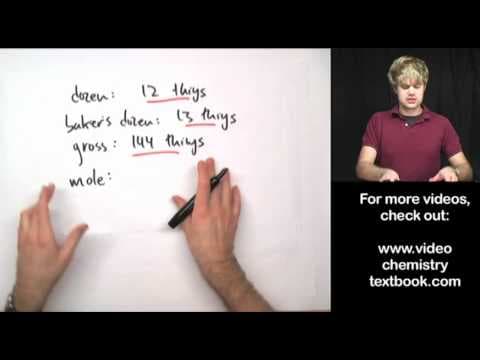
  • 🌥️ A mole is like a dozen but significantly larger, with 602 hexillion particles per mole compared to 12 in a dozen.

Install to Summarize YouTube Videos and Get Transcripts

Explore YouTube Video Summarizer or Get YouTube Transcript Extractor

Questions & Answers

Q: How many molecules are in one mole of a substance?

One mole contains 6.02 x 10^23 molecules, providing a standard unit for measuring quantities of particles in chemistry accurately.

Q: Why is the number 6.02 x 10^23 significant in chemistry?

The number 6.02 x 10^23, a mole in chemistry, simplifies calculations and quantifies the number of particles in a substance consistently.

Q: How is a mole similar to a dozen in everyday language?

A mole is analogous to a dozen but on a much larger scale, with a mole containing 602 hexillion particles compared to a dozen's 12.

Q: How can scientific notation help in understanding moles?

Scientific notation, such as 6.02 x 10^23, eases the representation of large numbers like 602 hexillion, making calculations and comparisons more manageable in chemistry.

Summary & Key Takeaways

  • A mole in chemistry is equivalent to 6.02 x 10^23 molecules, acting as a large unit of measurement.

  • The number 6.02 x 10^23 is commonly abbreviated from 602 hexillion to simplify calculations.

  • Understanding moles helps determine the quantity of molecules in a given substance accurately.


Read in Other Languages (beta)

English

Share This Summary 📚

Summarize YouTube Videos and Get Video Transcripts with 1-Click

Download browser extensions on:

Try YouTube Summary with ChatGPT & Claude or YouTube Transcript Generator

Explore More Summaries from Tyler DeWitt 📚
Kinetics and Reaction Rates (AP Chemistry) thumbnail
Kinetics and Reaction Rates (AP Chemistry)
Tyler DeWitt
Electroplating Part 2 thumbnail
Electroplating Part 2
Tyler DeWitt
What Are Endothermic and Exothermic Phase Changes? thumbnail
What Are Endothermic and Exothermic Phase Changes?
Tyler DeWitt
Charge of an Electron: Millikan's Oil Drop Experiment thumbnail
Charge of an Electron: Millikan's Oil Drop Experiment
Tyler DeWitt
What's the difference between a Mole and a Molecule? thumbnail
What's the difference between a Mole and a Molecule?
Tyler DeWitt
How to Calculate Oxidation Numbers Introduction thumbnail
How to Calculate Oxidation Numbers Introduction
Tyler DeWitt

Summarize YouTube Videos and Get Video Transcripts with 1-Click

Download browser extensions on:

Try YouTube Summary with ChatGPT & Claude or YouTube Transcript Generator

Apps & Extensions

  • Chrome Extension
  • Safari Extension
  • Edge Add-ons
  • Firefox Add-ons
  • iOS App
  • Android App

Key Features

  • YouTube Video Summarizer
  • Web & PDF Summarizer
  • Web & PDF Highlighter
  • Chat with PDF
  • Ask AI Clone
  • Audio Transcriber
  • Glasp Reader
  • Kindle Highlight Export
  • Idea Hatch

Integrations

  • Obsidian Plugin
  • Notion Integration
  • Pocket Integration
  • Instapaper Integration
  • Medium Integration
  • Readwise Integration
  • Snipd Integration
  • Hypothesis Integration

More Features

  • APIs
  • MCP Connector
  • Blog & Post
  • Embed Links
  • Image Highlight
  • Personality Test
  • Quote Shots

Company

  • About us
  • Blog
  • Community
  • FAQs
  • Job Board
  • Newsletter
  • Pricing
Terms

•

Privacy

•

Guidelines

© 2026 Glasp Inc. All rights reserved.