18. Cosmology I
TL;DR
Cosmology explores the large-scale structure of the universe by studying the geometry of spacetime using the Robertson-Walker metric and solving the Friedmann equations.
Transcript
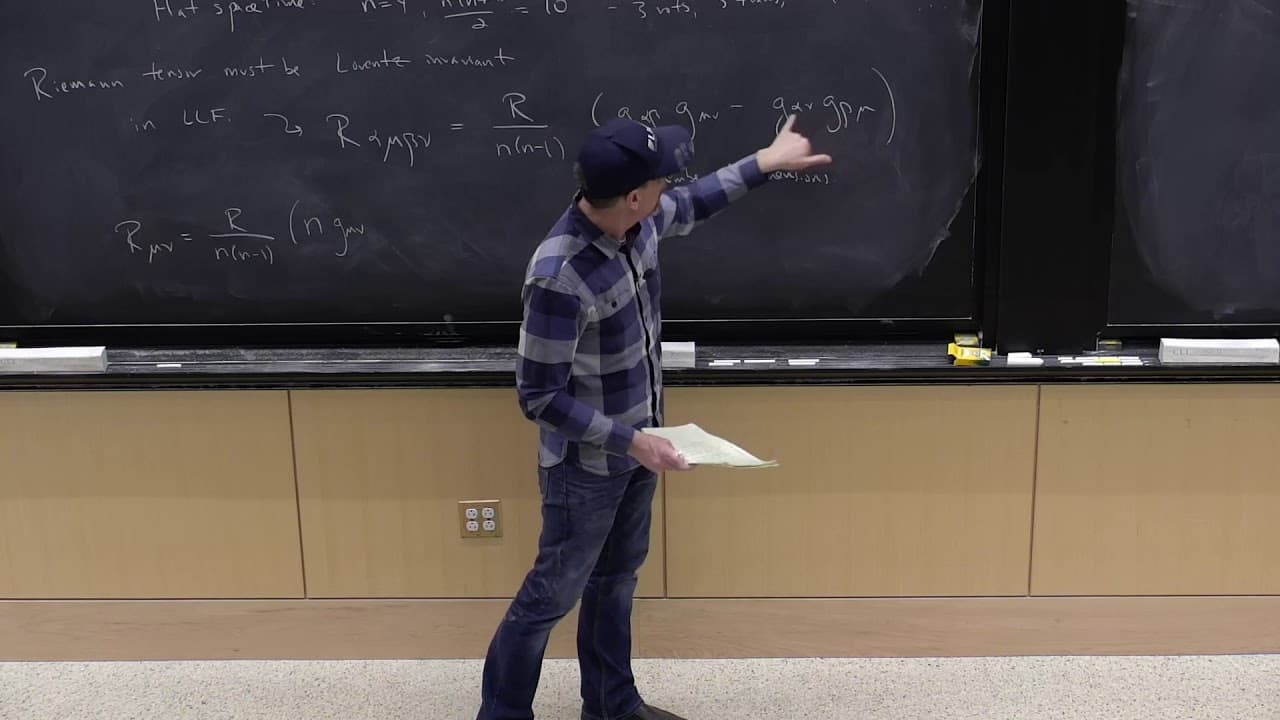
[SQUEAKING] [RUSTLING] [CLICKING] SCOTT HUGHES: All right. So at this point we're going to switch gears. Everything that we have done over the past several lectures has been in service of the approach to solving the Einstein field equations in which we assume a small perturbation around an exact background. Most of it was spent looking at perturbat... Read More
Key Insights
- 👾 Maximally symmetric spaces have uniform properties in all locations and directions, and the Robertson-Walker metric describes a spacetime that is maximally symmetric on large scales.
- ☠️ The Friedmann equations relate the expansion rate of the universe to its energy content, allowing us to study the evolution and dynamics of the universe.
- 💨 Different forms of matter, such as dust and radiation, have different equation of state parameters that affect the expansion of the universe in different ways.
Install to Summarize YouTube Videos and Get Transcripts
Explore YouTube Video Summarizer or Get YouTube Transcript Extractor
Questions & Answers
Q: How does the Robertson-Walker metric relate to the concept of maximally symmetric spaces?
The Robertson-Walker metric describes a spacetime that is both homogenous and isotropic, which are properties of maximally symmetric spaces.
Q: What does the Friedmann equation for matter-dominated universe imply about the expansion rate of the universe?
The Friedmann equation shows that in a matter-dominated universe, the expansion rate slows down over time, following an expansion proportional to the square root of time.
Q: How does radiation affect the expansion of the universe?
In a radiation-dominated universe, the expansion of the universe follows a square root of time relation, indicating a faster expansion rate compared to a matter-dominated universe.
Q: What is the role of the cosmological constant in the Friedmann equations?
The cosmological constant corresponds to a constant energy density in the universe and leads to an exponential expansion of spacetime.
Summary & Key Takeaways
-
The content introduces the concept of a maximally symmetric space, which is a space that is homogenous and isotropic.
-
The Robertson-Walker spacetime metric is derived, which describes the geometry of the universe on large scales.
-
The Friedmann equations are introduced, which relate the expansion rate of the universe to its energy content.
-
Different types of matter, such as dust, radiation, and a cosmological constant, are discussed in terms of their equation of state and their effects on the expansion of the universe.
Read in Other Languages (beta)
Share This Summary 📚
Summarize YouTube Videos and Get Video Transcripts with 1-Click
Try YouTube Summary with ChatGPT & Claude or YouTube Transcript Generator
Explore More Summaries from MIT OpenCourseWare 📚



Summarize YouTube Videos and Get Video Transcripts with 1-Click
Try YouTube Summary with ChatGPT & Claude or YouTube Transcript Generator