Class 8: Fold & One Cut
TL;DR
Fold and cut methods involve using straight lines or circular arcs to create intricate 2D shapes from a piece of paper.
Transcript
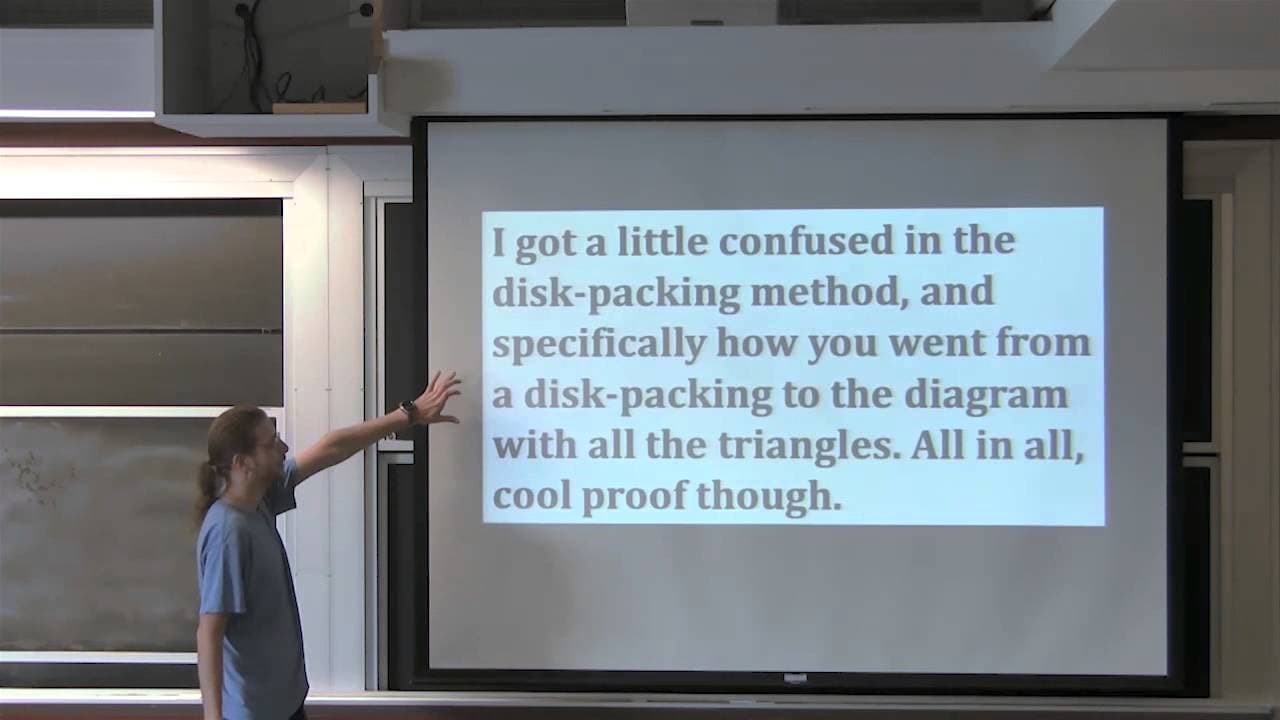
PROFESSOR ERIK DEMAINE: All right, so this lecture we talked about fold and one cut, two methods and a little bit about polyhedron flattening, so most of the questions are about fold and one cut. I'll stick to that. First question is, is there an equal software for doing fold-and-cut now? And the answer is yes, there's some software. Maybe not the ... Read More
Key Insights
- 🙏 Fold and cut methods can be used to create complex shapes and designs from a simple piece of paper.
- 💽 The number of creases in a shape is determined by the number of disks used in the disk-packing method.
- 🫠 The straight skeleton method can create intricate shapes with circular arc boundaries.
- 🙏 Fold and cut methods can be combined with other design techniques, such as tree theory and polyhedron flattening, to create more complex structures.
- 📂 There are still open questions and challenges in fold and cut methods, such as designing an alphabet with simple folds and creating animations for polyhedron flattening.
Install to Summarize YouTube Videos and Get Transcripts
Explore YouTube Video Summarizer or Get YouTube Transcript Extractor
Questions & Answers
Q: Is there software available to assist with fold-and-cut designs?
There are some software available, such as the Final Project software and JOrigami, that can help with fold-and-cut designs. These programs allow users to manipulate polygons and create folds and cuts.
Q: Can odd degree vertices be used in fold-and-cut designs?
Odd degree vertices can be used, but it makes the cutting process more challenging. Scissor cuts can still be achieved with even degree vertices, but mathematical cuts may be required for odd degree vertices.
Q: How do you convert a set of linear corridors into a tree using fold and cut methods?
To convert linear corridors into a tree, you assign edges to each corridor, create vertices at the connecting component of perpendiculars, and determine which vertices are adjacent. This allows you to create a tree-like structure.
Summary & Key Takeaways
-
The fold-and-cut method involves folding and cutting a piece of paper to create complex shapes like the magic trick of creating a word out of various pieces of paper.
-
The disk-packing method uses the concept of placing disks on a polygon to create a folded state. The number of disks used determines the number of creases in the final shape.
-
The straight skeleton method uses the straight skeleton of a shape and perpendicular fold lines to create a folded state. The resulting shape can have circular arc boundaries.
Read in Other Languages (beta)
Share This Summary 📚
Summarize YouTube Videos and Get Video Transcripts with 1-Click
Try YouTube Summary with ChatGPT & Claude or YouTube Transcript Generator
Explore More Summaries from MIT OpenCourseWare 📚



Summarize YouTube Videos and Get Video Transcripts with 1-Click
Try YouTube Summary with ChatGPT & Claude or YouTube Transcript Generator