How Is Udio Revolutionizing AI-Generated Music?
TL;DR
Udio leverages AI technology to enable users to create unique music by generating songs based on specified genres, themes, and lyrics. The platform enhances the composition process, allowing musicians of all skill levels to experiment with diverse sounds and styles, democratizing music creation. As Udio evolves, it aims to provide even greater user control and adaptability in musical outputs.
Transcript
hey everybody welcome back to twist this is Alex and we have a special interview for you today I am an enormous fan of music you may not know it but I grew up playing classical and jazz trumpet throughout my youth and music has remained an absolute huge passion of mine throughout really my entire life so when the AI revolution of the last couple ye... Read More
Key Insights
- 🎼 Udio utilizes AI to assist artists in music creation, learning from a diverse array of music data.
- 🎹 The platform encourages user creativity by offering controls over key modulation and the generation of music across genres.
- 👤 Despite some existing limitations, Udio is actively developing features to enhance user control and expand its functionality.
- 🎼 AI tools like Udio democratize music creation, empowering anyone, regardless of skill level, to participate in songwriting and composition.
- 💗 The company has rapidly grown both its user base and staff since its inception, demonstrating strong market interest and engagement.
- 👤 Udio's ability to adapt its services based on user feedback highlights its commitment to improving the music creation experience continuously.
- 🎼 The combination of AI-generated music and user collaboration fosters a community that thrives on shared creativity, breaking traditional barriers in music production.
Install to Summarize YouTube Videos and Get Transcripts
Explore YouTube Video Summarizer or Get YouTube Transcript Extractor
Questions & Answers
Q: What inspired David Deng to leave DeepMind to co-found Udio?
David Deng was passionate about both technology and music since childhood. His time at DeepMind exposed him to advancements in machine learning, leading him to explore how this technology could innovate music composition and help artists turn their ideas into reality.
Q: How does Udio's AI learn to generate music?
Udio's AI learns by analyzing vast amounts of music data, understanding the fundamental elements of music theory, such as chord progressions and rhythm interactions. This training allows the model to synthesize compositions that reflect these learned principles.
Q: What are the current limitations of Udio regarding user control over music creation?
Currently, Udio does not support detailed specifications like changing time signatures within a song, which users desire. However, it can accommodate key changes, reflecting efforts to provide users with more control over their music generation.
Q: How has Udio evolved since its initial launch?
Udio has seen significant improvements in audio quality and user capabilities since its launch. The introduction of key control and better performance allows a wider range of musical expression, enhancing its utility for both amateur and professional musicians.
Q: What types of users does Udio cater to?
Udio is designed for music lovers, artists, and songwriters who want to compose music easily and creatively. It aims to simplify the creative process while making music production more accessible for users with varying levels of expertise.
Q: How does Udio maintain its competitive edge amid rising AI technologies in music?
Udio differentiates itself through its advanced music generation capabilities and a focus on providing high-quality tools for artists, emphasizing the creative process over simply generating meme-based music common in competitor offerings.
Q: What was one unexpected success story that arose from Udio's use?
A song called "BBL Drizzy," created by a user who is a comedian, unexpectedly gained attention after being sampled by notable producers. This illustrates Udio's potential to facilitate impactful contributions to pop culture and the music industry.
Summary & Key Takeaways
-
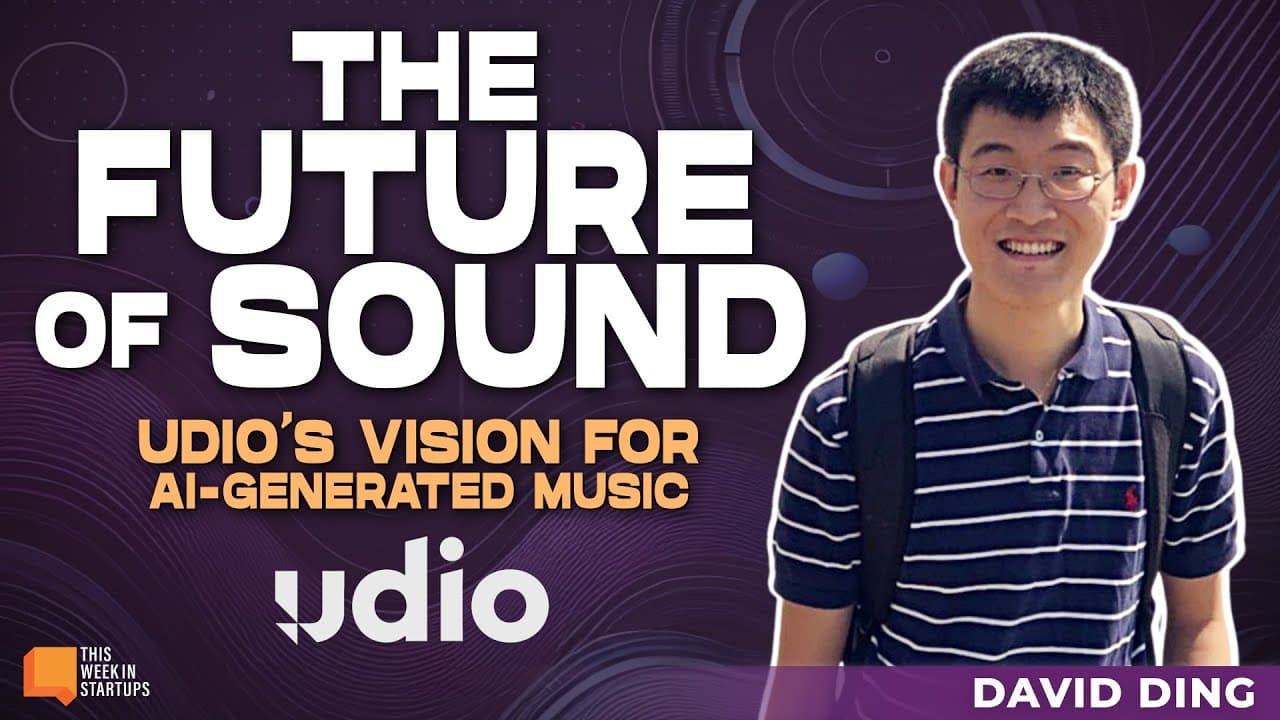
The interview features David Deng, co-founder of Udio, discussing how AI can enhance music creation by assisting composers in generating songs based on user specifications.
-
Udio uses advanced models that learn music theory and genre dynamics, allowing users greater control over time signatures, keys, and creative inputs to produce diverse musical outputs.
-
The rapid evolution of AI tools like Udio enables musicians of all levels to experiment creatively, democratizing music creation and expanding opportunities for unique sound exploration.
Read in Other Languages (beta)
Share This Summary 📚
Summarize YouTube Videos and Get Video Transcripts with 1-Click
Try YouTube Summary with ChatGPT & Claude or YouTube Transcript Generator
Explore More Summaries from This Week in Startups 📚






Summarize YouTube Videos and Get Video Transcripts with 1-Click
Try YouTube Summary with ChatGPT & Claude or YouTube Transcript Generator