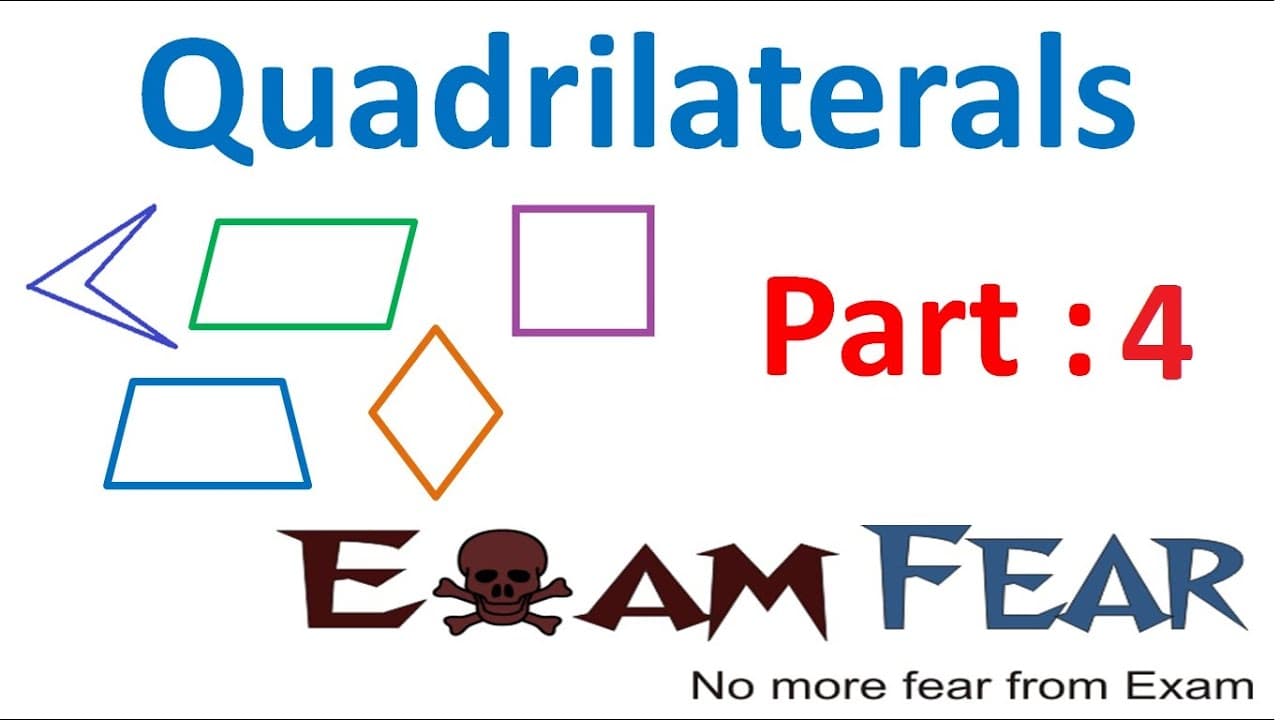
Maths Quadrilaterals part 4 (Polygon types & Diagonal) CBSE Class 8 Mathematics VIII
TL;DR
Polygons are closed curves with three or more sides, and diagonals are line segments that connect non-consecutive vertices of a polygon.
Transcript
hello friends this video on quadrilaterals part 4 is brought to you by exam furor calm no more fear from exam now in in terms of a polygon every polygon has a very important parameter which is called a diagonal now what is a diagonal of a polygon so it is a line segment that connects two non-consecutive vertices of a polygon now when we talk about ... Read More
Key Insights
- 🫥 A diagonal is a line segment that connects two non-consecutive vertices of a polygon.
- #️⃣ The number of diagonals in a polygon depends on its number of sides and vertices.
- 🙃 Polygons with fewer sides have fewer possible diagonals, while polygons with more sides have more potential diagonals.
- 🙃 A triangle does not have a diagonal because it has only three sides.
- 🙃 Polygons must have a minimum of three sides to be considered closed curves.
- 🙃 Different types of quadrilaterals have unique properties, such as having equal sides or parallel opposite sides.
- 🙃 The names of polygons are based on the number of sides they possess.
Install to Summarize YouTube Videos and Get Transcripts
Explore YouTube Video Summarizer or Get YouTube Transcript Extractor
Questions & Answers
Q: What is a diagonal in a polygon?
A diagonal is a line segment that connects two non-consecutive vertices of a polygon. It is not a side of the polygon.
Q: Can a triangle have a diagonal?
No, a triangle does not have a diagonal because it does not have two non-consecutive vertices. A diagonal requires at least four sides.
Q: Why can't a polygon have two sides?
A polygon must have a minimum of three sides to form a closed curve. If it has only two sides, it will not form a closed curve.
Q: How are the names of polygons determined?
The names of polygons are determined by the number of sides they have. For example, a polygon with three sides is called a triangle, and one with four sides is called a quadrilateral.
Q: Do all quadrilaterals have the same properties?
No, different types of quadrilaterals have different properties. Some have all equal sides, some have opposite sides parallel, and some have specific relationships between adjacent sides.
Q: Is there a limit to the number of diagonals a polygon can have?
The number of diagonals a polygon can have depends on the number of sides and vertices. As the number of sides increases, the number of possible diagonals also increases.
Summary & Key Takeaways
-
A diagonal is a line segment that connects two non-consecutive vertices of a polygon.
-
The number of diagonals in a polygon depends on the number of sides and vertices.
-
Different types of polygons, such as squares and concave polygons, have varying numbers of diagonals.
Read in Other Languages (beta)
Share This Summary 📚
Summarize YouTube Videos and Get Video Transcripts with 1-Click
Try YouTube Summary with ChatGPT & Claude or YouTube Transcript Generator
Explore More Summaries from LearnoHub - Class 11, 12 📚



Summarize YouTube Videos and Get Video Transcripts with 1-Click
Try YouTube Summary with ChatGPT & Claude or YouTube Transcript Generator