Armature Resistance | Lap winding | wave Winding | Examples | DC Machines | | Lec-14
TL;DR
Discusses the relationships and calculations of armature resistance for lap and wave winding in DC generators.
Transcript
hello everyone in this session we will discuss some problems regarding the lab finding and the way binding so before that we will discuss one statement in the last session the statement is if the same machine is connected for lap and wave winding lamp and wave winding depends on the application depends on the application so sometimes it required so... Read More
Key Insights
- 👋 Lap and wave winding serve different purposes; lap winding offers more current capacity due to additional parallel paths, making it suitable for applications requiring higher current.
- ⚡ Wave winding provides a higher voltage output due to its fewer parallel paths, beneficial for applications where voltage is prioritized over current.
- 😘 The armature resistance of a winding type affects the overall efficiency and thermal performance of a DC generator; lower resistance yields better efficiency.
- 💨 For a six-pole machine, each winding type uniquely influences the generated EMF and operational characteristics, necessitating careful selection for intended applications.
- 🥳 The calculations involved in determining EMF ratios and armature resistance values are fundamental for electrical engineering students and professionals to understand generator operations.
- ✊ Changing the winding type on the same machine highlights the versatility of DC generators in adapting to various power requirements.
- ❓ The content underscores the importance of practical problems and examples in learning electrical engineering concepts, enhancing comprehension through applied calculations.
Install to Summarize YouTube Videos and Get Transcripts
Explore YouTube Video Summarizer or Get YouTube Transcript Extractor
Questions & Answers
Q: What is the primary difference between lap and wave winding configurations in DC generators?
The primary difference between lap and wave winding configurations lies in the number of parallel paths. In lap winding, the number of parallel paths equals the number of poles, which for a six-pole generator is six. In contrast, wave winding has only two parallel paths regardless of the number of poles, affecting the overall voltage and current characteristics of the generator.
Q: How is the EMF generated in lap and wave windings calculated?
The EMF generated in lap and wave windings is linked to the number of parallel paths. For lap winding, with six parallel paths and a wave winding with two, the ratio of the EMF (E_l/E_w) can be calculated using the formula that relates parallel paths, resulting in a ratio of 3:1, leading to the conclusion that the generated EMF in wave winding is three times that of lap winding.
Q: What is the armature resistance in a six-pole lap wound DC generator and how does it compare to wave winding?
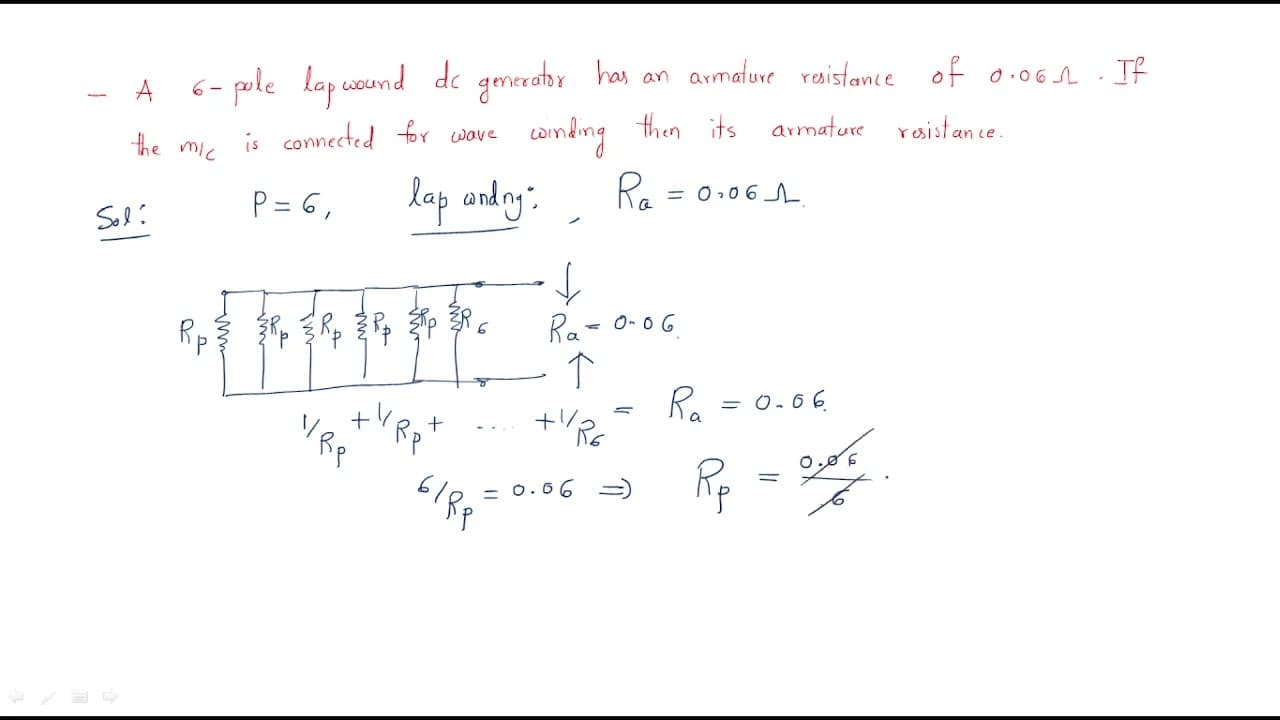
The armature resistance in a six-pole lap wound DC generator is 0.06 ohms. When the winding is changed to wave configuration, the armature resistance increases due to changes in the number of parallel paths and total resistance, ultimately resulting in an armature resistance of 0.54 ohms in the wave winding setup.
Q: Why is the configuration of winding significant for the performance of a DC generator?
The winding configuration is crucial for a DC generator's performance because it directly influences the generator's voltage, current capacity, and efficiency. The choice between lap and wave winding affects how the machine responds to different loads and under various operational conditions, determining the generator's suitability for specific applications.
Summary & Key Takeaways
-
The content explores the functionalities of lap and wave winding in a six-pole DC generator, highlighting how one machine can operate under both conditions based on current and voltage requirements.
-
It presents a problem that illustrates the ratios of generated EMFs between lap and wave windings, demonstrating that the lap winding has three parallel paths while wave winding has two, resulting in a 1:3 emf ratio.
-
Finally, it addresses the relationship between armature resistance and winding type, showcasing the calculations that determine how resistance values change between lap winding (0.06 ohms) and wave winding (0.54 ohms).
Read in Other Languages (beta)
Share This Summary 📚
Summarize YouTube Videos and Get Video Transcripts with 1-Click
Try YouTube Summary with ChatGPT & Claude or YouTube Transcript Generator