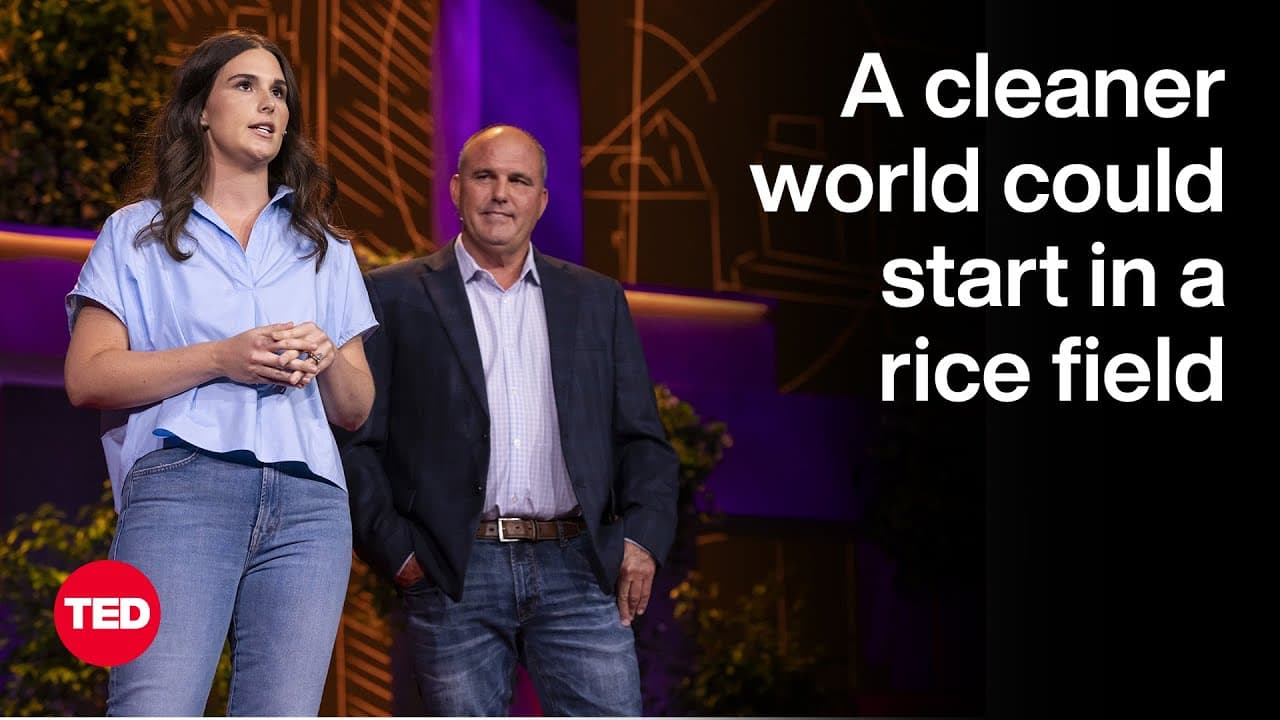
A Cleaner World Could Start in a Rice Field | Jim Whitaker and Jessica Whitaker Allen | TED
TL;DR
Jim and Jessica Whitaker share their family's journey in sustainable farming practices and how it has led to both economic success and environmental sustainability in the rice industry.
Transcript
Jim Whitaker: I grew up on a family farm. My family's been farming for 130 years in southeast Arkansas, and I'm a fifth generation farmer. We raise cotton, rice, corn and soybeans, along with my brother Sam, our extended families and a lot of great coworkers, could not do it without them. So when I was 16 years old, I came home from school one day.... Read More
Key Insights
- 🌾 Jim Whitaker's family farm faced financial hardship, but they were able to make sustainable changes that improved both their economic and environmental sustainability.
- 🌾 By using techniques like zero-grade leveling and capturing rainfall, the Whitakers were able to reduce water usage, runoff, erosion, and nutrient loss on their fields, resulting in higher yields and economic benefits.
- 🔋 They were also able to sell agricultural carbon credits to Microsoft in 2016, demonstrating the potential for farmers to contribute to carbon reduction efforts and earn additional income.
- 🌾 Jessica Whitaker Allen, a sixth-generation farmer, is actively involved in promoting sustainable rice production and conservation efforts through her work at Ducks Unlimited.
- 💼 Jessica's role involves data collection, protocol development, and educating other farmers about the economic and environmental benefits of sustainable practices.
- 👍 The Whitakers believe that risk mitigation and economic incentives are crucial to getting more farmers involved in sustainability efforts.
- 🌍 Sustainable rice production methods, such as alternate wetting and drying, have the potential to significantly reduce greenhouse gas emissions and water usage on a global scale.
- 🌱 In order to ensure a sustainable farming industry, there is a need to reward and support farmers who are pioneering and adopting sustainable practices.
Install to Summarize YouTube Videos and Get Transcripts
Explore YouTube Video Summarizer or Get YouTube Transcript Extractor
Questions & Answers
Q: How did Jim and Jessica Whitaker's family farm initially face financial challenges?
Jim Whitaker's family farm faced financial challenges due to a historic drought in 1980, leading to a foreclosure letter and potential loss of the farm.
Q: What were some of the sustainable farming practices adopted by the Whitaker family?
The Whitaker family adopted zero-grade farming techniques, leveling fields flat, capturing rainfall with a perimeter road, and reducing water usage, runoff, and nutrient loss.
Q: How did the Whitaker family's focus on economic sustainability lead to environmental sustainability?
By using fewer fertilizers and less water, the Whitaker family's yields increased, showing the symbiotic relationship between economic and environmental sustainability in farming.
Q: What role does Jessica Whitaker Allen play in the family farm and their sustainability efforts?
Jessica Whitaker Allen works alongside her family on the farm and also serves as a conservation coordinator with Ducks Unlimited, helping implement sustainable rice practices and documenting their greenhouse gas benefits.
Q: What are some of the key practices that the Whitaker family is promoting in their partnership with other farmers?
The Whitaker family is promoting practices such as alternate wetting and drying, cover crops, no till, and low till, aiming to educate and support other farmers in growing sustainable rice.
Q: How can sustainable farming practices in the rice industry have a positive impact on the environment?
Sustainable farming practices in the rice industry, such as adopting zero-grade techniques and implementing alternate wetting and drying, can reduce greenhouse gas emissions by 50% and decrease water usage by 50% while increasing yields to meet global food demand.
Q: How does the Whitaker family believe consumers can support sustainable farming?
Jim and Jessica Whitaker believe it is important for consumers to understand and support sustainable farming practices, as farmers play a vital role in providing food, and consumers should in turn support and appreciate the efforts farmers make to care for the planet.
Summary & Key Takeaways
-
Jim Whitaker grew up on a family farm and faced financial struggles due to drought, eventually starting his own farm with his brother and focusing on economic sustainability.
-
The Whitaker family's adoption of zero-grade farming techniques, such as leveling fields flat and capturing rainfall, led to increased yields and reduced water usage and runoff.
-
Jessica Whitaker Allen, a sixth-generation farmer, is now working with farmers in southeast Arkansas to educate them about sustainable rice production and implement practices for economic and environmental benefits.
Read in Other Languages (beta)
Share This Summary 📚
Summarize YouTube Videos and Get Video Transcripts with 1-Click
Try YouTube Summary with ChatGPT & Claude or YouTube Transcript Generator
Explore More Summaries from TED 📚




Summarize YouTube Videos and Get Video Transcripts with 1-Click
Try YouTube Summary with ChatGPT & Claude or YouTube Transcript Generator