Singly Link List Program Part 3 | Data Structure Using C
TL;DR
Learn how to delete a node from a singly linked list in programming.
Transcript
hello dear students i am samir velankar i welcome all of you to this third video on programming of singly linked list it is amazing isn't it that we are learning one program or the third video now but the challenging part of this is that we are learning many many fundamentals which will help us in understanding complicated data structures like doub... Read More
Key Insights
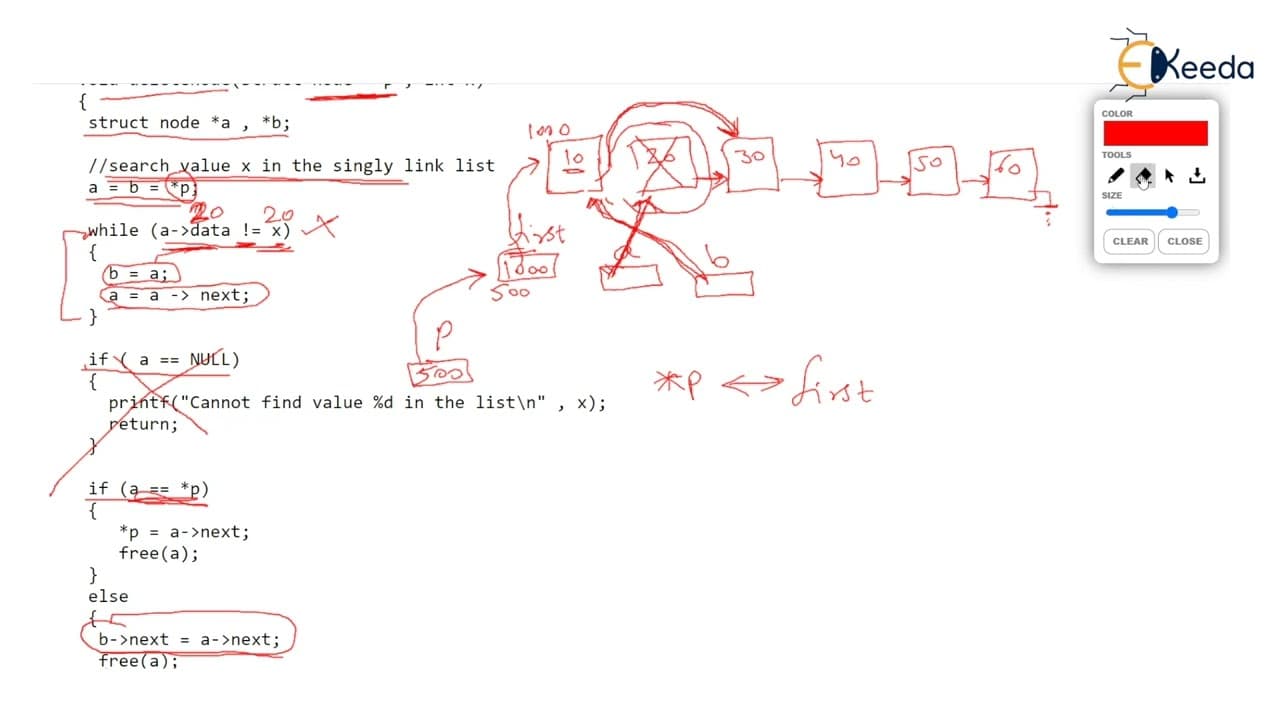
- 👂 Node deletion in a singly linked list involves searching, identification, and reorganizing pointers for removing the desired node.
- 👻 Passing the address of the first pointer allows the delete node function to access and alter the structure of the linked list.
- 🤕 Special handling is required for deleting the first node in a singly linked list due to changing the head pointer.
- 🖲️ Utilizing two pointers, a and b, aids in efficiently tracking the current node and its predecessor during the deletion process.
- 👂 The condition "a equal to null" indicates that the value to be deleted is not present in the linked list, preventing further action.
- 🥶 Deletion involves disconnecting the node by adjusting pointer references and freeing the memory allocated to the deleted node.
- 👂 Error handling for missing values ensures proper feedback to users when attempting to delete a non-existent value in the linked list.
Install to Summarize YouTube Videos and Get Transcripts
Explore YouTube Video Summarizer or Get YouTube Transcript Extractor
Questions & Answers
Q: What is the significance of passing the address of the first pointer in delete node function?
Passing the address allows the function to access and modify the first pointer, crucial for changing the structure of the linked list during node deletion.
Q: How does the algorithm use two pointers, a and b, for searching in the linked list?
Pointer a points to the current node being checked, while b follows a, ensuring that b is always pointing to the predecessor of a, aiding in node deletion.
Q: Why is deleting the first node in a linked list considered a special case?
Deleting the first node requires changing the first pointer to the next node as the new head of the list, a unique situation that needs additional conditional handling.
Q: What role does the condition "a equal to null" play in the delete node function?
The condition "a equal to null" signifies that the value being searched for is not present in the linked list, prompting a message that the deletion cannot be performed.
Summary & Key Takeaways
-
Explanation of deleting a node from a singly linked list.
-
Importance of value matching for deletion.
-
Process of searching, identifying, disconnecting, and freeing a node.
Read in Other Languages (beta)
Share This Summary 📚
Summarize YouTube Videos and Get Video Transcripts with 1-Click
Try YouTube Summary with ChatGPT & Claude or YouTube Transcript Generator
Explore More Summaries from Ekeeda 📚






Summarize YouTube Videos and Get Video Transcripts with 1-Click
Try YouTube Summary with ChatGPT & Claude or YouTube Transcript Generator