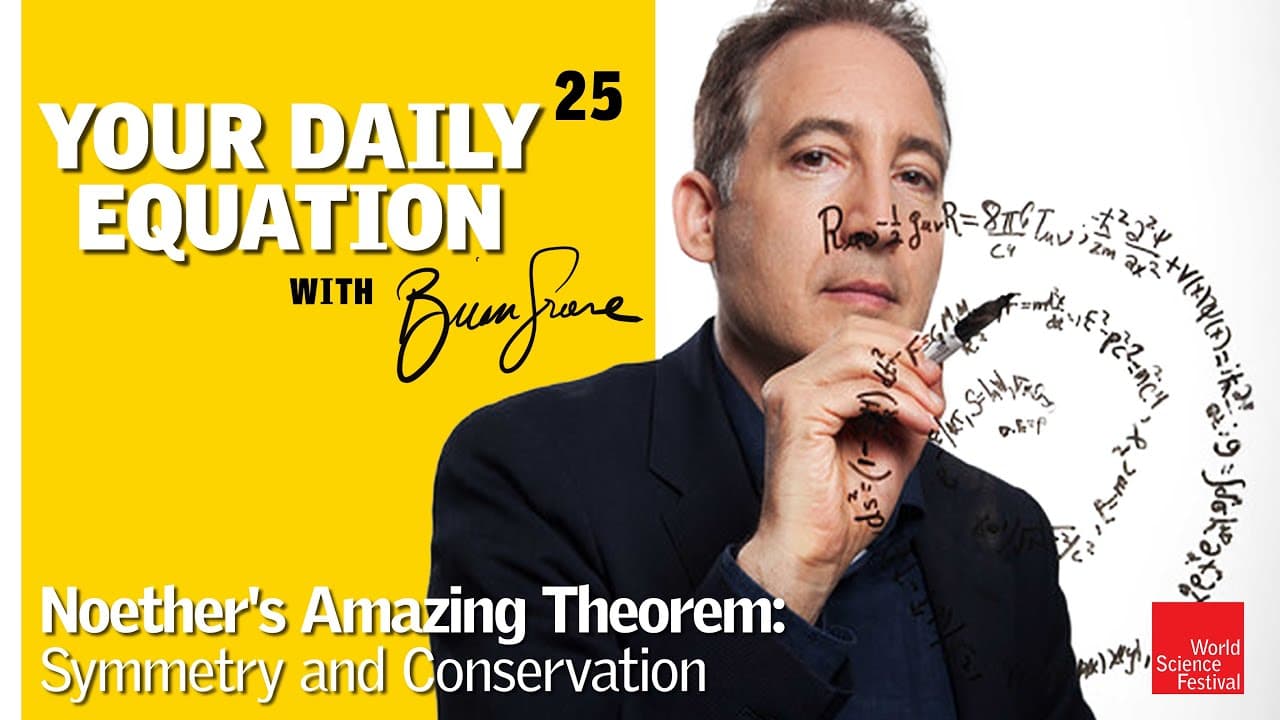
Your Daily Equation #25: Noether's Amazing Theorem: Symmetry and Conservation
TL;DR
- Emmy Noether's theorem connects symmetry in physics to conservation laws, proving that invariant quantities don't change over time.
Transcript
hey everyone welcome to this next episode of your daily equation and today I'm going to focus attention on a very famous theorem proved by the mathematician Emmy Noether which has really had profound impact in physics ever since she established his theorem back in 1918 so here is the hero of today's episode I mean oh they're German mathematician bo... Read More
Key Insights
- 👮 Emmy Noether's theorem links symmetry in physics to conservation laws, providing deep insights into fundamental physics principles.
- 🖐️ Conservation laws, such as the conservation of energy or momentum, play a crucial role in understanding how physical systems evolve over time.
- 👮 Noether's contributions to abstract algebra and Galois theory are significant, but her most famous theorem in physics remains the connection between symmetries and conservation laws.
- 🥺 Examples of translation and rotational invariance demonstrate how Noether's theorem leads to the conservation of linear and angular momentum.
Install to Summarize YouTube Videos and Get Transcripts
Explore YouTube Video Summarizer or Get YouTube Transcript Extractor
Questions & Answers
Q: Who was Emmy Noether, and why is she significant in the field of mathematics and physics?
Emmy Noether was a German mathematician known for proving the famous theorem in 1918 that connects symmetry and conservation laws in physics. Her theory has had a profound impact on our understanding of the universe.
Q: Can you explain the concept of conservation laws in physics?
Conservation laws in physics state that certain quantities, such as energy or momentum, remain constant over time. These laws are powerful tools in understanding the behavior of physical systems and play a crucial role in physics equations.
Q: How does Noether's theorem connect symmetry and conservation laws?
Noether's theorem establishes a link between the symmetries of a physical system and the conservation laws that govern it. If a system is invariant under a transformation, a corresponding conserved quantity emerges, such as momentum or angular momentum.
Q: What are continuous and discrete symmetries, and how do they relate to Noether's theorem?
Continuous symmetries involve transformations where an object remains the same under arbitrary angles or translations, like rotating a ball. Discrete symmetries involve transformations like a 90-degree rotation that leave parts of the object invariant. Noether's theorem applies to continuous symmetries in physics.
Summary & Key Takeaways
-
Emmy Noether, a German mathematician, formulated a theorem in 1918 connecting conservation laws and symmetry in physics.
-
Conservation laws state that quantities don't change over time, with energy conservation being a well-known example.
-
Noether's theorem proves that if a physical system is invariant under a continuous transformation, a conserved quantity emerges.
Read in Other Languages (beta)
Share This Summary 📚
Summarize YouTube Videos and Get Video Transcripts with 1-Click
Try YouTube Summary with ChatGPT & Claude or YouTube Transcript Generator
Explore More Summaries from World Science Festival 📚



Summarize YouTube Videos and Get Video Transcripts with 1-Click
Try YouTube Summary with ChatGPT & Claude or YouTube Transcript Generator