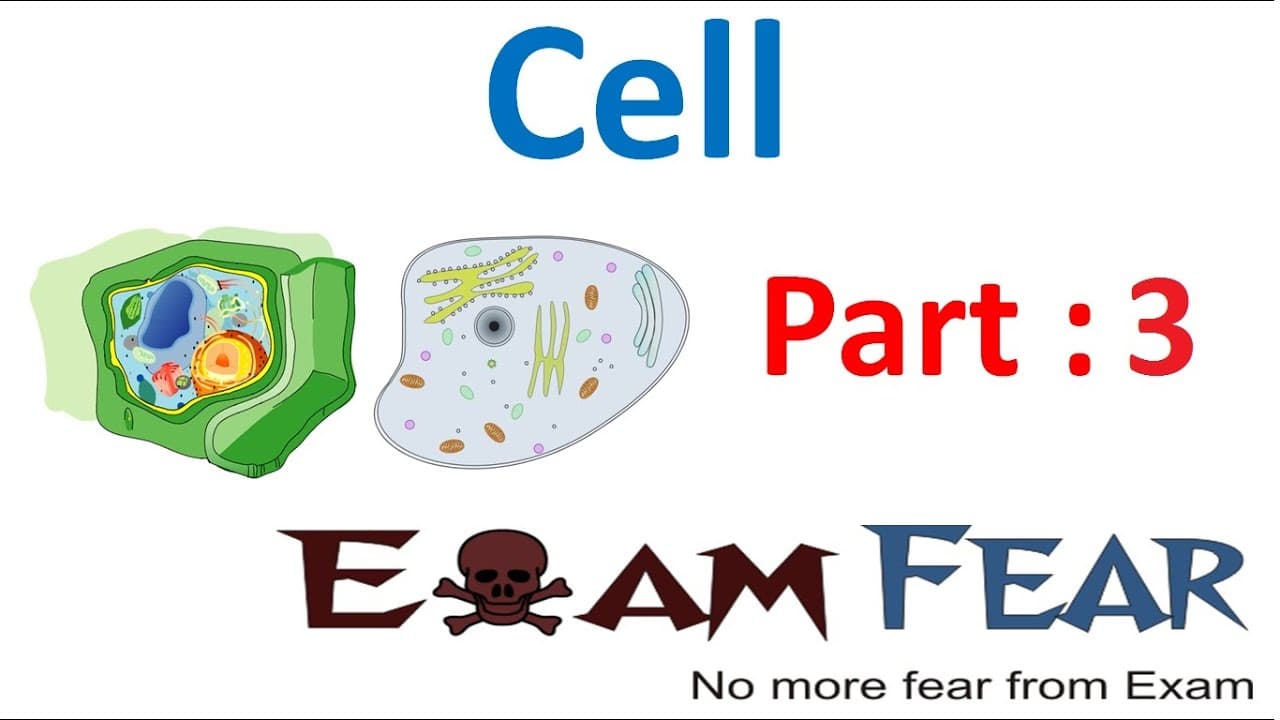
Biology Cell Part 3 (Number of cells : Unicellular & Multicellular) Class 8 VIII
TL;DR
Unicellular organisms consist of one cell that performs all necessary functions, while multicellular organisms have multiple cells with labor divided to perform specific functions.
Transcript
hello friends this video on cell part 3 is brought to you by exam feel calm no more fear from exam so now that we have introduced cell so now we have to see different aspects of cell as the number of cells which are present in a living organism well it became valid so if we want if we can actually look at different organisms and we see that the num... Read More
Key Insights
- 🧡 Living organisms can have a wide range of cell numbers, from one to billions or trillions.
- 🎭 Unicellular organisms like amoeba and Paramecium consist of a single cell that performs all necessary functions.
- 🎭 Multicellular organisms have multiple cells that divide labor to perform specific functions, and different types of cells may have different structures.
- 💪 Cells in multicellular organisms can be specialized for specific functions, such as blood cells, muscle cells, or nerve cells.
- 💁 The formation of multicellular organisms starts from a single fertilized egg cell that divides and differentiates into various cell types.
- #️⃣ The number of cells in an organism is not dependent on its size; even smaller organisms can have a significant number of cells.
- 💠 Unicellular microorganisms like bacteria can be found in various habitats and exhibit different shapes and sizes.
Install to Summarize YouTube Videos and Get Transcripts
Explore YouTube Video Summarizer or Get YouTube Transcript Extractor
Questions & Answers
Q: What are unicellular organisms?
Unicellular organisms consist of one cell that performs all essential functions, such as eating, excreting waste products, and respiration. Examples include amoeba, Paramecium, and bacteria.
Q: How do amoeba and Paramecium move?
Amoeba moves by constantly changing its shape, while Paramecium uses small hair-like structures called cilia for locomotion.
Q: What are bacteria?
Bacteria are unicellular microorganisms that exist in various shapes and sizes. They were among the first life-forms on Earth and can be found in soil, water, or inside the bodies of plants and animals.
Q: How do multicellular organisms divide labor?
Multicellular organisms divide labor among different groups of cells. Each group performs a specific function, such as muscle cells for contraction or nerve cells for transmitting signals.
Summary & Key Takeaways
-
Living organisms can have varying numbers of cells, ranging from one to billions or trillions.
-
Unicellular organisms, such as amoeba and Paramecium, consist of a single cell that performs all necessary functions.
-
Multicellular organisms have multiple cells that divide labor to perform specific functions, and different types of cells may have different structures and functions.
Read in Other Languages (beta)
Share This Summary 📚
Summarize YouTube Videos and Get Video Transcripts with 1-Click
Try YouTube Summary with ChatGPT & Claude or YouTube Transcript Generator
Explore More Summaries from LearnoHub - Class 11, 12 📚




Summarize YouTube Videos and Get Video Transcripts with 1-Click
Try YouTube Summary with ChatGPT & Claude or YouTube Transcript Generator