What Mathematical Error Did Homer Simpson Make?
TL;DR
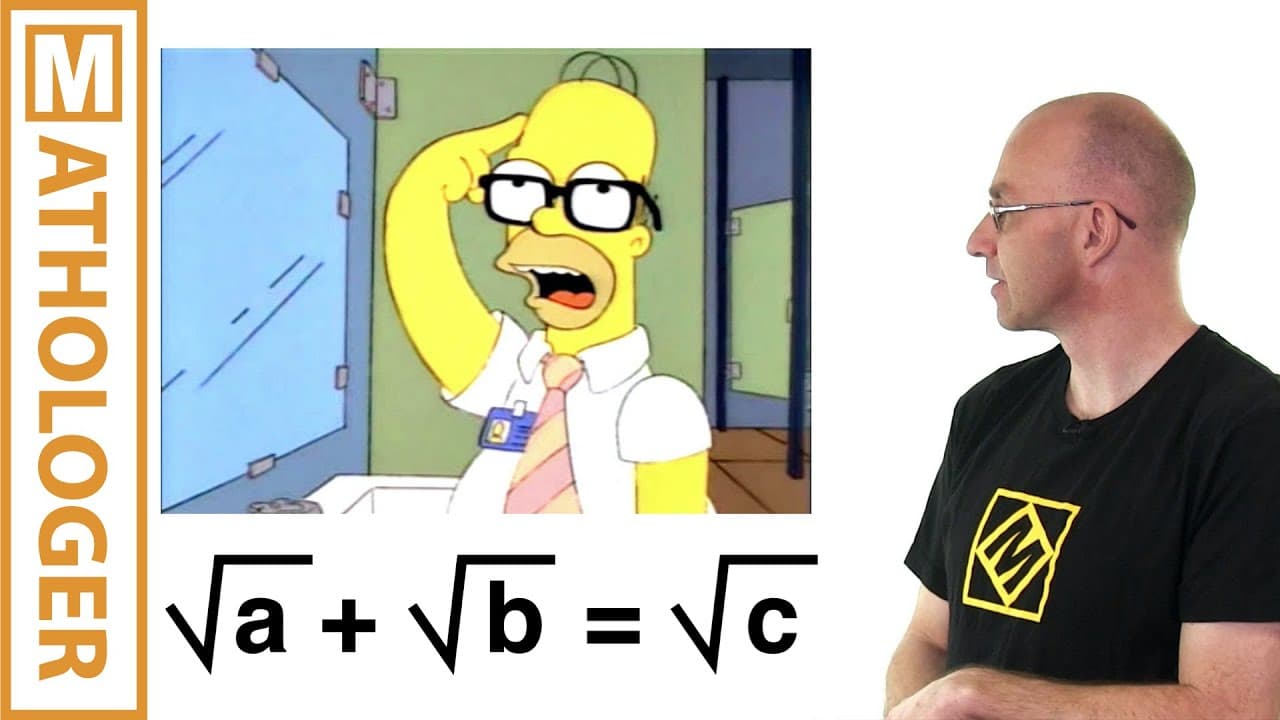
Homer Simpson mistakenly claims that the sum of the square roots of two sides of an isosceles triangle equals the square root of the remaining side, which is incorrect as it actually describes a right triangle. The error contradicts the triangle inequality, and the analysis suggests that Homer may have confused this with a line from The Wizard of Oz.
Transcript
Last weekend I actually did a talk on math in the Simpsons here in Melbourne and I am going to split it up into three different videos so today get the first one nice and shot some of you will be familiar with this first clip but I think I've got a few twists and turns to add to all this which will entertain most of you. Okay, here we go: (Homer) S... Read More
Key Insights
- 🎁 The content explores the mathematical errors present in The Simpsons, emphasizing the importance of accuracy in mathematics even in entertainment.
- 🔺 The video points out the inconsistency in Homer's knowledge of isosceles triangles, suggesting that he may have learned the incorrect equation from a different source.
- 🔺 The mistaken equation in The Simpsons contradicts the triangle inequality, which is a fundamental principle in geometry.
- 🤨 The content also raises the possibility of finding a strange world where the mistaken equation could hold true, asking for input from viewers.
- 🫵 The video notes the presence of other instances of mathematical errors in The Simpsons and encourages viewers to identify and discuss them.
- 🫵 The analysis highlights the significance of mathematics in popular culture and its potential influence on viewers' perceptions of mathematical concepts.
- 🫵 The inclusion of mathematical errors in The Simpsons adds a layer of humor and entertainment for viewers who can spot and understand them.
Install to Summarize YouTube Videos and Get Transcripts
Explore YouTube Video Summarizer or Get YouTube Transcript Extractor
Questions & Answers
Q: What is the incorrect equation stated by Homer in The Simpsons?
Homer states that the sum of the square roots of any two sides of an isosceles triangle is equal to the square root of the remaining side, which is incorrect.
Q: What mistakes are pointed out regarding this equation?
The mistakes include the fact that the triangle Homer references is actually a right triangle, the sum of the square roots does not work, and the equation contradicts the triangle inequality.
Q: Where might Homer have learned this incorrect equation?
The video suggests that Homer may have learned this incorrect equation from The Wizard of Oz, specifically from the character Scarecrow who states a similar equation after gaining a brain.
Q: What are some notable references to mathematical errors in The Simpsons?
The video calls for viewers to identify other instances of mathematical errors in The Simpsons and highlights that pythagoras also appears in two instances in the show.
Summary & Key Takeaways
-
The video discusses an incorrect mathematical equation stated by Homer in The Simpsons, involving the sum of the square roots of any two sides of an isosceles triangle equaling the square root of the remaining side.
-
Various mistakes are pointed out, including the fact that the triangle Homer references is actually a right triangle, the sum of the square roots does not work, and the equation contradicts the triangle inequality.
-
The video also explores possible sources where Homer may have learned this incorrect equation, including a reference to The Wizard of Oz.
Read in Other Languages (beta)
Share This Summary 📚
Summarize YouTube Videos and Get Video Transcripts with 1-Click
Try YouTube Summary with ChatGPT & Claude or YouTube Transcript Generator
Explore More Summaries from Mathologer 📚
Summarize YouTube Videos and Get Video Transcripts with 1-Click
Try YouTube Summary with ChatGPT & Claude or YouTube Transcript Generator