How to Use Tree Diagrams for Probability Problems
TL;DR
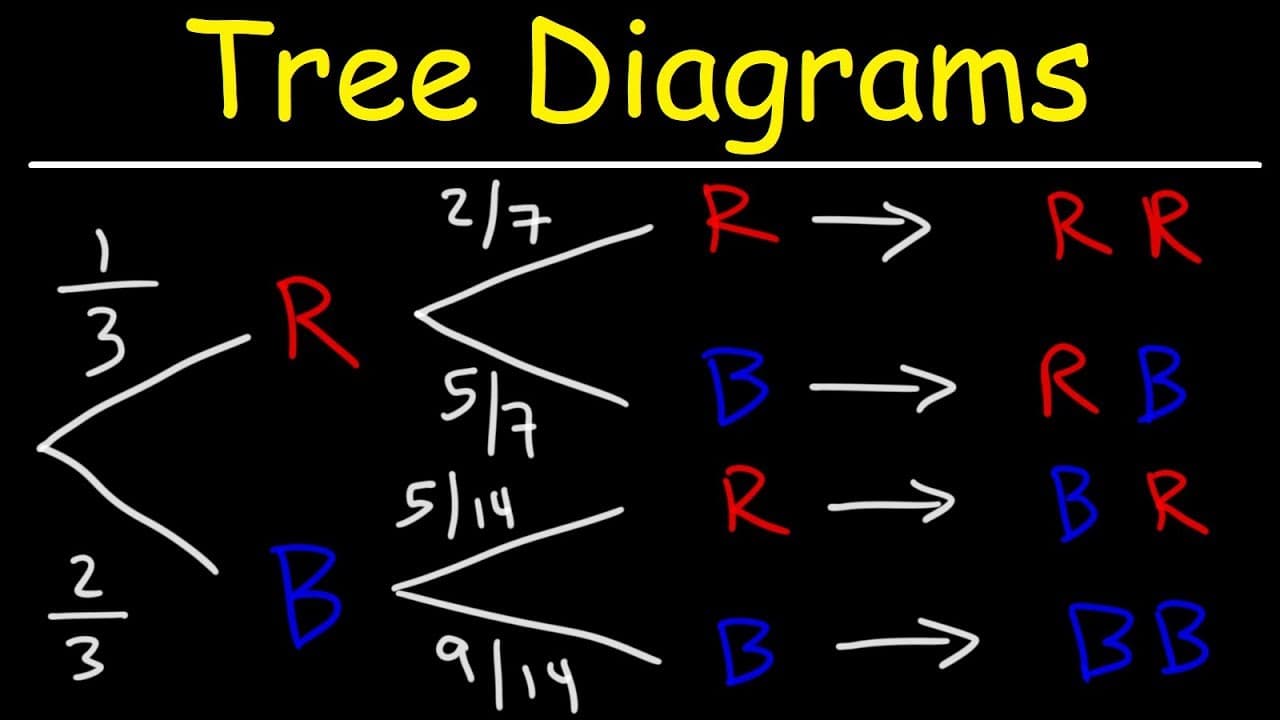
To solve probability problems using tree diagrams, identify all possible outcomes by branching for each selection. Calculate probabilities based on the number of favorable outcomes divided by the total number of outcomes. When selecting with replacement, probabilities remain constant; without replacement, they change as the number of items decreases.
Transcript
in this video we're going to talk about how to use tree diagrams to solve probability problems like this one so we have a bag that contains 8 red marbles and 12 blue marbles and two marbles are selected with replacement so part a what is the probability of selecting two blue marbles so let's begin by drawing the tree diagram so during the first sel... Read More
Key Insights
- 🌲 Tree diagrams can be a helpful tool in solving probability problems.
- #️⃣ The probability of selecting a certain color marble is determined by dividing the number of marbles of that color by the total number of marbles.
- 💱 Selecting with replacement means the probabilities remain the same for each selection, while without replacement, the probabilities change.
- 🪜 The probability of at least one event occurring can be found by adding the probabilities of the individual outcomes that satisfy that condition.
- 🪈 The order of the events can affect the probability, with "and" requiring multiplication and "or" requiring addition.
- ➖ The probability of an event occurring is equal to 1 minus the probability of that event not occurring.
- ❓ Understanding dependent and independent events is crucial in probability calculations.
Install to Summarize YouTube Videos and Get Transcripts
Explore YouTube Video Summarizer or Get YouTube Transcript Extractor
Questions & Answers
Q: How can tree diagrams be used to solve probability problems?
Tree diagrams are a visual representation that helps break down the possible outcomes of a probability problem. By following the branches, you can calculate the probability of each outcome and find the desired probability.
Q: What is the difference between selecting with replacement and without replacement?
When selecting with replacement, each marble selected is returned to the bag before the next selection. Without replacement means that the marble is not returned, so the number of marbles available for selection decreases with each pick.
Q: How do you calculate the probability of selecting a certain color marble?
The probability of selecting a certain color marble is calculated by dividing the number of marbles of that color by the total number of marbles.
Q: How is the probability of at least one red marble calculated?
The probability of at least one red marble can be calculated by adding the probabilities of the outcomes that contain at least one red marble. This can also be determined by subtracting the probability of not getting two blue marbles from 1.
Summary & Key Takeaways
-
The video explains how to use tree diagrams to solve probability problems, specifically using the example of selecting marbles from a bag.
-
The probability of selecting a certain color marble is calculated by dividing the number of that color by the total number of marbles.
-
When selecting with replacement, the probabilities remain the same for each selection. Without replacement, the probabilities change as the number of marbles available for selection decreases.
Read in Other Languages (beta)
Share This Summary 📚
Summarize YouTube Videos and Get Video Transcripts with 1-Click
Try YouTube Summary with ChatGPT & Claude or YouTube Transcript Generator
Explore More Summaries from The Organic Chemistry Tutor 📚






Summarize YouTube Videos and Get Video Transcripts with 1-Click
Try YouTube Summary with ChatGPT & Claude or YouTube Transcript Generator