How AI is revolutionizing science | Alex Bronstein | TEDxDanube Intl School Vienna Youth
TL;DR
Exploring the impact of AI on scientific pursuits, from composing sonnets to predicting protein structures.
Transcript
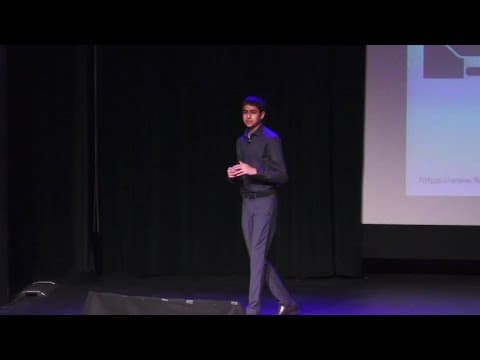
so at least I don't need to play any music but I think the topic that I would like to reflect with you tonight also requires a non non-negligible amount of human creativity so I would like to reflect with you about how uh science how the scientific Pursuit uh may look like in the this new age that is unfolding in front of us which is the age of art... Read More
Key Insights
- 🎼 AI excels at creative tasks like composing music and poetry without prior human instruction, showcasing its potential in various artistic domains.
- 🪛 The integration of AI technologies like self-driving cars raises ethical dilemmas, emphasizing the need for moral considerations in AI-driven scenarios.
- 🙏 AI's neural networks and learning algorithms revolutionize scientific pursuits by predicting complex structures like protein folding, advancing fields like structural biology and biotechnology.
- 🖤 The shift towards black-box scientific models challenges traditional scientific methods, prompting a reevaluation of experimental design to optimize data collection and interpretation.
Install to Summarize YouTube Videos and Get Transcripts
Explore YouTube Video Summarizer or Get YouTube Transcript Extractor
Questions & Answers
Q: How has AI impacted creative tasks like composing music and writing poetry?
AI, devoid of human-inspired knowledge, excels at tasks like composing music and writing poetry, generating outputs that experts find indistinguishable from human creations.
Q: What are some ethical implications of integrating AI technologies, such as self-driving cars, into our lives?
The presence of AI technologies, like self-driving cars, raises ethical dilemmas such as the trolley problem, highlighting the need to address societal implications and decision-making in AI-driven scenarios.
Q: How do AI technologies like AlphaFold predict protein structures without understanding the physics of protein folding?
AlphaFold uses machine learning to predict protein structures based on amino acid sequences, demonstrating the ability of AI to make accurate predictions without comprehending the underlying scientific principles.
Q: What potential transformations might AI bring to the scientific method and experimental design?
AI's black-box models challenge traditional scientific methods by requiring a reevaluation of experimental design, allowing machines to design experiments based on data to enhance efficiency and accuracy.
Summary & Key Takeaways
-
AI technologies, like GPT, create impressive outputs such as Shakespearean sonnets on science in the age of AI.
-
AI programs, devoid of human-inspired knowledge, excel at tasks like composing music and self-driving cars, raising ethical and philosophical questions.
-
AI's unique approach, involving neural networks and learning algorithms, transforms scientific pursuits by predicting protein structures with AlphaFold.
Read in Other Languages (beta)
Share This Summary 📚
Summarize YouTube Videos and Get Video Transcripts with 1-Click
Try YouTube Summary with ChatGPT & Claude or YouTube Transcript Generator
Explore More Summaries from TEDx Talks 📚

Summarize YouTube Videos and Get Video Transcripts with 1-Click
Try YouTube Summary with ChatGPT & Claude or YouTube Transcript Generator