How to Create Your Own Q-Learning Environment
TL;DR
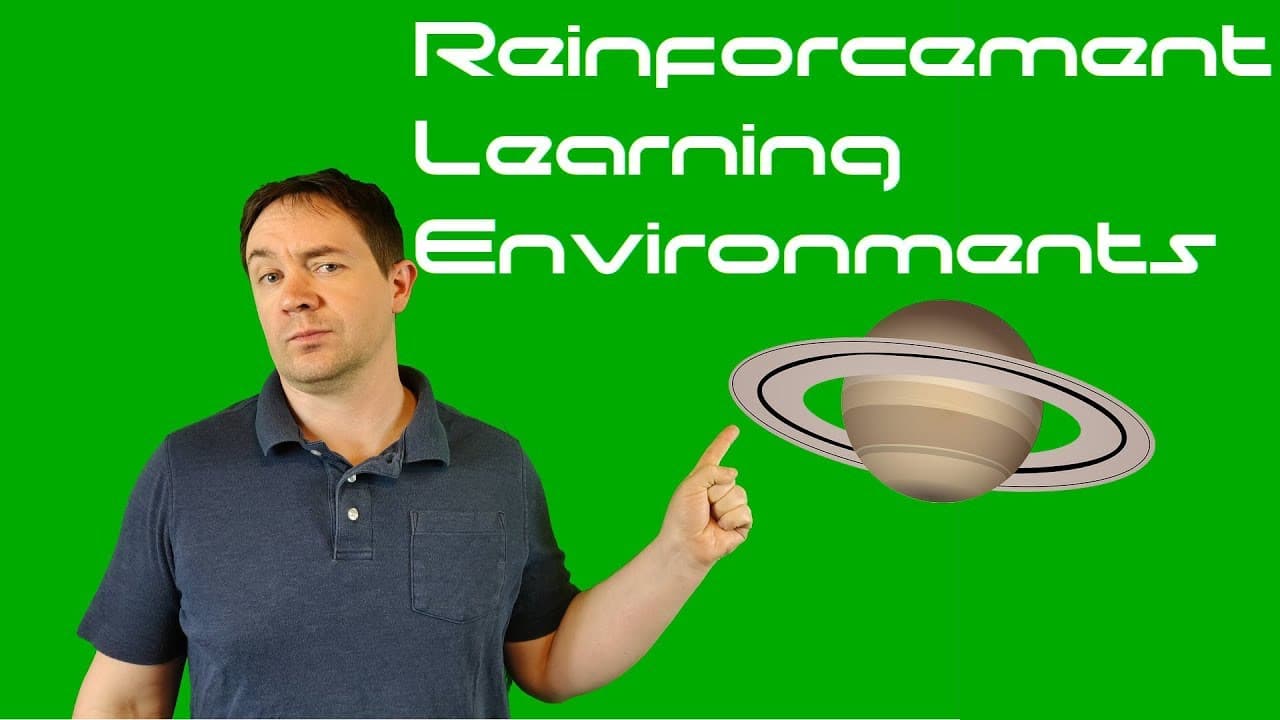
To create your own reinforcement learning environment, code a Q-learning agent that utilizes a table of state-action pairs to estimate their values. Implement main components like magic squares for movement, model hyperparameters for learning, and an epsilon-greedy strategy to balance exploration and exploitation. Visualize the agent's performance by plotting total rewards across episodes.
Transcript
welcome back everybody to a new tutorial from neural net a I I am your host Phil Taber if you're new to the channel I'm a physicist former semiconductor process engineer turned machine learning practitioner if you haven't subscribed yet go ahead and hit the subscribe button so you don't miss any future of reinforcement learning tutorials when we le... Read More
Key Insights
- 😒 Q-learning is a tabular method that uses a table of state-action pairs to estimate the value of each pair.
- 🧑🏭 Magic squares in the grid world environment act as teleporters, moving the agent forward or backward.
- 😫 Optimistic initial values encourage exploration by setting an initial estimate of 0 for state-action pairs.
- ✋ Epsilon-greedy action selection balances exploration (with a random action) and exploitation (with the action with the highest expected future reward).
- 🥺 Epsilon decay reduces the exploration rate over time, leading the agent towards a deterministic greedy strategy.
- 🇶🇦 The Q-function is updated using the Bellman equation, which combines the immediate reward with the estimated future rewards.
- 😆 The main loop of the program involves taking actions, updating the Q-function, and tracking rewards for each episode.
- ❓ The agent's performance can be visualized by plotting the total rewards over the episodes.
Install to Summarize YouTube Videos and Get Transcripts
Explore YouTube Video Summarizer or Get YouTube Transcript Extractor
Questions & Answers
Q: What are magic squares in the grid world environment?
Magic squares in the grid world environment are teleporters that either advance the agent forward or send it back to an earlier square.
Q: What are the model hyperparameters in Q-learning?
The model hyperparameters in Q-learning include the learning rate, which controls how fast the agent learns; the discount factor, which determines the importance of future rewards; and epsilon, which balances exploration and exploitation.
Q: How does optimistic initial values encourage exploration in Q-learning?
By setting the initial estimate for the value of state-action pairs to 0, the agent is encouraged to explore unexplored states because any reward less than 0 will be considered worse than the initial value of 0.
Q: How does epsilon decay work in Q-learning?
Epsilon decay gradually decreases the value of epsilon over time, moving the agent from a random exploration strategy to a more deterministic greedy strategy.
Summary & Key Takeaways
-
The tutorial starts by discussing magic squares, which are teleporters in the grid world that move the agent forward or backward.
-
It then covers the model hyperparameters, such as learning rate, discount factor, and epsilon for epsilon-greedy action selection.
-
The tutorial explains the process of constructing a table of state-action pairs, using optimistic initial values to encourage exploration.
-
It details the main loop of the program, including episodes, epsilon decay, updating the Q-function, and keeping track of rewards.
-
The tutorial concludes with a visualization of the agent solving the grid world.
Read in Other Languages (beta)
Share This Summary 📚
Summarize YouTube Videos and Get Video Transcripts with 1-Click
Try YouTube Summary with ChatGPT & Claude or YouTube Transcript Generator
Explore More Summaries from Machine Learning with Phil 📚



Summarize YouTube Videos and Get Video Transcripts with 1-Click
Try YouTube Summary with ChatGPT & Claude or YouTube Transcript Generator