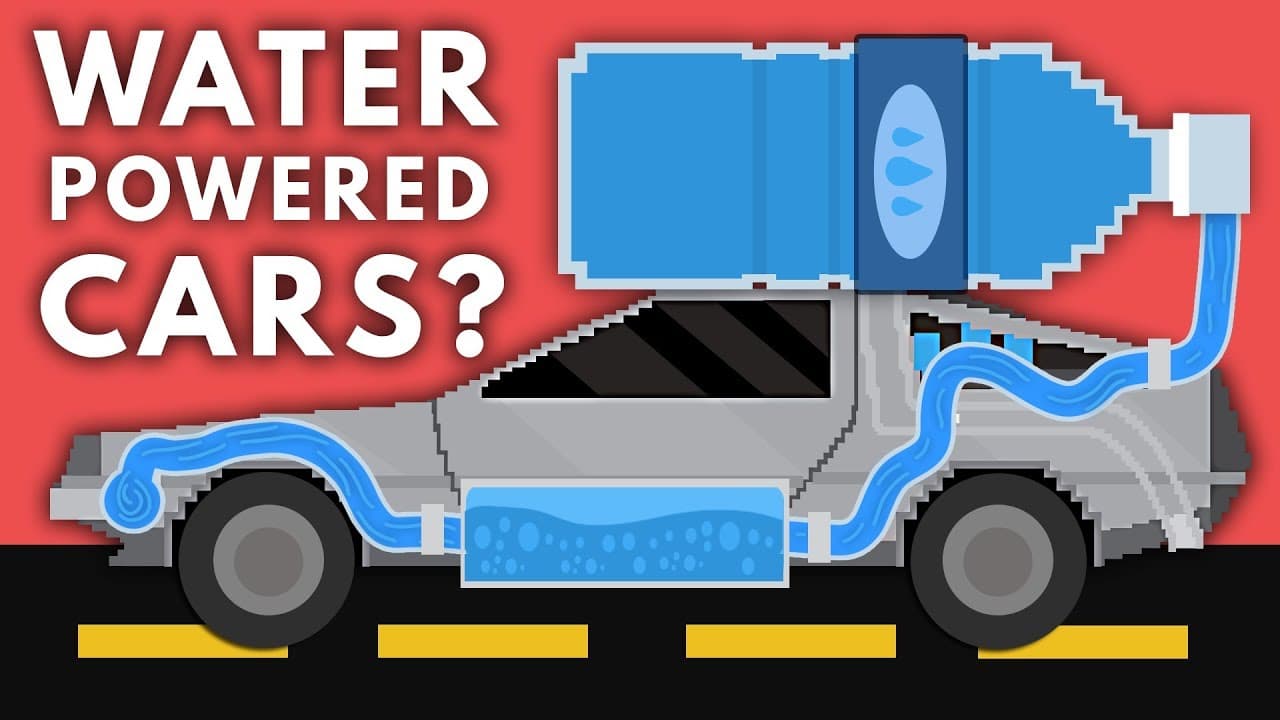
Why Don't We Have Water Powered Cars Yet?
TL;DR
History of water-powered cars, challenges in splitting water for fuel, current advancements in hydrogen fuel production.
Transcript
Hey there, welcome to Life Noggin! Hey there! Welcome to my garage-slash-workshop-slash-Olympic-sized swimming pool room. And it’s the perfect place to work on my new invention, a water-powered car! Well, ok, it’s not technically my invention. The idea for water-powered cars has been kicking around for ages. Jules Verne wrote that “water will be ... Read More
Key Insights
- 😨 Water-powered cars have a long history but face technological limitations and legal challenges.
- ⛽ Water is not a fuel in itself but can be converted to hydrogen for use in engines or fuel cells.
- 💦 Advances in renewable energy sources like solar power are improving the efficiency of water electrolysis for hydrogen fuel production.
- ⛽ Hydrogen fuel from water is still a small fraction of overall production, with most coming from fossil fuels.
- 👨🔬 Efforts are underway to make hydrogen energy more sustainable through innovative research and technology.
- 💦 While water-powered cars offer zero emissions potential, the practical challenges of splitting water for fuel remain significant.
- 🥺 Future advancements in hydrogen production could lead to a more environmentally friendly transportation sector.
Install to Summarize YouTube Videos and Get Transcripts
Explore YouTube Video Summarizer or Get YouTube Transcript Extractor
Questions & Answers
Q: Why aren't water-powered cars popular despite their clean energy potential?
Water, not being a fuel itself, needs to be split into hydrogen, which requires more energy than it produces, limiting its feasibility as a primary fuel source.
Q: How have recent developments improved the efficiency of water electrolysis for hydrogen fuel production?
Scientists have made progress in using renewable energy sources like solar power and saltwater to generate hydrogen fuel, doubling the efficiency of water electrolysis.
Q: What was Stanley Mayer's contribution to water-powered cars, and why did he face legal issues?
Stanley Mayer patented a vehicle that could run on water but failed to deliver as he claimed, leading to legal troubles due to the unproven scientific basis of his invention.
Q: What is hindering the widespread adoption of water-powered cars?
The instability of water as a fuel source, the energy-intensive process of splitting water for hydrogen fuel, and the current reliance on fossil fuels for hydrogen production are key barriers.
Summary & Key Takeaways
-
Water-powered cars have been around since the 1970s but faced legal issues and scientific challenges.
-
Water is not a fuel itself but can be split into hydrogen for use in engines or fuel cells.
-
Recent advancements show promise in generating hydrogen fuel from water efficiently.
Read in Other Languages (beta)
Share This Summary 📚
Summarize YouTube Videos and Get Video Transcripts with 1-Click
Try YouTube Summary with ChatGPT & Claude or YouTube Transcript Generator
Explore More Summaries from Life Noggin 📚





Summarize YouTube Videos and Get Video Transcripts with 1-Click
Try YouTube Summary with ChatGPT & Claude or YouTube Transcript Generator