What are Spherical Mirrors? | Reflection and Refraction | Don't Memorise
TL;DR
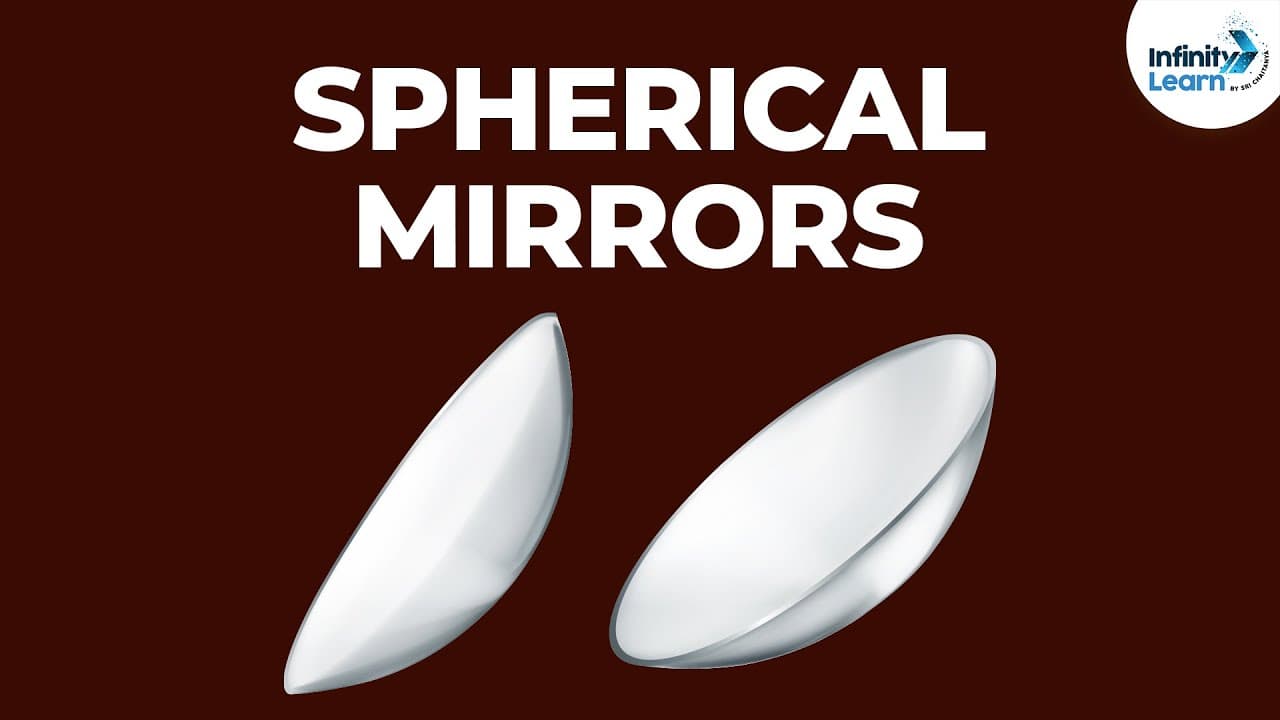
Spherical mirrors have curved surfaces, concave and convex types, with specific terminology like pole, center of curvature, and focal point.
Transcript
Till now we have been looking at the properties of images formed by plane mirrors. A plane mirror is a mirror whose reflecting surface is flat What about this mirror? Is this also a plane mirror? This is a mirror as it has the smooth reflecting surface. But this is not a plane mirror as this reflecting surface is not flat. The reflecting surface ... Read More
Key Insights
- 🪩 Spherical mirrors have reflecting surfaces that are part of a sphere, defining their concave or convex nature.
- ⚾ Differentiating between concave and convex mirrors is based on the direction of their curved reflecting surfaces.
- 🤩 Important terms like pole, center of curvature, and focal point are key in understanding the geometry of spherical mirrors.
- 🪩 The assumption of the radius of curvature being much greater than the aperture is crucial in studying spherical mirrors.
- 🖐️ Spherical mirrors play a vital role in the formation of images and understanding optical phenomena.
- 🪩 Curved mirrors like spherical mirrors can be found in everyday objects like spoons with dual reflecting surfaces.
- 😥 The specific terminology related to spherical mirrors, including pole, center of curvature, and focal point, aids in their study.
Install to Summarize YouTube Videos and Get Transcripts
Explore YouTube Video Summarizer or Get YouTube Transcript Extractor
Questions & Answers
Q: What are the differences between plane mirrors and curved mirrors?
Plane mirrors have flat reflecting surfaces, while curved mirrors like spherical mirrors have reflecting surfaces that are part of a sphere, which can be concave or convex.
Q: How are concave and convex mirrors defined in terms of their reflecting surfaces?
Concave mirrors have reflecting surfaces curved inwards, while convex mirrors have reflecting surfaces curved outwards, defining the types of images they produce.
Q: Why are concave mirrors called concave and convex mirrors called convex?
Concave mirrors are concave in shape with reflecting surfaces curved inwards, while convex mirrors are convex in shape with reflecting surfaces curved outwards, reflecting their curvature.
Q: What specific terms are used to describe the geometry of spherical mirrors?
Terms like pole, center of curvature, radius of curvature, principal axis, and focal point are essential in understanding the properties of spherical mirrors and the formation of images.
Summary & Key Takeaways
-
Plane mirrors have flat reflecting surfaces, while curved mirrors, like spherical mirrors, have reflecting surfaces that are part of a sphere.
-
Spherical mirrors can be concave (curved inwards) or convex (curved outwards), with specific terms like pole, center of curvature, and focal point.
-
Understanding the properties of images formed by spherical mirrors requires knowledge of specific terms and assumptions about mirror curvature.
Read in Other Languages (beta)
Share This Summary 📚
Summarize YouTube Videos and Get Video Transcripts with 1-Click
Try YouTube Summary with ChatGPT & Claude or YouTube Transcript Generator
Explore More Summaries from Infinity Learn NEET 📚


Summarize YouTube Videos and Get Video Transcripts with 1-Click
Try YouTube Summary with ChatGPT & Claude or YouTube Transcript Generator