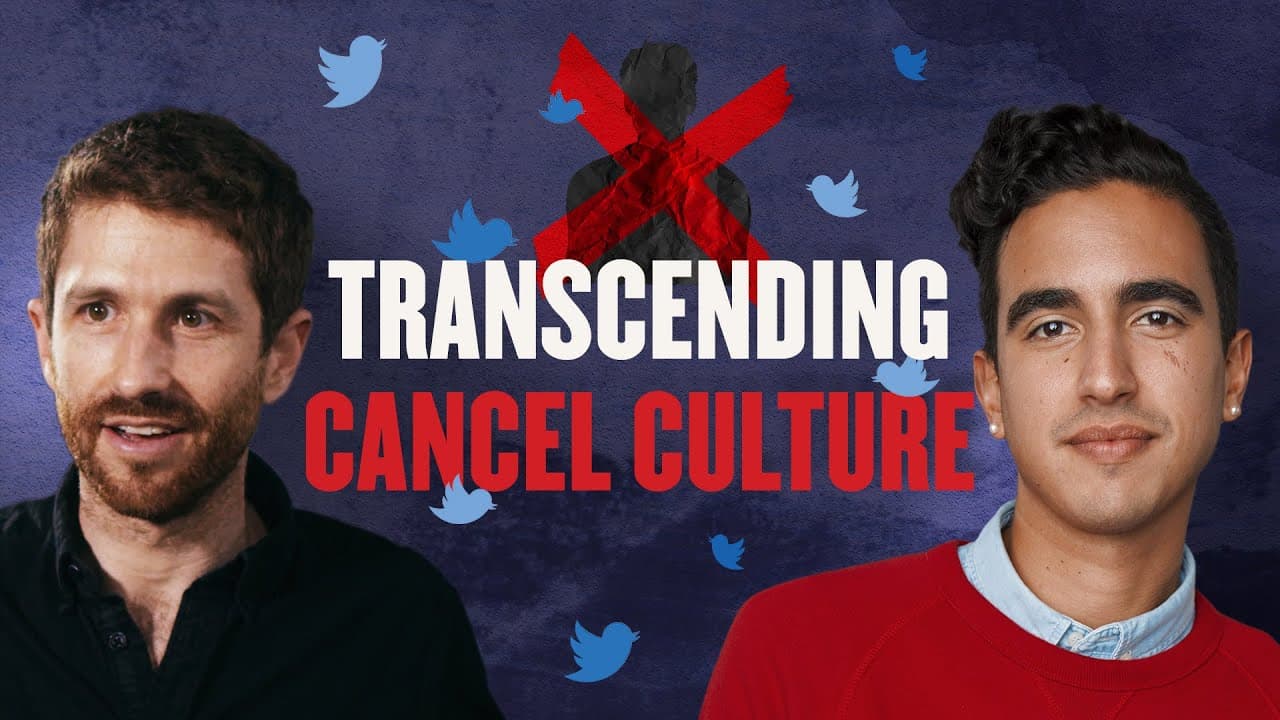
How Twitter is Enabling Cancel Culture
TL;DR
The conversation explores the dangers of cancel culture and the need for empathy through dialogue.
Transcript
you get into these pylons right where you have an individual who might say one thing that was taken out of context and then we know this is happening every five minutes and there's these moral swarms that are sort of emerging not based on a conscious process it's almost never the case that all those people who are piling on actually know the detail... Read More
Key Insights
- 🖤 Moral swarms emerge from reactive responses to perceived offenses, often lacking context or understanding.
- 🪡 Cancel culture is reframed as a shame culture, prompting a need for nuanced discussions around moral accountability.
- 😚 The complexities of individuals’ narratives are frequently lost in the haste to assign labels such as "racist" or "transphobic."
- 🥺 Individual trauma significantly shapes social media interactions, leading to skewed perceptions of reality.
- 👯 Empathy can wane when people are exposed to vastly different narratives, creating communication barriers between opposing viewpoints.
- ❓ Intentional conversations can function as a remedy to societal empathy deflation, fostering deeper connections and understanding.
- 👤 The technological design of social media often limits the choices available to users, hindering meaningful dialogue about moral issues.
Install to Summarize YouTube Videos and Get Transcripts
Explore YouTube Video Summarizer or Get YouTube Transcript Extractor
Questions & Answers
Q: What is the significance of moral swarms in today's culture?
Moral swarms refer to the phenomenon where individuals react swiftly and collectively to perceived offenses, often without fully understanding the context. This can lead to destructive behavior, undermining essential morals and values in society. The discussion highlights that these reactions are not conscious or informed, which hinders constructive dialogue.
Q: How does cancel culture relate to shame culture as discussed in the content?
Cancel culture and shame culture are interlinked concepts where individuals are publicly shamed for their actions or statements. The speakers suggest renaming cancel culture as shame culture to reduce stigma and encourage more nuanced conversations about offensive actions, thus allowing for an understanding of the layered complexities of each person's experience.
Q: What role does individual trauma play in cultural reactions on social media?
The speakers note that individual trauma influences how people perceive and react to content on social media. When users are repeatedly exposed to content that resonates with their trauma, it can create a skewed view of reality. This perpetuates a cycle of reactivity, where individuals respond emotionally without recognizing the broader context of others' experiences.
Q: What solutions do the speakers propose for combatting empathy deflation?
The speakers advocate for intentional conversations as a means to restore empathy. They emphasize that facilitating dialogues—where differing perspectives can be shared—creates an environment that fosters understanding and empathy. The idea is to create safe spaces where individuals can connect with each other, humanizing the often polarized discourse seen online.
Q: Why do the speakers believe conversations are essential for societal healing?
The speakers argue that conversations enable people to see the humanity in each other, which breaks down barriers created by misunderstandings and assumptions. Through dialogue, individuals can better appreciate the complexities of each other's experiences, ultimately reducing the tension and divisiveness that characterize cancel culture and moral swarms.
Q: How does technology influence the way we interact with moral issues online?
Technology shapes our interactions by presenting simplified choices—like likes or retweets—without the option for deeper engagement. This technological arrangement limits our ability to explore and discuss moral issues thoughtfully, thus contributing to a culture of reactiveness rather than reflective understanding.
Summary & Key Takeaways
-
The discussion critiques how cancel culture often results in moral swarms, where individuals act reactively without understanding the full context of a situation, leading to a breakdown in moral values.
-
It emphasizes the complexity of narratives surrounding 'canceled' individuals, arguing that a lack of time and depth in understanding these situations fuels a simplified and often damaging response to perceived offenses.
-
The speakers advocate for creating spaces for conversation to foster empathy, suggesting that recognizing shared humanity can mitigate the effects of trauma inflation and empathy deflation in society.
Read in Other Languages (beta)
Share This Summary 📚
Summarize YouTube Videos and Get Video Transcripts with 1-Click
Try YouTube Summary with ChatGPT & Claude or YouTube Transcript Generator
Explore More Summaries from Center for Humane Technology 📚
Summarize YouTube Videos and Get Video Transcripts with 1-Click
Try YouTube Summary with ChatGPT & Claude or YouTube Transcript Generator