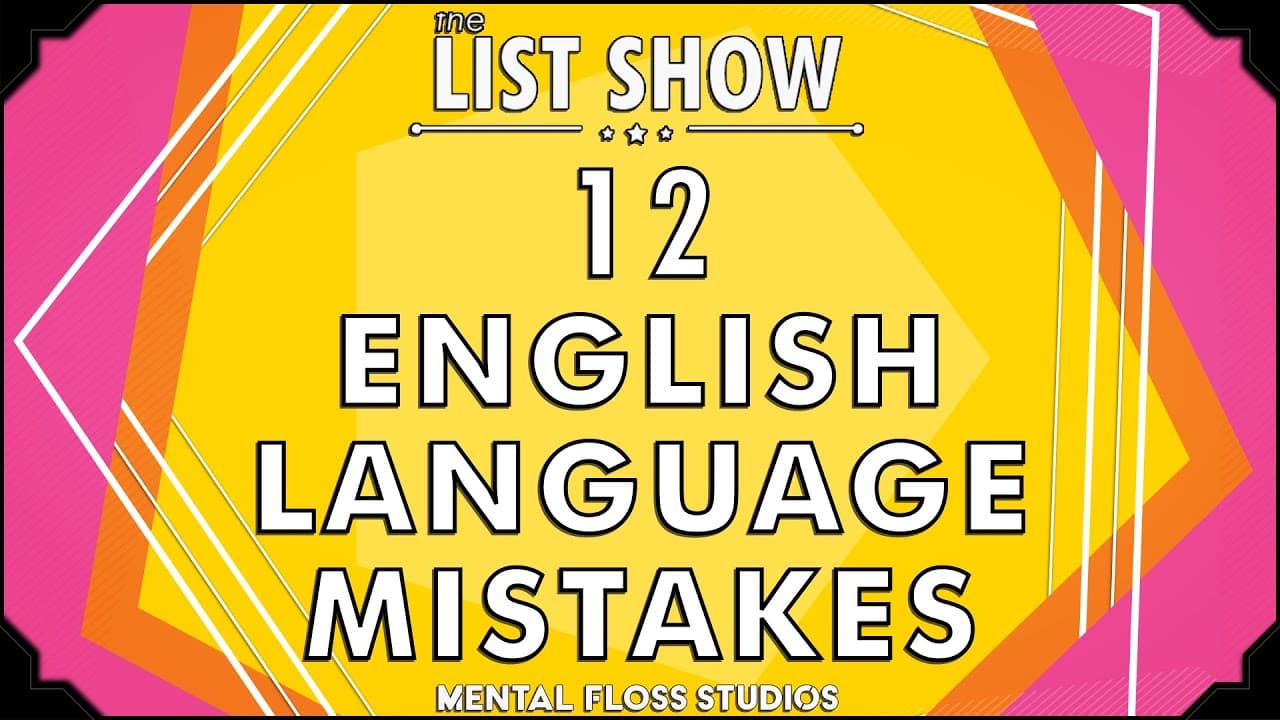
12 Notable English Language Mistakes
TL;DR
From dord to shakespearean names, explore centuries-old language errors and oddities in English.
Transcript
did you know that dord is a synonym for density probably not because it isn't dord is a ghost word a non-existent word that slipped into the dictionary in the case of dord it stayed there for about 13 years this particular flub occurred in the early 1930s after an editor typed an entry that read d or d meaning that density can be abbreviated with a... Read More
Key Insights
- 👻 Ghost words like "dord" and erroneous terms like "abacot" showcase how language mistakes can persist in dictionaries for centuries.
- 💖 Shakespeare's influence on English language extends to potentially inventing names like "Imogen," sparking debates on pronunciation and origin.
- 🦄 Linguistic oddities such as "egg corns" continue to shape the evolution of the English language despite their illogical nature.
- ❄️ The impact of homophones and spelling errors, like "flack" vs. "flak," highlight the nuances and complexities of English pronunciation.
- 😫 The pronunciation debate over "gif" vs. "jif" for graphics interchange format exemplifies how language usage can vary even with set rules.
- 🍉 Merriam-Webster's inclusion of contentious terms like "irregardless" and "unthaw" reflects the evolving nature of language and vocabulary.
- 🛟 Historical printing errors, like the typo in the King James Bible, serve as cautionary tales of the importance of meticulous proofreading in publishing.
Install to Summarize YouTube Videos and Get Transcripts
Explore YouTube Video Summarizer or Get YouTube Transcript Extractor
Questions & Answers
Q: How did the word "dord" end up in Webster's dictionary for 13 years?
Dord slipped into the dictionary due to a simple editorial mistake where a space was missing, creating a ghost word that stayed unnoticed for over a decade.
Q: What was the significance of the term "abacot" in English dictionaries for 200 years?
Abacot was erroneously defined as a double-crowned cap worn by English kings, originating from a misinterpretation in the 16th century that persisted until the 19th century.
Q: What is the debate surrounding the pronunciation of Shakespearean name "Imogen"?
Scholars speculate that Shakespeare may have created the name "Imogen," potentially based on an existing name "Inogen," leading to variations in pronunciation and spelling over the years.
Summary & Key Takeaways
-
Dord, a ghost word, found its way into Webster's dictionary for 13 years due to a clerical error in the 1930s.
-
Abacot, an erroneous term for a double-crowned cap, persisted in dictionaries for 200 years before being corrected.
-
Shakespeare may have coined the name Imogen, and linguistic errors like "egg corns" persist in English today.
Read in Other Languages (beta)
Share This Summary 📚
Summarize YouTube Videos and Get Video Transcripts with 1-Click
Try YouTube Summary with ChatGPT & Claude or YouTube Transcript Generator
Explore More Summaries from Mental Floss 📚




Summarize YouTube Videos and Get Video Transcripts with 1-Click
Try YouTube Summary with ChatGPT & Claude or YouTube Transcript Generator