7.3.1 Visualization for Law and Order - Video 1: Predictive Policing
TL;DR
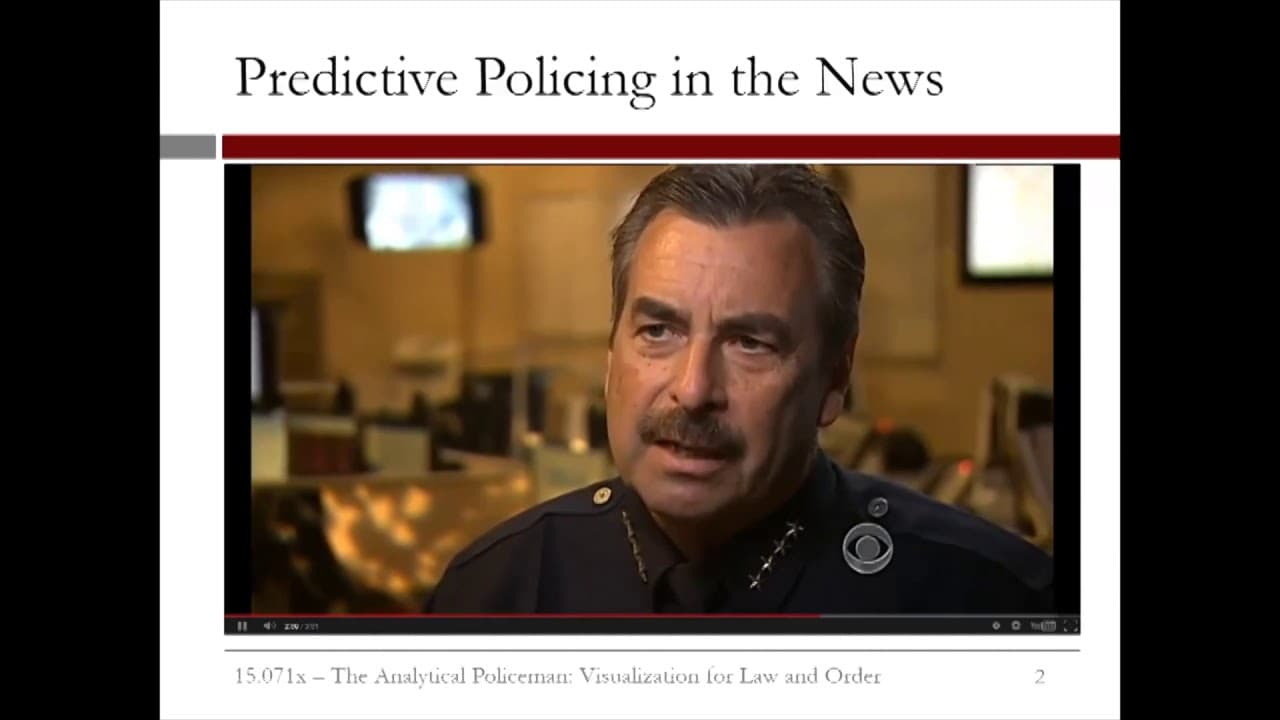
Police forces are using computer programs to predict crime hotspots and prevent criminal activity.
Transcript
In this lecture, we will discuss how visualization can offer insights in the area of policing in urban environments. The explosion of computerized data affects all parts of society, including policing. In the past, human judgment and experience was the only tool in identifying patterns in criminal behavior. Police forces around the United States an... Read More
Key Insights
- ❓ Predictive policing relies on analyzing computerized data to identify patterns in criminal behavior.
- 😒 The use of predictive policing has led to a decrease in property crimes and violent crimes in the areas it has been implemented.
- 🙈 Police officers may initially be skeptical of predictive policing but can be convinced of its effectiveness through seeing the results.
- 👮 Visualization is essential for effectively communicating the results of predictive policing models to police officers on patrol.
- 👻 Predictive policing allows for the optimization of limited police resources and can lead to lower crime rates.
- 👻 The success of predictive policing in Los Angeles has allowed for the expansion of the program to other areas of the city.
- 🥅 The ultimate goal of predictive policing is to prevent crime and create safer communities.
Install to Summarize YouTube Videos and Get Transcripts
Explore YouTube Video Summarizer or Get YouTube Transcript Extractor
Questions & Answers
Q: How does predictive policing work?
Predictive policing uses data analysis to identify patterns in criminal behavior, including times, dates, and locations of crimes. Computers then project hotspots for specific crimes, allowing police to allocate resources and patrols effectively.
Q: What are the benefits of predictive policing?
Predictive policing allows police forces to prevent crimes before they occur, reducing both property crimes and violent crimes. It helps optimize the use of limited resources and can lead to a decrease in overall crime rates.
Q: How do police officers react to predictive policing?
Initially, some police officers may be skeptical of predictive policing. However, as they see the results and experience the effectiveness of the program, they are more likely to embrace the concept and change their mindset towards it.
Q: How does visualization play a role in predictive policing?
Visualization is crucial in communicating the results of predictive policing models to police officers on patrol. It bridges the gap between analytics and end-users by presenting information in a clear and intuitive manner.
Summary & Key Takeaways
-
Policing in urban areas has been transformed by the use of computerized data and predictive analytics.
-
Predictive policing uses mathematical calculations to identify patterns in criminal behavior and project hotspots for various crimes.
-
The Los Angeles Police Department has successfully implemented predictive policing, resulting in a significant decrease in burglaries and violent crimes.
Read in Other Languages (beta)
Share This Summary 📚
Summarize YouTube Videos and Get Video Transcripts with 1-Click
Try YouTube Summary with ChatGPT & Claude or YouTube Transcript Generator
Explore More Summaries from MIT OpenCourseWare 📚



Summarize YouTube Videos and Get Video Transcripts with 1-Click
Try YouTube Summary with ChatGPT & Claude or YouTube Transcript Generator