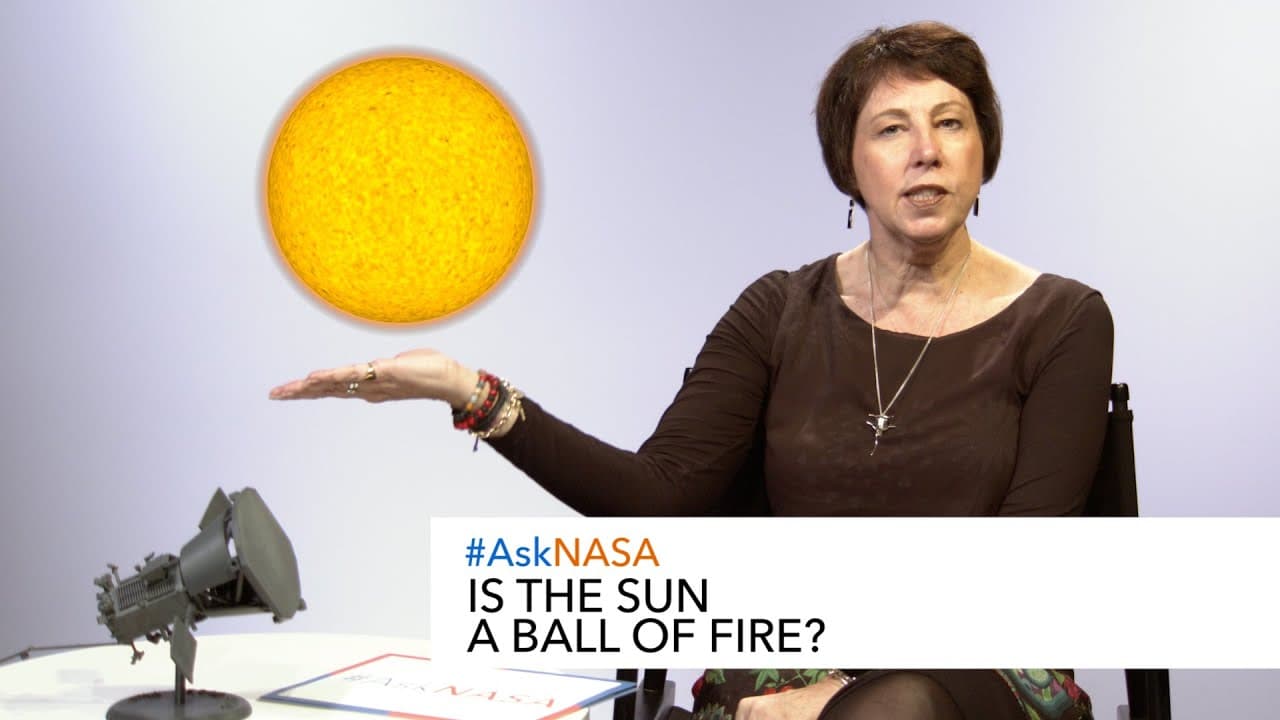
#AskNASA┃ Is the Sun a ball of fire?
TL;DR
NASA's sun science expert explains that the sun is a nuclear furnace, and NASA sends missions to the sun to understand its energy and protect astronauts during future space missions.
Transcript
Hi, I'm Nicky Fox. And I'm in charge of all sun science here at NASA. Oh. This is "Ask NASA," and I'm here to answer your questions. "Is the sun a ball of fire?" No, it's not. We know that the sun can't be a ball of fire, because we need oxygen to be able to have combustion and there's no oxygen in space. The sun, however, is a giant nuclear fur... Read More
Key Insights
- 😎 The sun is a giant nuclear furnace, not a ball of fire.
- 🎟️ NASA sends missions to the sun to study its energy and protect astronauts during future missions.
- 😎 The Parker Solar Probe has discovered switchbacks, reversals in the sun's magnetic field, and is providing valuable data on the sun's atmosphere.
- 🤩 Studying the sun is crucial for understanding other stars in the universe.
- 😒 The Parker Solar Probe uses specially designed materials to withstand extreme heat and temperature changes during its mission.
- 😚 The probe will eventually get closer to the sun's surface than any previous mission, providing unprecedented data.
- 🎟️ NASA expects to uncover unexpected scientific discoveries through the Parker Solar Probe mission.
Install to Summarize YouTube Videos and Get Transcripts
Explore YouTube Video Summarizer or Get YouTube Transcript Extractor
Questions & Answers
Q: Why isn't the sun a ball of fire?
The sun lacks the necessary oxygen for combustion. Instead, it is a nuclear furnace with immense pressure and chemical reactions happening in its core.
Q: Why does NASA send missions to the sun?
The sun is crucial for our existence, providing light and energy to Earth. Understanding the sun's behavior is vital for future space missions and protecting astronauts from the solar wind.
Q: What are switchbacks and why are they significant?
Switchbacks are reversals in the sun's magnetic field that make an "S" shape. They release excess energy into the solar wind, and studying them helps us understand the sun's magnetic behavior.
Q: How does the Parker Solar Probe handle the extreme heat near the sun?
The probe has a heat shield that remains pointed towards the sun at all times. Although the front of the shield reaches 2,500 degrees Fahrenheit, the spacecraft's main body stays cool at 80 degrees Fahrenheit.
Summary & Key Takeaways
-
The sun is not a ball of fire, but a giant nuclear furnace with different layers and chemical reactions happening in its core.
-
NASA sends missions to the sun because it is the most important thing in our solar system, generating light and energy that affects Earth.
-
The Parker Solar Probe is a recent mission that aims to study the sun's atmosphere up close and understand phenomena like switchbacks and the solar wind.
Read in Other Languages (beta)
Share This Summary 📚
Summarize YouTube Videos and Get Video Transcripts with 1-Click
Try YouTube Summary with ChatGPT & Claude or YouTube Transcript Generator
Explore More Summaries from NASA 📚

Summarize YouTube Videos and Get Video Transcripts with 1-Click
Try YouTube Summary with ChatGPT & Claude or YouTube Transcript Generator