Is Reality an Illusion According to Evolution and Physics?
TL;DR
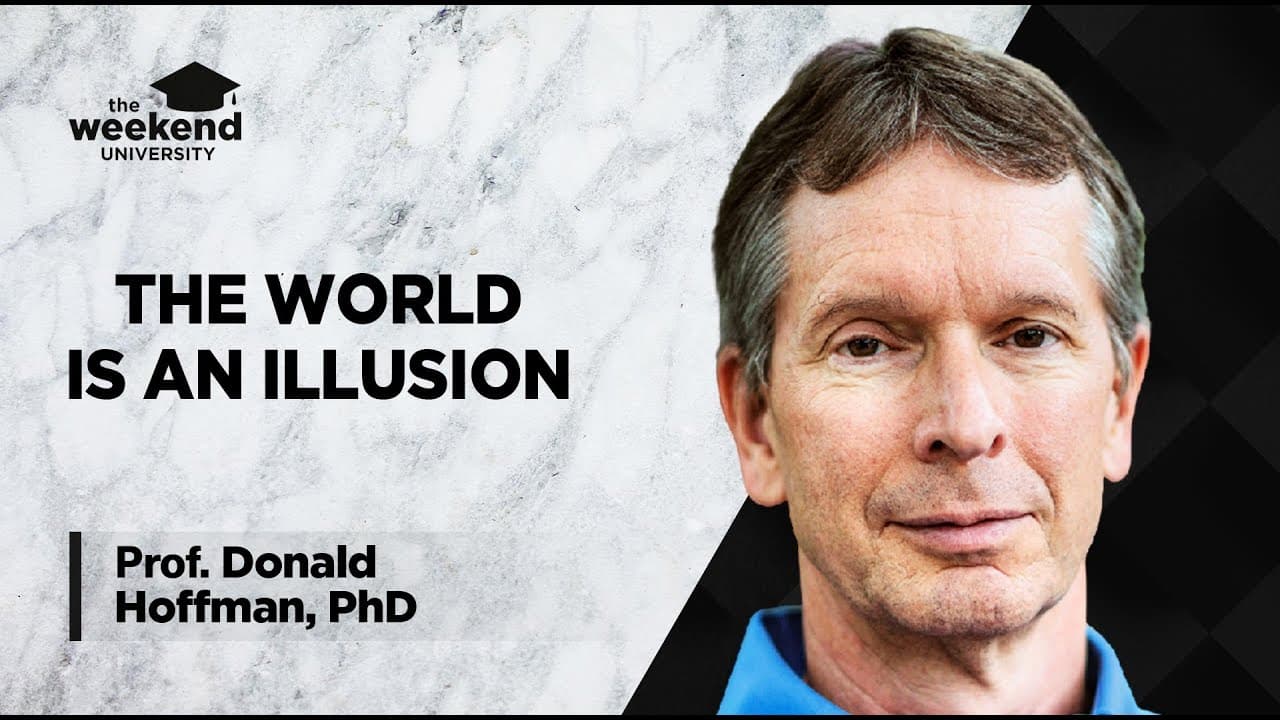
Both evolutionary theory and modern physics suggest that our everyday perceptions of reality are not accurate reflections of the true nature of existence. They propose that space, time, and physical objects are not fundamental, likening consciousness to a virtual reality interface that simplifies our understanding of reality while exploring its own possibilities.
Transcript
professor hoffman is a professor emeritus of cognitive sciences at the university of california in irvine he's authored over 100 scientific papers and three books including visual intelligence and the case against reality how evolution hid the truth from her eyes professor hoffman has been awarded with a distinguished scientific award from the amer... Read More
Key Insights
- 👾 Space, time, and physical objects are not fundamental, according to evolutionary theory and physics.
- ❓ Consciousness may be constantly exploring its own possibilities, rendering our perception of reality as a simplified virtual reality interface.
- 👾 The exploration of consciousness is endless, and our understanding of reality is limited by our interface of space-time.
- 👻 Consciousness could potentially exist beyond the physical structures of the brain, allowing for the emergence of consciousness in artificial intelligence.
Install to Summarize YouTube Videos and Get Transcripts
Explore YouTube Video Summarizer or Get YouTube Transcript Extractor
Questions & Answers
Q: How do evolutionary theory and physics challenge the notion of space, time, and physical objects being fundamental?
Evolutionary theory suggests that our perceptions of reality are not accurate representations, as they are shaped by survival and reproductive needs. Physics shows that space-time is not fundamental and that there may be deeper structures beyond it.
Q: What is the significance of consciousness being fundamental and space-time being an illusion?
If consciousness is fundamental, it means that the exploration of consciousness and its possibilities is endless. Space-time and physical objects are just simplified interfaces that allow us to interact with consciousness. Space-time being an illusion challenges our traditional understanding of reality.
Q: How does this theory change our understanding of reality?
Our perception of reality is not an accurate representation of the world. It suggests that our experiences are not objective, and that there may be countless other interfaces and perceptions beyond space-time. It challenges the idea of a fixed, objective reality.
Q: Can this theory explain the existence of consciousness in artificial intelligence?
The theory suggests that consciousness can arise from the right functional organization, not necessarily tied to the physical structures of the brain. It opens up the possibility of consciousness in artificial intelligence if the right architecture and program are developed.
Summary & Key Takeaways
-
Our everyday perceptions of objects and space-time are not an objective representation of reality.
-
Space, time, and physical objects are not fundamental, according to evolutionary theory and physics.
-
Consciousness may be constantly exploring its own possibilities, and our perception of reality is like a virtual reality interface.
Read in Other Languages (beta)
Share This Summary 📚
Summarize YouTube Videos and Get Video Transcripts with 1-Click
Try YouTube Summary with ChatGPT & Claude or YouTube Transcript Generator
Explore More Summaries from The Weekend University 📚



Summarize YouTube Videos and Get Video Transcripts with 1-Click
Try YouTube Summary with ChatGPT & Claude or YouTube Transcript Generator