L05.2 Definition of Random Variables
TL;DR
Random variables are numerical quantities that take random values, determined by the outcome of a probabilistic experiment.
Transcript
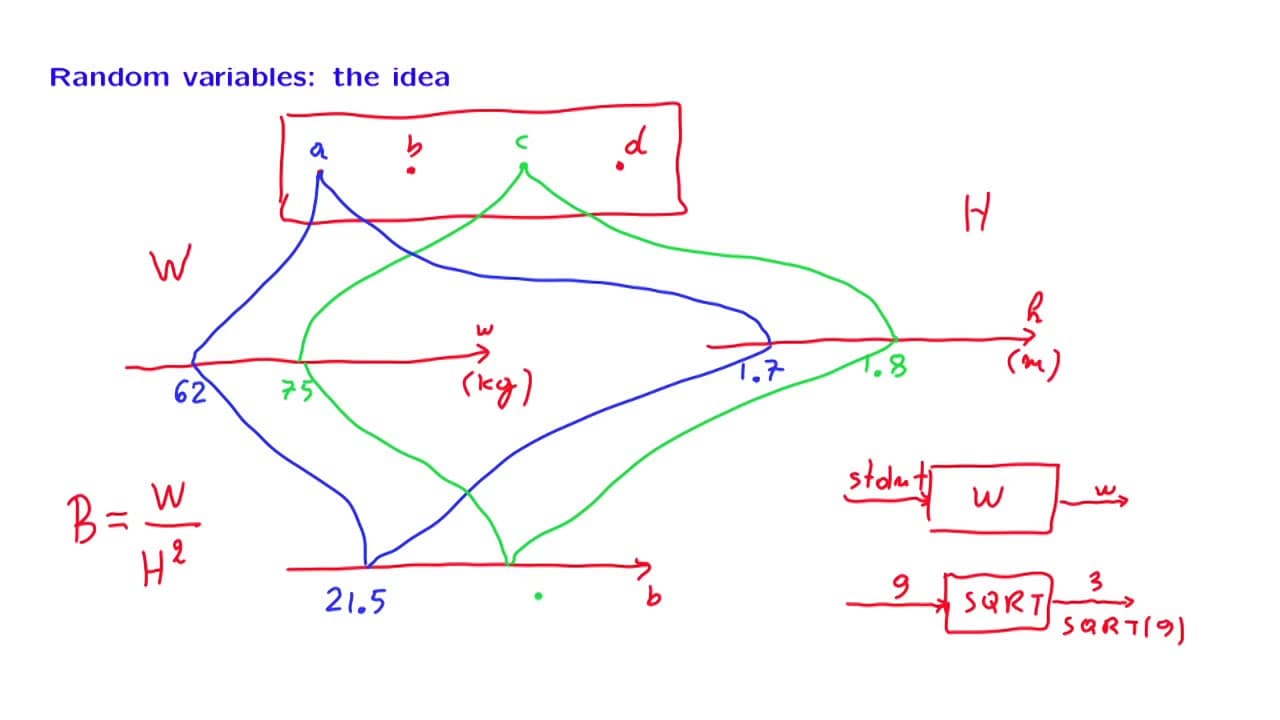
We will now define the notion of a random variable. Very loosely speaking, a random variable is a numerical quantity that takes random values. But what does this mean? We want to be a little more precise and I'm going to introduce the idea through an example. Suppose that our sample space is a set of students labeled according to their names. Or fo... Read More
Key Insights
- ❓ Random variables are numerical quantities that take random values and are determined by the outcome of a probabilistic experiment.
- 🫵 Random variables can be viewed as functions that associate specific values with each outcome.
- ❓ Multiple random variables can be associated with the same experiment, representing different aspects or measurements.
- 👶 New random variables can be created by combining or manipulating original random variables.
- #️⃣ Random variables can take discrete values, like integers, or continuous values, like real numbers.
- 🍵 Discrete random variables are easier to handle, but continuous random variables will be discussed in later lectures.
- 🔠 Random variables are denoted by uppercase letters, while the numerical values they take are denoted by lowercase letters.
Install to Summarize YouTube Videos and Get Transcripts
Explore YouTube Video Summarizer or Get YouTube Transcript Extractor
Questions & Answers
Q: What is a random variable?
A random variable is a numerical quantity that takes random values determined by the outcome of a probabilistic experiment. It can be viewed as a function that associates a specific value to each outcome.
Q: How are random variables related to functions?
Random variables can be seen as functions that take as input the outcome of the experiment and produce a specific value. For example, the weight of a student can be seen as a function of the student's outcome.
Q: Can there be multiple random variables associated with the same experiment?
Yes, a single probabilistic experiment can have multiple random variables associated with it. For example, the weight and height of a student can both be random variables in the same experiment.
Q: How are new random variables created?
New random variables can be created by combining original random variables. For example, the body mass index, which is calculated using weight and height, can be considered a new random variable.
Summary & Key Takeaways
-
A random variable is a numerical quantity that takes random values, such as the weight or height of a student in a probabilistic experiment.
-
Random variables can be viewed as functions that take as input the outcome of the experiment and produce a specific value.
-
New random variables can be created by combining original random variables, such as calculating the body mass index using weight and height.
Read in Other Languages (beta)
Share This Summary 📚
Summarize YouTube Videos and Get Video Transcripts with 1-Click
Try YouTube Summary with ChatGPT & Claude or YouTube Transcript Generator
Explore More Summaries from MIT OpenCourseWare 📚



Summarize YouTube Videos and Get Video Transcripts with 1-Click
Try YouTube Summary with ChatGPT & Claude or YouTube Transcript Generator