Goodie Bag 1: Atoms and Reactions (Intro to Solid-State Chemistry)
TL;DR
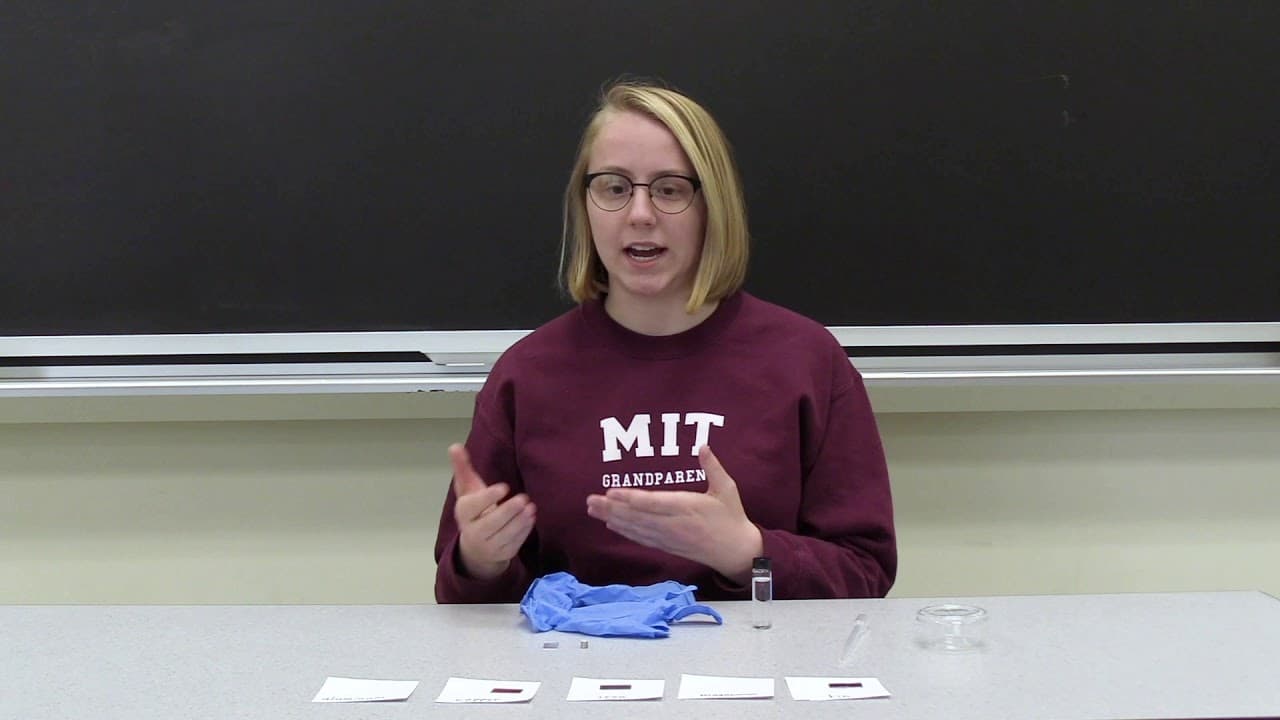
In this video, we learn how to identify different metals based on their properties, observe a chemical reaction using vinegar, determine the limiting reagent, and estimate the number of atoms in a copper sample.
Transcript
[SQUEAKING] [RUSTLING] [CLICKING] CLAIRE HALLORAN: Today, we're going to be doing goody bag 1, atoms and reactions. Our objectives today are to identify material based on its properties, observe a simple chemical reaction, and identify the limiting reagent, and estimate the number of atoms in a real object. To do this goody bag, you'll need vinegar... Read More
Key Insights
- 🤘 Properties such as color, malleability, density, and reactivity can be used to identify different metals.
- 🤘 Vinegar can be used to determine which metals react (magnesium) and which do not (aluminum).
- 🧑🏭 The acetic acid in vinegar can act as a limiting reagent in a chemical reaction with magnesium.
Install to Summarize YouTube Videos and Get Transcripts
Explore YouTube Video Summarizer or Get YouTube Transcript Extractor
Questions & Answers
Q: How can we tell different metals apart?
Different metals can be distinguished based on their properties, such as color (copper's orange-ish color), malleability (iron is the most difficult to bend), density (tin is the most dense), and reactivity (magnesium reacts with vinegar).
Q: How can we count atoms that are too small to see?
Although atoms are too small to see individually, we can estimate the number of atoms in a sample by measuring its dimensions (using a ruler in this activity) and employing the principles of Avogadro's number and atomic mass.
Q: What is the limiting reagent in the vinegar and magnesium reaction?
The acetic acid inside the vinegar is the limiting reagent in the reaction with magnesium. This means that there is still plenty of magnesium left after the reaction, indicating that the acetic acid is fully consumed.
Q: What is the significance of the hydrogen gas bubbles observed during the reaction?
The formation of hydrogen gas bubbles indicates that magnesium is reacting with vinegar. These bubbles are a product of the chemical reaction between magnesium and acetic acid, as they release hydrogen gas.
Summary & Key Takeaways
-
The objective of this goody bag activity is to identify metals based on their properties, observe a chemical reaction with vinegar, determine the most difficult metal to bend (iron), and compare the density of different metals.
-
Copper is easily identified by its orange-ish color, while iron is the most difficult to bend. Tin is the most dense metal, and magnesium reacts with vinegar to produce hydrogen gas.
-
The acetic acid in vinegar is the limiting reagent in the reaction with magnesium. By measuring the width and height of a copper sample, an estimate of the number of atoms can be made.
Read in Other Languages (beta)
Share This Summary 📚
Summarize YouTube Videos and Get Video Transcripts with 1-Click
Try YouTube Summary with ChatGPT & Claude or YouTube Transcript Generator
Explore More Summaries from MIT OpenCourseWare 📚



Summarize YouTube Videos and Get Video Transcripts with 1-Click
Try YouTube Summary with ChatGPT & Claude or YouTube Transcript Generator