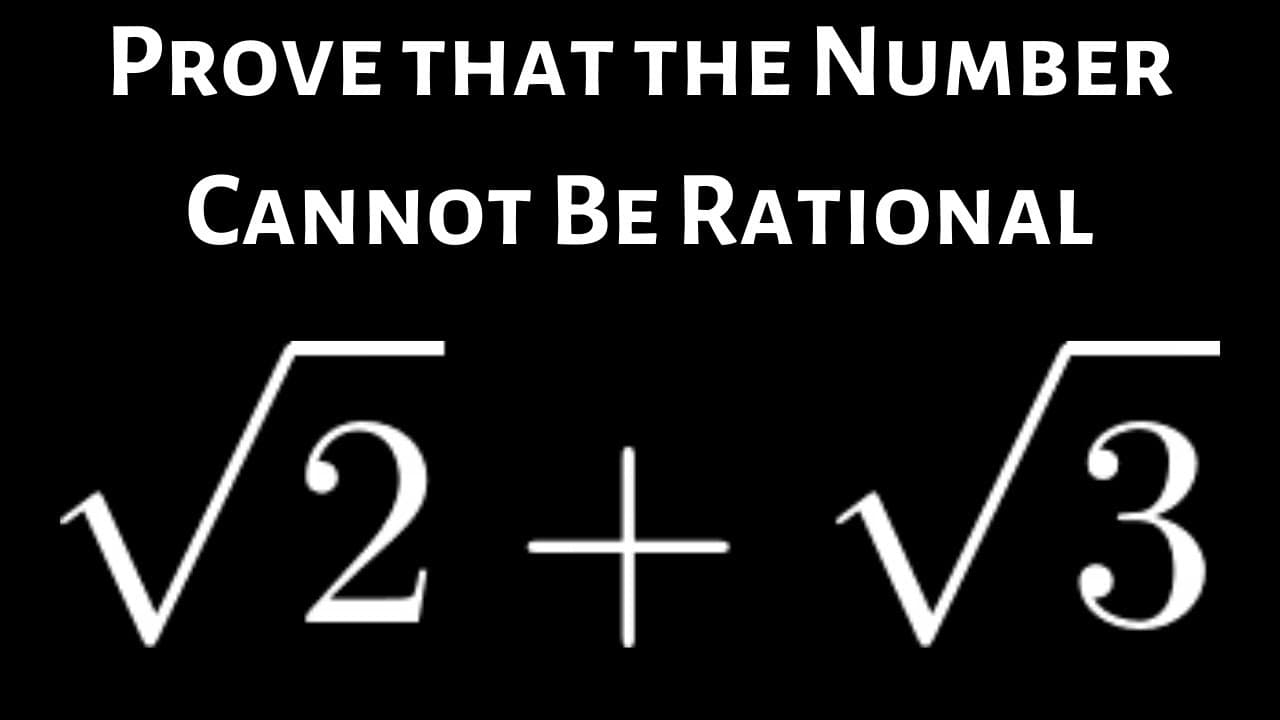
Prove that sqrt(2) + sqrt(3) Cannot be a Rational Number
TL;DR
The sum of square roots, square root of 2 plus square root of 3, is irrational, proven by polynomial equations.
Transcript
prove that the square root of 2 plus the square root of 3 cannot be a rational number let's go ahead and go through the proof so we're going to do a really nice proof we're going to start by letting it be called x we're going to call it x and we're going to try to find an equation for which this is a solution of so now let's go ahead and square bot... Read More
Key Insights
- ❎ Squaring both sides simplifies square root sums into a polynomial equation.
- 🫚 Irreducibility to rational numbers makes the sum of square roots irrational.
- 🦮 Rational roots theorem guides the exclusion of rational possibilities for the sum.
- 👍 Polynomial equations serve as tools for proving the irrationality of certain numbers.
Install to Summarize YouTube Videos and Get Transcripts
Explore YouTube Video Summarizer or Get YouTube Transcript Extractor
Questions & Answers
Q: How is the square root of 2 plus the square root of 3 proven to be irrational?
By assuming x as the sum and deriving a polynomial equation, irrationality is proven through the rational roots theorem, showing x doesn't match possible rational roots.
Q: What formula is used to simplify (a + b)^2 in the proof?
The formula (a + b)^2 = a^2 + 2ab + b^2 simplifies the square of square roots in the proof involving the sum of square roots.
Q: Why is the sum of square roots considered irrational?
The sum is irrational as it can't be expressed as a fraction of integers, verified through a polynomial equation contradicting possible rational roots.
Q: How does the rational roots theorem help prove the sum's irrationality?
By examining possible rational roots from the equation, the theorem confirms that the sum of square roots doesn't align with any rational number possibilities.
Summary & Key Takeaways
-
The proof starts by assuming x = square root of 2 plus square root of 3.
-
Squaring both sides reveals a polynomial equation x^4 - 10x^2 + 1 = 0.
-
Applying rational roots theorem excludes x from being rational, affirming its irrationality.
Read in Other Languages (beta)
Share This Summary 📚
Summarize YouTube Videos and Get Video Transcripts with 1-Click
Try YouTube Summary with ChatGPT & Claude or YouTube Transcript Generator
Explore More Summaries from The Math Sorcerer 📚


Summarize YouTube Videos and Get Video Transcripts with 1-Click
Try YouTube Summary with ChatGPT & Claude or YouTube Transcript Generator