VHDL code for T Flip flop | Behavioral model | Digital Systems Design | Lec-81
TL;DR
Learn to write VHDL code for a T flip flop.
Transcript
hi everyone in this video I'm going to tell how to write a vhdl code for T flip Lop so in the last class I have started the introduction of the T flip lop and the internal gate level diagram and as well as symbolic representation after that we have already seen the truth table of this T flip Loop so T flip Loop is nothing but which is formed by sho... Read More
Key Insights
- 🎨 The T flip flop is a fundamental digital memory circuit pivotal in counter applications and simplifying logic designs.
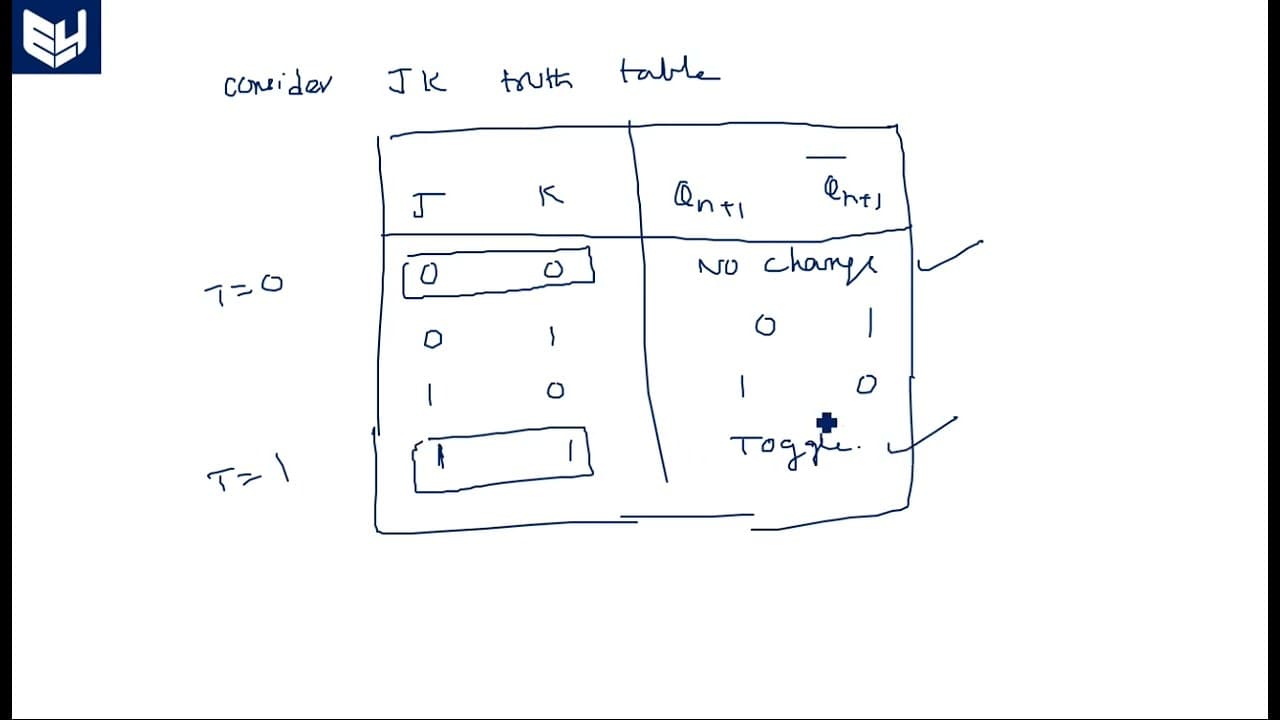
- 🦖 The truth table of the T flip flop delineates that the output remains unchanged when T = 0 and toggles when T = 1 on clock edges.
- 👨💻 Mastering VHDL requires understanding logical operations and implementing syntactically correct codes with appropriate library usage.
- 👻 The behavioral model approach in VHDL allows for a high-level description of the flip flop's functionality, improving code clarity.
- ✊ Handling reset conditions effectively is crucial in digital circuit design, ensuring predictable outcomes during initialization and power-up.
- ❓ Utilizing temporary variables enhances the readability and manageability of VHDL programs by segmenting logic operations.
- 👻 Correctly assessing clock events allows for synchronous design, essential for reliable operation in digital systems.
Install to Summarize YouTube Videos and Get Transcripts
Explore YouTube Video Summarizer or Get YouTube Transcript Extractor
Questions & Answers
Q: What is the fundamental operation of a T flip flop as explained in the video?
The T flip flop operates based on its toggle functionality, where the output changes state when the input T equals 1, causing it to complement or toggle the previous output state. It holds the previous output state when the input T is 0, effectively creating a memory function critical for applications like counters.
Q: Why are the library packages crucial at the start of the VHDL code?
The library packages are essential because they contain necessary components and functions that the program will utilize. Without these packages, the VHDL code would fail to compile and run correctly. As such, defining the library at the start ensures proper access to required functionalities, making code execution successful.
Q: How does the reset function influence the T flip flop's output?
The reset function takes priority in controlling the output of the T flip flop. When activated (reset = 1), it forces the output to 0, regardless of the T input's state or the clock signal. This ensures a defined output state, which is crucial for synchronous logic design.
Q: What are the roles of temporary variables in the VHDL code for the T flip flop?
In the VHDL code, temporary variables serve as intermediate signals used to process the output conditionally. By initially setting a temporary variable to zero, it simplifies toggling and storing the output state based on the clock edge and input conditions. This approach allows for clearer logic structuring.
Q: How does the clock signal interact with input conditions in the T flip flop logic?
The clock signal provides timing for the T flip flop's operation. Input conditions are evaluated only when a rising edge of the clock is detected. This mechanism ensures that changes in the flip flop's state occur synchronously with the clock, maintaining stable operation in sequential circuits.
Q: What coding conventions are highlighted in the video for behavioral models in VHDL?
The video emphasizes the importance of adhering to coding conventions such as starting with library imports, clearly defining entities and architectures, and ensuring proper syntax with semicolons at the end of statements. Following these conventions leads to cleaner, more maintainable code and reduces errors during compilation.
Summary & Key Takeaways
-
The video provides a detailed explanation of how to write VHDL code for a T flip flop, starting from basic concepts and components such as J and K flip flops.
-
A behavioral model of the T flip flop is shown, which includes defining inputs, outputs, and the reset pin's function in various states of operation.
-
Essential coding practices are discussed, such as the necessity of library imports and the structure of VHDL programs, emphasizing syntax rules and coding conventions.
Read in Other Languages (beta)
Share This Summary 📚
Summarize YouTube Videos and Get Video Transcripts with 1-Click
Try YouTube Summary with ChatGPT & Claude or YouTube Transcript Generator