Delta function potential I: Preliminaries
TL;DR
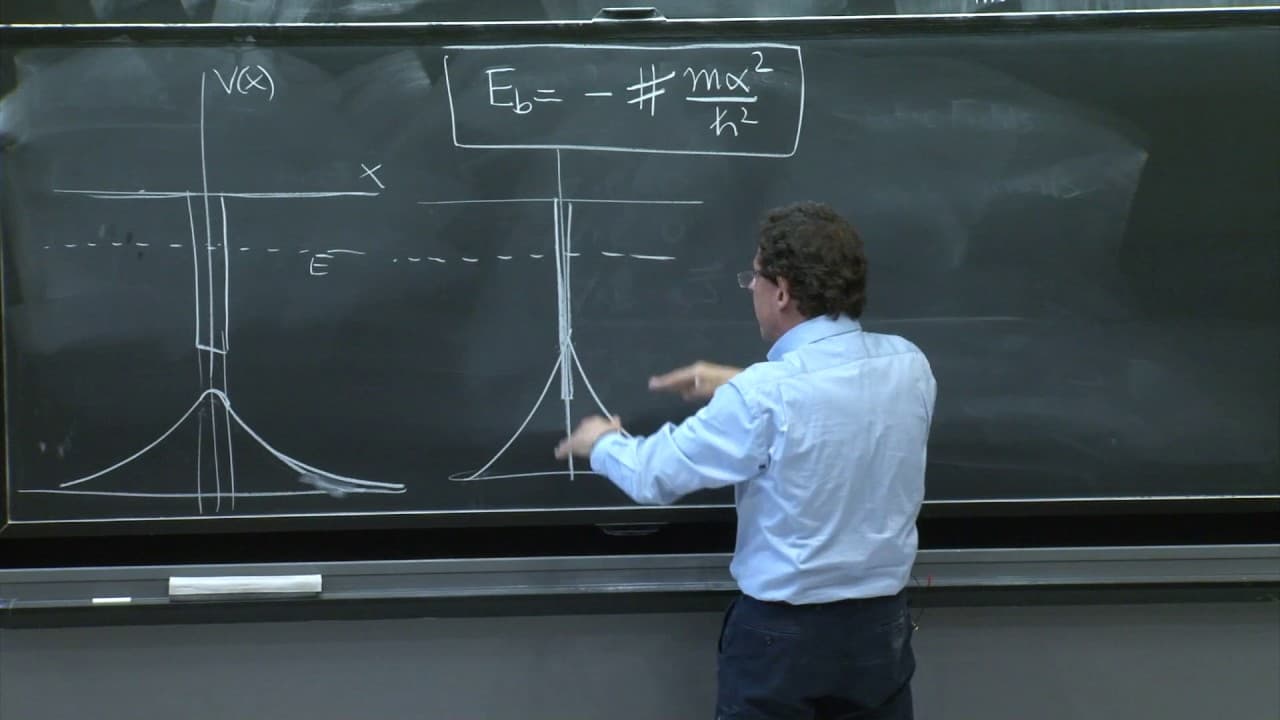
The delta function potential is a one-dimensional potential that becomes infinite and negative at x equals zero, with the potential represented as a thick arrow pointing down. The potential has bound states with energy less than zero, and the number of bound states depends on the intensity of the delta function.
Transcript
PROFESSOR: Delta function potential. So it's still a one-dimensional potential-- potential is a function of x. We'll write it this way-- minus alpha delta of x, where alpha is positive. So this is a delta function in a negative direction. So if you want to draw the potential-- there's no way to draw really nicely a delta function. So you just do a ... Read More
Key Insights
- 👈 The delta function potential is represented by a thick arrow pointing down, indicating that it becomes infinite and negative at x equals zero.
- 0️⃣ Bound states in the delta function potential have energy less than zero.
- #️⃣ The number of bound states in the potential depends on the intensity of the delta function.
- ◻️ The energy of a bound state in the delta function potential is proportional to the quantity (m alpha squared / h squared).
- 🙃 The bound state wave function in the potential is even and decays on both sides of x equals zero.
- 👋 As the delta function potential becomes narrower and deeper, the bound state wave function approaches a discontinuous shape.
- 🙃 The differential equation for the delta function potential is simplified to psi double prime equals kappa squared psi, where kappa squared is positive.
- ☺️ The solutions to the differential equation are e to the minus kappa x and e to the kappa x (or cosh kappa x and sinh kappa x).
- 🦕 Only even bound states exist in the delta function potential, while odd bound states do not have solutions.
Install to Summarize YouTube Videos and Get Transcripts
Explore YouTube Video Summarizer or Get YouTube Transcript Extractor
Questions & Answers
Q: What are bound states in the delta function potential?
Bound states are energy eigenstates in the potential with energy less than zero.
Q: Does the delta function potential have bound states?
Yes, the delta function potential has bound states with energy less than zero.
Q: Does the number of bound states depend on the intensity of the delta function?
Yes, the number of bound states in the delta function potential depends on the intensity of the delta function. A deeper potential leads to more bound states.
Q: How can we determine the energy of bound states in the delta function potential without solving the differential equation?
By considering the units of the constants in the problem (alpha, mass, and h-bar), we can determine that the energy of a bound state in the delta function potential is proportional to the quantity (m alpha squared / h squared).
Summary & Key Takeaways
-
The delta function potential is a one-dimensional potential with infinite and negative values at x equals zero, represented by a thick arrow pointing down.
-
Bound states in this potential are energy eigenstates with energy less than zero.
-
The number of bound states depends on the intensity of the delta function.
Read in Other Languages (beta)
Share This Summary 📚
Summarize YouTube Videos and Get Video Transcripts with 1-Click
Try YouTube Summary with ChatGPT & Claude or YouTube Transcript Generator
Explore More Summaries from MIT OpenCourseWare 📚



Summarize YouTube Videos and Get Video Transcripts with 1-Click
Try YouTube Summary with ChatGPT & Claude or YouTube Transcript Generator