Products
Features
YouTube Video Summarizer
Summarize YouTube videos
Web & PDF Highlighter
Highlight web pages & PDFs
Chat with PDF
Ask any PDF questions with AI
Ask AI Clone
Chat with your highlights & memories
Audio Transcriber
Transcribe audio files to text
Glasp Reader
Read and highlight articles
Kindle Highlight Export
Export your Kindle highlights
Idea Hatch
Hatch ideas from your highlights
Integrations
Obsidian Plugin
Notion Integration
Pocket Integration
Instapaper Integration
Medium Integration
Readwise Integration
Snipd Integration
Hypothesis Integration
Apps & Extensions
Chrome Extension
Safari Extension
Edge Add-ons
Firefox Add-ons
iOS App
Android App
Discover
Discover
Ideas
Discover new ideas and insights
Articles
Curated articles and insights
Books
Book recommendations by great minds
Posts
Essays and notes from readers
Quotes
Inspiring quotes collection
Videos
Curated videos and summaries
Explore Glasp
Glasp Newsletter
Weekly insights and updates
Glasp Talk
Interview series with great minds
Glasp Blog
Latest news and articles
Glasp Use Cases
Learn how others use Glasp
Build & Support
Glasp API
Access Glasp's API for developers
MCP Connector
Connect Glasp to Claude & ChatGPT
Community
Glasp Reddit Community
Students
Student discount and benefits
FAQs
Frequently Asked Questions
AboutPricing
DashboardLog inSign up

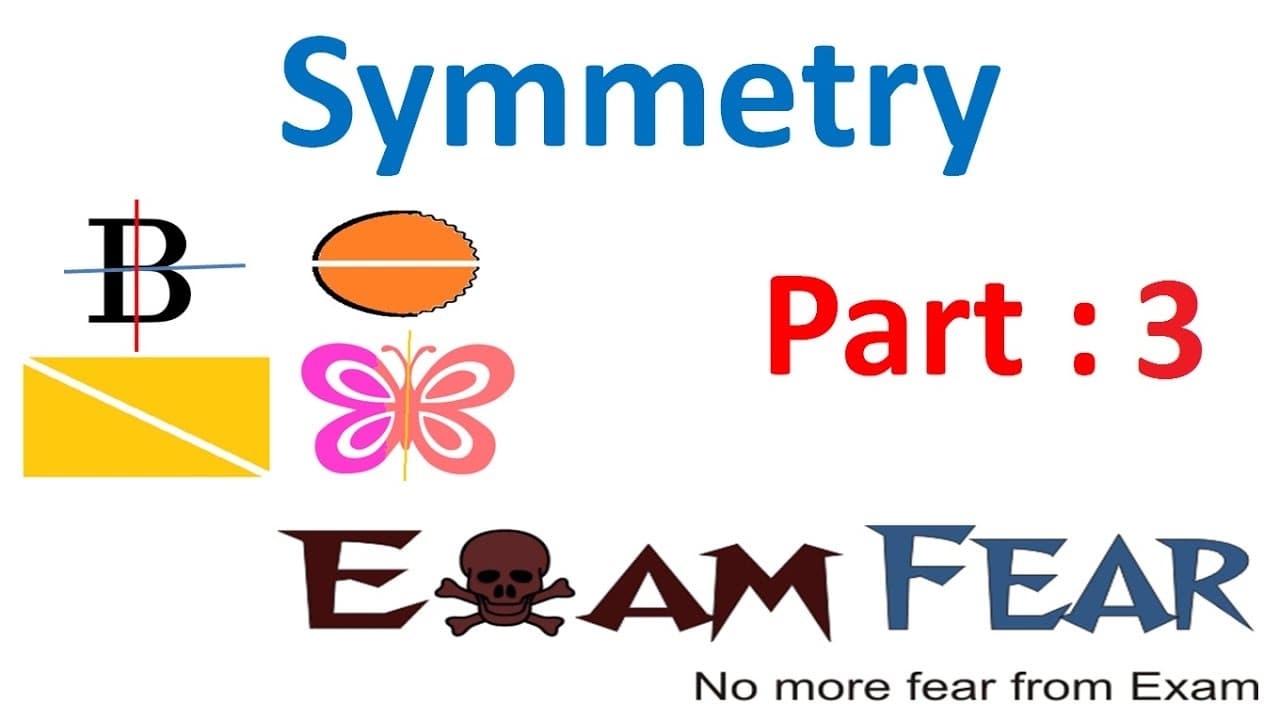
Maths Symmetry part 3 (Symmetry in Nature) CBSE Class 6 Mathematics VI
January 5, 2017
by
LearnoHub - Class 11, 12
YouTube video player
Maths Symmetry part 3 (Symmetry in Nature) CBSE Class 6 Mathematics VI

TL;DR

Many objects in nature, such as butterflies and flowers, as well as everyday objects like necklaces, can have symmetry.

Transcript

hello friends this video on symmetry part 3 is brought to you by exam fire comm no more fear from exam now symmetric in nature now as I mentioned before also that when you absorb things around you you will see that a lot of things in nature have symmetry so one such example is a butterfly so when you look at a butterfly which obviously looks very p... Read More

Key Insights

  • 😀 Many objects in nature, including butterflies, flowers, insects, and human faces, exhibit symmetry.
  • 🫥 Symmetry can be visualized by folding an object along a line and determining if the two halves overlap completely.

Install to Summarize YouTube Videos and Get Transcripts

Explore YouTube Video Summarizer or Get YouTube Transcript Extractor

Questions & Answers

Q: What is an example of an object in nature that has symmetry?

One example is a butterfly, where the left half and the right half are identical when folded along a line. This can be visualized by drawing the butterfly on a piece of paper and folding it.

Q: How can symmetry be identified in the human face?

The human face has symmetry when divided along a line. The eyes, nose, and lips form identical halves, and if the face is drawn on paper and folded along the line, the halves would overlap completely.

Q: Do all objects in nature have symmetry?

No, not all objects have symmetry. For example, a cockroach has symmetry when divided along a line, but not all insects or organisms possess this characteristic.

Q: How can symmetry be determined in objects like necklaces?

To determine if a necklace has symmetry, imagine folding it along a line. If the two halves overlap completely, the necklace has symmetry. If there are differences or designs that prevent complete overlap, the necklace does not have symmetry.

Summary & Key Takeaways

  • Nature is full of symmetrical objects, including butterflies, flowers, and even the human face.

  • Symmetry can be visualized by folding an object along a line and seeing if the two halves overlap completely.

  • Not all objects have symmetry, as demonstrated by two different necklaces.


Read in Other Languages (beta)

English

Share This Summary 📚

Summarize YouTube Videos and Get Video Transcripts with 1-Click

Download browser extensions on:

Try YouTube Summary with ChatGPT & Claude or YouTube Transcript Generator

Explore More Summaries from LearnoHub - Class 11, 12 📚
NEET Biology Ecology : Multiple Choice Previous Years Questions MCQs 2 thumbnail
NEET Biology Ecology : Multiple Choice Previous Years Questions MCQs 2
LearnoHub - Class 11, 12
Maths Mensuration part 2 (Perimeter of Rectangle and Square) CBSE Class 6 Mathematics VI thumbnail
Maths Mensuration part 2 (Perimeter of Rectangle and Square) CBSE Class 6 Mathematics VI
LearnoHub - Class 11, 12
Maths Fraction part 12 (Numericals) CBSE Class 6 Mathematics VI thumbnail
Maths Fraction part 12 (Numericals) CBSE Class 6 Mathematics VI
LearnoHub - Class 11, 12
Biology Getting to Know Plants Part 3 (Creepers, Climbers, Plant parts) Class 6 VI thumbnail
Biology Getting to Know Plants Part 3 (Creepers, Climbers, Plant parts) Class 6 VI
LearnoHub - Class 11, 12
Biology Ecosystem part 5 (Components : Decomposers) class 12 XII thumbnail
Biology Ecosystem part 5 (Components : Decomposers) class 12 XII
LearnoHub - Class 11, 12

Summarize YouTube Videos and Get Video Transcripts with 1-Click

Download browser extensions on:

Try YouTube Summary with ChatGPT & Claude or YouTube Transcript Generator

Apps & Extensions

  • Chrome Extension
  • Safari Extension
  • Edge Add-ons
  • Firefox Add-ons
  • iOS App
  • Android App

Key Features

  • YouTube Video Summarizer
  • Web & PDF Summarizer
  • Web & PDF Highlighter
  • Chat with PDF
  • Ask AI Clone
  • Audio Transcriber
  • Glasp Reader
  • Kindle Highlight Export
  • Idea Hatch

Integrations

  • Obsidian Plugin
  • Notion Integration
  • Pocket Integration
  • Instapaper Integration
  • Medium Integration
  • Readwise Integration
  • Snipd Integration
  • Hypothesis Integration

More Features

  • APIs
  • MCP Connector
  • Blog & Post
  • Embed Links
  • Image Highlight
  • Personality Test
  • Quote Shots

Company

  • About us
  • Blog
  • Community
  • FAQs
  • Job Board
  • Newsletter
  • Pricing
Terms

•

Privacy

•

Guidelines

© 2026 Glasp Inc. All rights reserved.