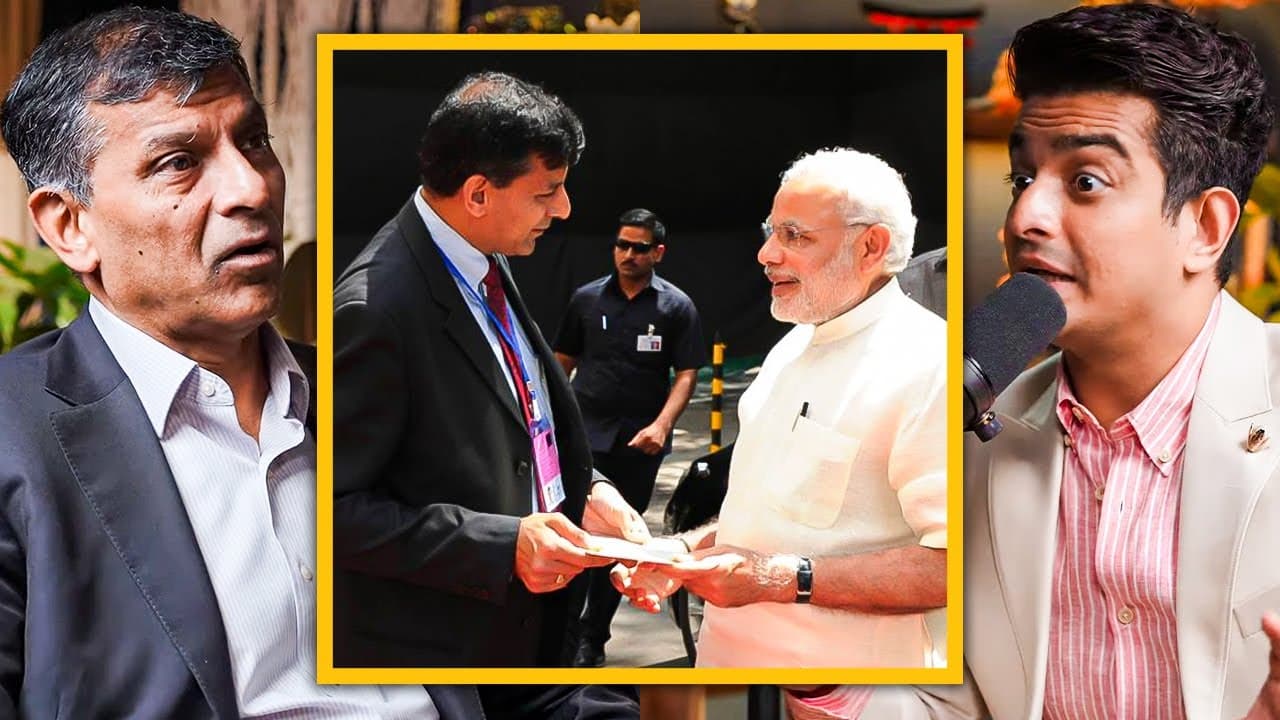
Why I Quit Working With PM Modi - Dr.Raghuram Rajan
TL;DR
The speaker discusses their experiences with the Modi government and critiques current governance practices.
Transcript
welcome to TRS Clips where you'll find happiness through your own curiosity the narrative in the public eye is that uh you left working with the Modi government because your opinions weren't heard no I I actually could do everything I needed to do uh one of the interesting issues is I had a very good working relationship both with the prime Ministe... Read More
Key Insights
- 🤩 Maintaining strong interpersonal relationships with key government officials can facilitate the implementation of significant economic policies.
- 🇨🇫 Effective communication of economic concepts to the public is crucial for understanding policy impacts and fostering acceptance.
- 🔉 Media portrayals can heavily influence public perception, often distorting the nuances of political discourses and criticisms.
- 🥺 Decentralizing governance can lead to more responsive political systems, enhancing accountability at local levels.
- ❓ A focus on grassroots governance can empower citizens to address local issues more effectively.
- 🥺 The suppression of critique in political spaces can lead to governance failures and loss of democratic integrity.
- 🪡 Historical governance structures need reconsideration to effectively address modern challenges and complexities.
Install to Summarize YouTube Videos and Get Transcripts
Explore YouTube Video Summarizer or Get YouTube Transcript Extractor
Questions & Answers
Q: What does the speaker mean by "Dosa economics"?
"Dosa economics" refers to a simplified explanation of economic principles that the speaker used to illustrate how lower fixed deposit rates, due to decreased inflation, allow individuals to purchase more with their earnings. This analogy helped explain the benefits of lower inflation rates and real interest rates in terms relatable to the public.
Q: How does the speaker feel about their media portrayal during their time with the Modi government?
The speaker feels that their media portrayal often focused on negative aspects and taken quotes out of context, leading to misconceptions about their views and roles. They noted that the press tended to emphasize dissenting voices, which may have resulted in an imbalanced narrative focusing on the downside of policies without acknowledging the positives.
Q: What governance changes does the speaker advocate for in India?
The speaker advocates for decentralization as a means to improve governance. They argue that local politicians, such as sarpanches, should have greater responsibilities and control over local education and healthcare, ensuring immediate accountability and responsiveness to community needs rather than relying on central authorities.
Q: How does the speaker describe the relationship between governance and economics?
The speaker asserts that governance and economics are interconnected; successful economic policies require effective governance structures. They emphasize the need for a rethinking of governance to adapt to modern challenges, suggesting that outdated structures from the past are ineffective in addressing contemporary issues.
Q: Why does the speaker believe criticism is important in governance?
The speaker believes that criticism plays a vital role in ensuring accountability and preventing poor governance. By suppressing dissent, authorities risk becoming insulated and make significant mistakes. They reference Dr. Ambedkar's warning against blind worship of a single powerful leader as a recipe for potential dictatorship.
Q: What is the significance of the speaker's relationship with both the Prime Minister and Finance Minister?
The speaker highlights that a good working relationship with both prominent officials allowed them to effectively advocate for necessary policy changes. Their collaboration enabled them to address critical financial issues, such as non-performing assets in banks, ensuring that essential economic reforms were enacted.
Q: How does the speaker assess their popularity among economists and the media?
The speaker feels respected within the intellectual community, noting that many economists cite their work as influential. However, they recognize that their critical stance may paint them as a dissenter in the media narrative, with some portraying them as oppositional rather than constructive.
Q: What is the speaker's perspective on the current political climate in India?
The speaker expresses concern about the current political climate, warning against an over-concentration of power in the Prime Minister’s Office. They argue that this undermines broader democratic processes, calling for a rebalancing that allows for more diverse voices within the cabinet and government structure.
Summary & Key Takeaways
-
The speaker asserts they maintained a productive relationship with key government officials while emphasizing the importance of effective communication of economic policies and realities to the public.
-
They share reflections on the media’s portrayal of their critiques, expressing concerns over how criticism can be misconstrued and lead to the amplification of negativity.
-
The speaker calls for decentralized governance as a solution to improve accountability, advocating for a more grassroots-based political system rather than top-down approaches.
Read in Other Languages (beta)
Share This Summary 📚
Summarize YouTube Videos and Get Video Transcripts with 1-Click
Try YouTube Summary with ChatGPT & Claude or YouTube Transcript Generator
Explore More Summaries from TRS Clips 📚


Summarize YouTube Videos and Get Video Transcripts with 1-Click
Try YouTube Summary with ChatGPT & Claude or YouTube Transcript Generator