Pronunciation: How fluent speakers pronounce plosives
TL;DR
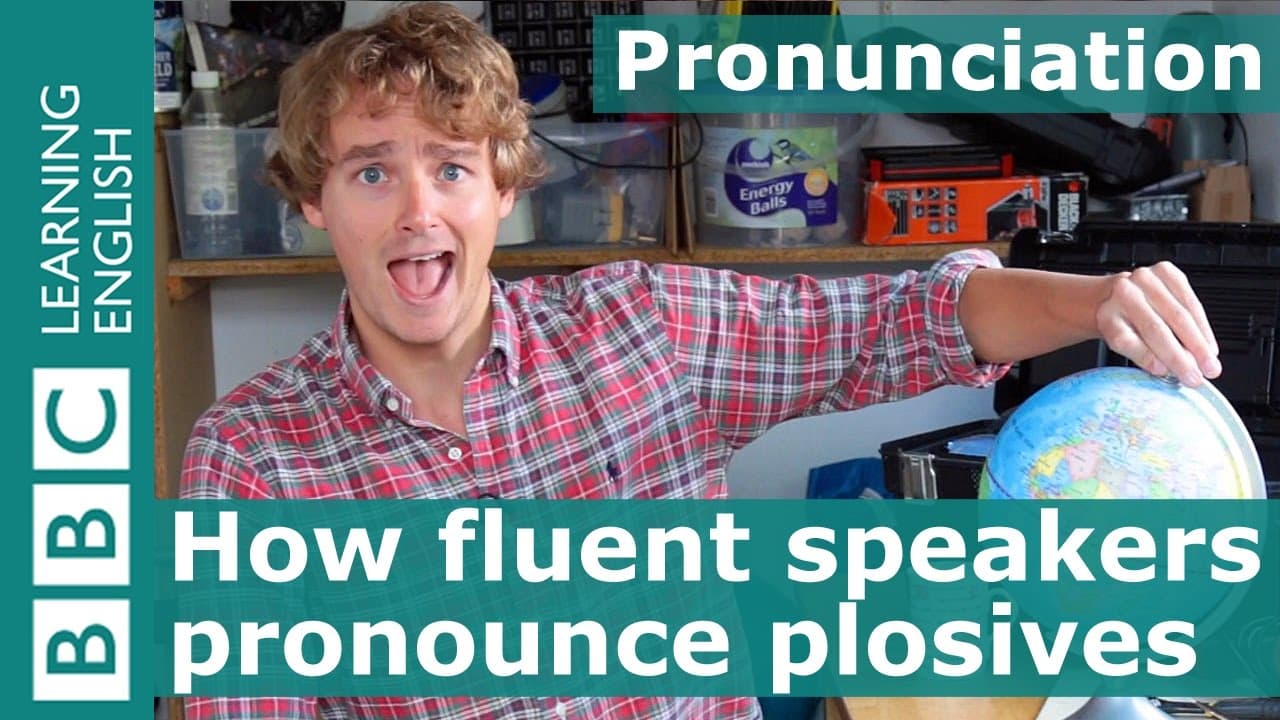
Tim explains how plosives are pronounced in fluent English.
Transcript
Hi. I'm Tim and this is my pronunciation workshop. Here I'm gonna show you how English is really spoken. Come on, let's go inside. Wow. Isn't the world an amazing place? Look how many countries there are! Well - at least ten! Do you like travelling? How many countries have you visited? Now, is there any particular place, or country, that you'd like... Read More
Key Insights
- Tim introduces the concept of plosives in English, which are consonant sounds made by blocking and suddenly releasing air.
- Plosive sounds include /b/, /t/, /p/, /k/, /g/, and /d/, and they resemble small explosions in speech.
- In fluent speech, plosive sounds at the end of a word may not be fully released when followed by another consonant.
- This phenomenon is known as an 'unreleased stop' or 'a stop with no audible release', common in everyday English.
- Tim provides examples where plosive sounds are unreleased, such as 'I'd like to' becoming 'Idliketuh'.
- Listeners are encouraged to practice by repeating examples to improve their pronunciation skills.
- Tim emphasizes the importance of understanding plosives for natural and fluent English speaking.
- The workshop is part of a series aimed at helping learners improve their English pronunciation.
Install to Summarize YouTube Videos and Get Transcripts
Explore YouTube Video Summarizer or Get YouTube Transcript Extractor
Questions & Answers
Q: What are plosive sounds in English?
Plosive sounds in English are consonant sounds created by blocking and then suddenly releasing air in the mouth. They include sounds like /b/, /t/, /p/, /k/, /g/, and /d/. These sounds resemble small explosions and are an essential part of English pronunciation.
Q: How are plosive sounds typically pronounced in fluent English?
In fluent English, plosive sounds at the end of a word may not be fully released when the next word begins with a consonant. This is called an 'unreleased stop' or 'a stop with no audible release', resulting in smoother and more natural speech patterns.
Q: Can you give an example of an unreleased plosive in a sentence?
An example of an unreleased plosive in a sentence is 'I'd like to', which can be pronounced as 'Idliketuh' in fluent speech. The /d/ sound in 'I'd' is not fully released, blending smoothly into the following word.
Q: Why is it important to understand plosive pronunciation?
Understanding plosive pronunciation is important for achieving natural and fluent English speech. It helps learners recognize and practice the subtle nuances of spoken English, making communication more effective and reducing the likelihood of misunderstandings.
Q: What is an 'unreleased stop' in English pronunciation?
An 'unreleased stop' in English pronunciation occurs when a plosive sound at the end of a word is not fully released before the next consonant sound. This results in a smoother transition between words, a feature common in natural and fluent English speech.
Q: How does Tim suggest practicing plosive pronunciation?
Tim suggests practicing plosive pronunciation by listening to examples and repeating them. He provides sentences where plosive sounds are unreleased and encourages learners to mimic these examples to improve their pronunciation and achieve more natural speech.
Q: What resources does Tim recommend for further learning?
Tim recommends visiting the BBC Learning English website for further resources on pronunciation. The website offers additional materials and exercises to help learners improve their English speaking skills, particularly in mastering the nuances of plosive sounds.
Q: What is the main goal of Tim's pronunciation workshop?
The main goal of Tim's pronunciation workshop is to help English learners understand and practice the nuances of spoken English, particularly the pronunciation of plosive sounds. By doing so, learners can achieve more natural and fluent speech, enhancing their overall communication skills.
Summary & Key Takeaways
-
Tim's pronunciation workshop focuses on plosive consonants in English, explaining how they are produced and often unreleased in fluent speech. He provides examples and encourages practice to help learners speak more naturally.
-
The workshop highlights the concept of 'unreleased stops', where plosive sounds are not fully pronounced at the end of words, particularly when followed by another consonant. This is a key feature of natural English pronunciation.
-
Tim concludes the session by inviting learners to practice the examples provided and visit the BBC Learning English website for further resources, emphasizing the workshop's goal of improving English speaking skills.
Read in Other Languages (beta)
Share This Summary 📚
Summarize YouTube Videos and Get Video Transcripts with 1-Click
Try YouTube Summary with ChatGPT & Claude or YouTube Transcript Generator
Explore More Summaries from BBC Learning English 📚

Summarize YouTube Videos and Get Video Transcripts with 1-Click
Try YouTube Summary with ChatGPT & Claude or YouTube Transcript Generator