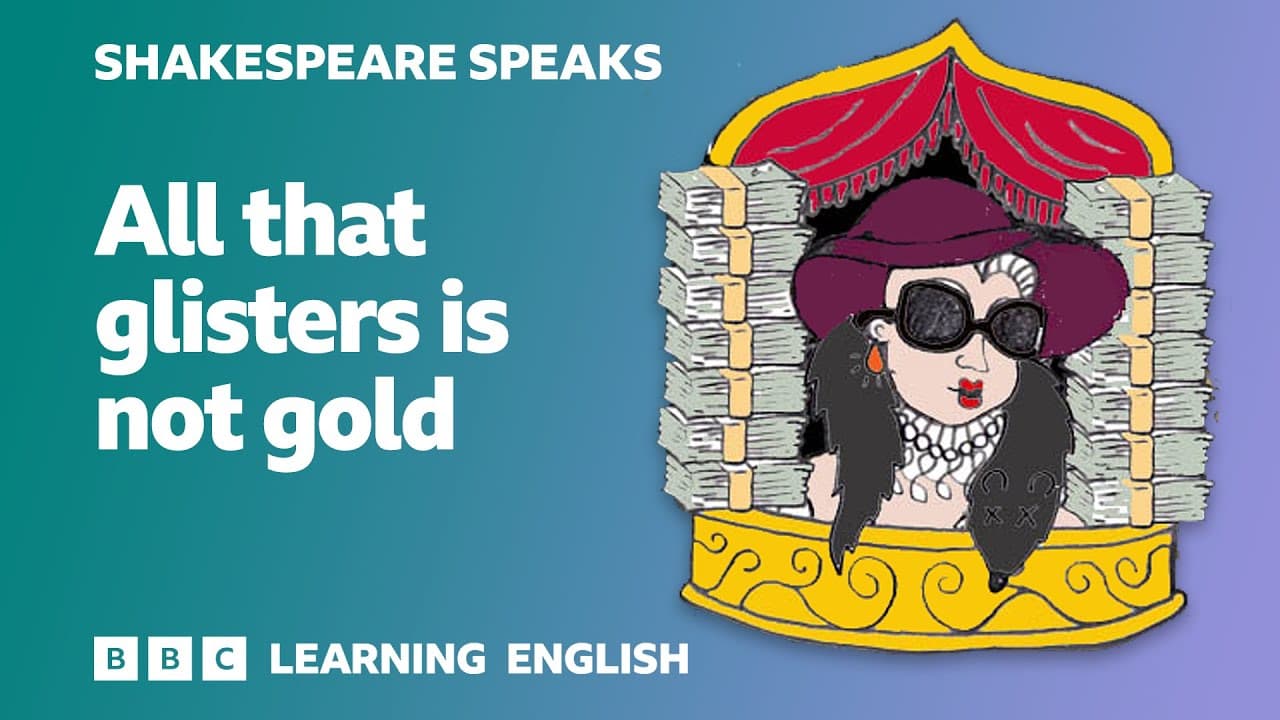
🎭 All that glisters is not gold - Learn English vocabulary & idioms with 'Shakespeare Speaks'
TL;DR
Shakespeare's idiom teaches that appearances can be deceiving.
Transcript
It was a sunny afternoon. William Shakespeare is working on his play The Merchant of Venice. His daughter comes to see him. Father, look at my new ring! Isn't it lovely, gold and shiny... Dear daughter, it is very beautiful. Where did you get such a pretty thing? From the market. It was much cheaper than the gold merchant! Is it real gold? Yes, of ... Read More
Key Insights
- The phrase 'All that glisters is not gold' originates from Shakespeare's play 'The Merchant of Venice', illustrating that appearances can be deceptive.
- In the play, the Prince of Morocco chooses a gold box, believing it contains a portrait of Portia, but finds a scroll with the warning instead.
- The idiom warns against judging the value of things based solely on their outward appearance, as they may not be as valuable as they seem.
- In modern English, the word 'glisters' is often replaced with 'glistens' or 'glitters', but the meaning remains the same.
- The narrative includes a humorous exchange between Shakespeare and his daughter, who buys a ring that turns her finger green, illustrating the idiom's lesson.
- The video is part of a series by BBC Learning English and The Open University, designed to teach English idioms through Shakespeare's works.
- The content encourages viewers to apply the idiom in everyday situations, such as checking a car's engine before purchasing it.
- Additional resources, including lesson plans and worksheets, are provided to help teachers incorporate the idiom into their English lessons.
Install to Summarize YouTube Videos and Get Transcripts
Explore YouTube Video Summarizer or Get YouTube Transcript Extractor
Questions & Answers
Q: What is the main lesson of the idiom 'All that glisters is not gold'?
The main lesson of the idiom 'All that glisters is not gold' is that appearances can be deceiving. It cautions against judging the value or worth of something based solely on its outward appearance, as it might not be as valuable or genuine as it seems.
Q: How does 'The Merchant of Venice' illustrate the idiom's meaning?
In 'The Merchant of Venice', the Prince of Morocco chooses a gold box, believing it contains a portrait of Portia due to its beautiful appearance. However, he finds a scroll inside with the warning 'All that glisters is not gold', illustrating the lesson that outward appearances can be misleading.
Q: What modern variations of the word 'glisters' are commonly used?
In modern English, the word 'glisters' is often replaced with 'glistens' or 'glitters'. Despite the change in wording, the meaning of the idiom remains the same, emphasizing the idea that not everything that looks valuable on the outside is truly valuable on the inside.
Q: How does Shakespeare's interaction with his daughter relate to the idiom?
Shakespeare's interaction with his daughter humorously illustrates the idiom's lesson. She buys a shiny ring from the market, believing it to be gold. However, when it turns her finger green, it becomes clear that the ring's appearance was deceptive, reinforcing the idea that appearances can be misleading.
Q: What educational resources accompany the video?
The video is part of a series by BBC Learning English and The Open University, which includes additional educational resources such as lesson plans and worksheets. These resources are designed to help teachers incorporate the idiom into their English lessons, providing a comprehensive learning experience.
Q: How can the idiom be applied in everyday situations?
The idiom can be applied in everyday situations to remind individuals to look beyond surface appearances. For example, when purchasing a car, one should check the engine and other components rather than relying solely on the car's exterior appearance, as it may not reflect the vehicle's true condition.
Q: What is the purpose of the 'Shakespeare Speaks' series?
The 'Shakespeare Speaks' series, a collaboration between BBC Learning English and The Open University, aims to teach English idioms through the works of Shakespeare. The series provides engaging narratives and educational resources to help learners understand and apply these idioms in real-life contexts.
Q: What is the significance of the phrase 'to buy, or not to buy: that is the question'?
The phrase 'to buy, or not to buy: that is the question' is a humorous adaptation of Shakespeare's famous line 'to be, or not to be' from 'Hamlet'. It is used in the video to emphasize the decision-making process involved in purchases, highlighting the importance of considering factors beyond appearances.
Summary & Key Takeaways
-
The video explores the Shakespearean idiom 'All that glisters is not gold', teaching viewers that appearances can be misleading. Through a scene from 'The Merchant of Venice', it illustrates how the Prince of Morocco is deceived by a gold box's appearance, finding a warning scroll inside instead.
-
Shakespeare's interaction with his daughter further demonstrates the idiom's lesson, as her cheap market ring turns her finger green. This narrative humorously underlines the importance of looking beyond surface appearances to determine true value, a lesson applicable in everyday life.
-
The video is part of a comprehensive educational series by BBC Learning English and The Open University, which aims to teach English idioms through Shakespeare's works. Additional resources, such as lesson plans, are available for educators to enhance their teaching of English idioms.
Read in Other Languages (beta)
Share This Summary 📚
Summarize YouTube Videos and Get Video Transcripts with 1-Click
Try YouTube Summary with ChatGPT & Claude or YouTube Transcript Generator
Explore More Summaries from BBC Learning English 📚

Summarize YouTube Videos and Get Video Transcripts with 1-Click
Try YouTube Summary with ChatGPT & Claude or YouTube Transcript Generator