How Did Federal Spending Shape the Pandemic?
TL;DR
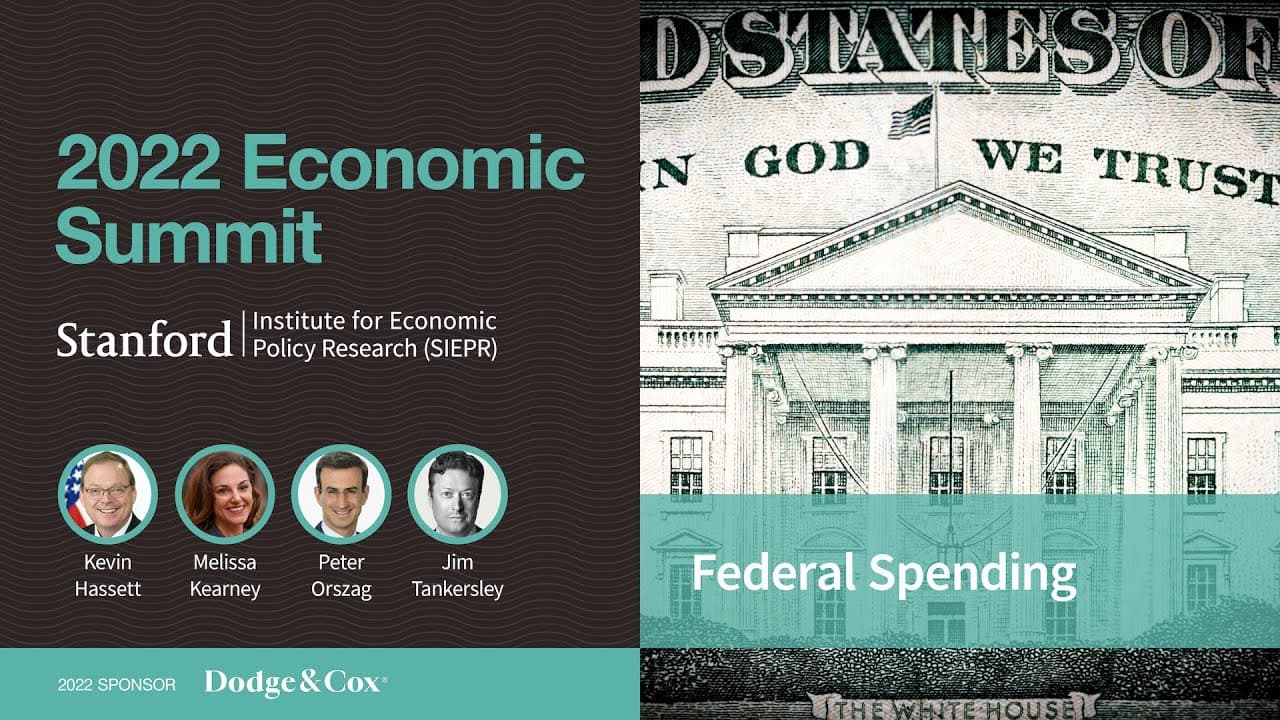
Aggressive federal spending helped prevent the pandemic shutdown from becoming a financial crisis and depression while allowing millions of Americans to retain health insurance. The panelists argue that support was remarkably effective despite imperfect program design, and that spending is now declining so rapidly that accelerating fiscal tightening could threaten the recovery amid inflation, energy-price pressures, and uncertainty surrounding Ukraine.
Transcript
welcome back everyone uh this has been a truly amazing day here at the super economic summit packed with a lot of information and insight we still have one more session to go for the next hour we're going to take a wide angle view of the government response during the pandemic our panelists will cover this uh its response to the pandemic an... Read More
Key Insights
- The pandemic fiscal response was a positive bipartisan effort that helped prevent an abrupt economic shutdown from developing into a financial crisis and depression. The panel expects economic historians to view the speed and scale of the response as an important policy achievement.
- The initial shutdown generated a second-quarter economic contraction described as minus 32 percent. Policymakers responded with unusually large programs because the economy had effectively been turned off for more than a month, creating risks far beyond a conventional slowdown.
- The $600 unemployment insurance supplement was accepted despite concerns that it might provide some recipients with too much money. Kevin Hassett reasoned that excessive benefits were less likely to discourage work while government restrictions were already preventing people from going to their jobs.
- Federal spending rose to levels comparable with 1943 as a share of GDP during the emergency. That extraordinary increase reflected efforts to support households, firms, health coverage, and the financial system while ordinary economic activity was severely constrained.
- The fiscal-policy debate had shifted from emergency expansion to the appropriate speed of withdrawal. Spending and deficits were expected to decline, but the panel cautioned that removing support too quickly could weaken growth before the recovery was secure.
- A reduction in government spending of roughly six percent of GDP over a short period could have negative effects on economic growth. Kevin Hassett characterized the projected fiscal contraction as near the maximum desirable pace if policymakers wanted to avoid endangering the recovery.
- Expanded federal support helped prevent a projected loss of health insurance for three to nine million Americans. Peter Orszag specifically connected the preservation of coverage during a health crisis to expanded FMAP and other government measures adopted during the downturn.
- The claim that United States stimulus solely caused domestic inflation is questioned by the international evidence presented in the discussion. Peter Orszag notes that aggressive fiscal responses occurred across much of the industrialized world, although their relative scale differed among the United States, United Kingdom, and continental Europe.
Install to Summarize YouTube Videos and Get Transcripts
Explore YouTube Video Summarizer or Get YouTube Transcript Extractor
Questions & Answers
Q: How did federal spending prevent a deeper pandemic crisis?
Federal spending supported households, businesses, health coverage, and financial stability after authorities sharply restricted economic activity. The panel argues that these interventions prevented the shutdown, which produced a second-quarter contraction described as minus 32 percent, from turning into a financial crisis and depression. Policymakers also created conditions for growth to resume after the most severe phase of the downturn had passed.
Q: Why was the $600 unemployment supplement approved?
Kevin Hassett supported the $600 unemployment insurance supplement because many people had already been told that they could not go to work during the shutdown. Under those conditions, he reasoned that providing somewhat more money than necessary was unlikely to cause recipients to leave or avoid jobs that were already unavailable. The priority was maintaining household support while the economy remained deliberately closed.
Q: What role did bipartisan policymaking play in the pandemic response?
Bipartisan cooperation enabled policymakers to respond rapidly and forcefully to an extraordinary economic emergency. Kevin Hassett describes the response as underappreciated and positive, emphasizing that officials prevented a temporary shutdown from becoming a much more destructive financial crisis and depression. Although individual measures were not structured exactly as every adviser preferred, the broad response addressed immediate threats to incomes, businesses, and economic stability.
Q: How did pandemic policy help Americans keep health insurance?
Early projections suggested that three to nine million Americans could lose health insurance because of job losses and the broader economic downturn. Peter Orszag says that this projected loss did not occur, connecting the result directly to expanded FMAP and other support measures. Maintaining coverage was especially important because the economic crisis was occurring simultaneously with a public-health crisis.
Q: Why could rapid deficit reduction threaten the recovery?
A sharp decline in federal spending removes demand and support from the economy while recovery may still be vulnerable. Kevin Hassett notes that cutting spending by roughly six percent of GDP over a short period could negatively affect growth even without adopting a strongly Keynesian position. He argues that the projected reduction was already near the fastest desirable pace for avoiding unnecessary risk to the recovery.
Q: Should federal spending fall after the pandemic emergency?
The panel agrees that spending should decline from the extraordinary levels reached during the emergency and that deficits should also decrease. The key issue is the speed of that adjustment. Kevin Hassett argues that the existing trajectory already looked sharp, so accelerating near-term cuts might be unwise when the economy faced uncertainty surrounding Ukraine, higher energy prices, and continuing recovery risks.
Q: Did United States stimulus alone cause inflation?
Peter Orszag disputes the narrative that United States stimulus was solely and exclusively responsible for domestic inflation. He points to the broad international pattern of aggressive fiscal intervention across industrialized economies, with particularly strong responses in the United States and United Kingdom and a somewhat smaller response in continental Europe. He argues that cross-country evidence makes a single-cause explanation difficult to sustain.
Q: What lessons does the pandemic offer for future economic crises?
The discussion suggests that rapid, large-scale intervention can keep an abrupt shutdown from becoming a financial crisis and depression. Policymakers may need to tolerate imperfectly designed assistance when speed and household protection are urgent. The later phase requires equal care because withdrawing support too quickly can restrain growth, particularly when additional uncertainties and energy-price pressures are affecting the recovery.
Summary & Key Takeaways
-
The pandemic response received significant bipartisan support and included the Paycheck Protection Program, expanded unemployment insurance, and assistance that helped preserve health coverage. Kevin Hassett argues that accepting some overpayment through the $600 unemployment supplement was reasonable because shutdown orders already prevented many people from working, limiting its immediate effect on employment decisions.
-
The initial economic shutdown produced a second-quarter contraction described as minus 32 percent and pushed federal spending near 1943 levels as a share of GDP. The panel credits forceful policy intervention with keeping this extraordinary disruption from escalating into a financial crisis and depression, while supporting the subsequent return of economic growth.
-
Federal spending and deficits were already moving downward at the time of the discussion. The panel warns that removing roughly six percent of GDP in government spending over a short period could restrain growth. Given uncertainty surrounding Ukraine and higher energy prices, additional near-term tightening could place the continuing economic recovery at risk.
Read in Other Languages (beta)
Share This Summary 📚
Summarize YouTube Videos and Get Video Transcripts with 1-Click
Try YouTube Summary with ChatGPT & Claude or YouTube Transcript Generator
Explore More Summaries from Stanford Institute for Economic Policy Research (SIEPR) 📚



Summarize YouTube Videos and Get Video Transcripts with 1-Click
Try YouTube Summary with ChatGPT & Claude or YouTube Transcript Generator