Leah Buechley: How to "sketch" with electronics
TL;DR
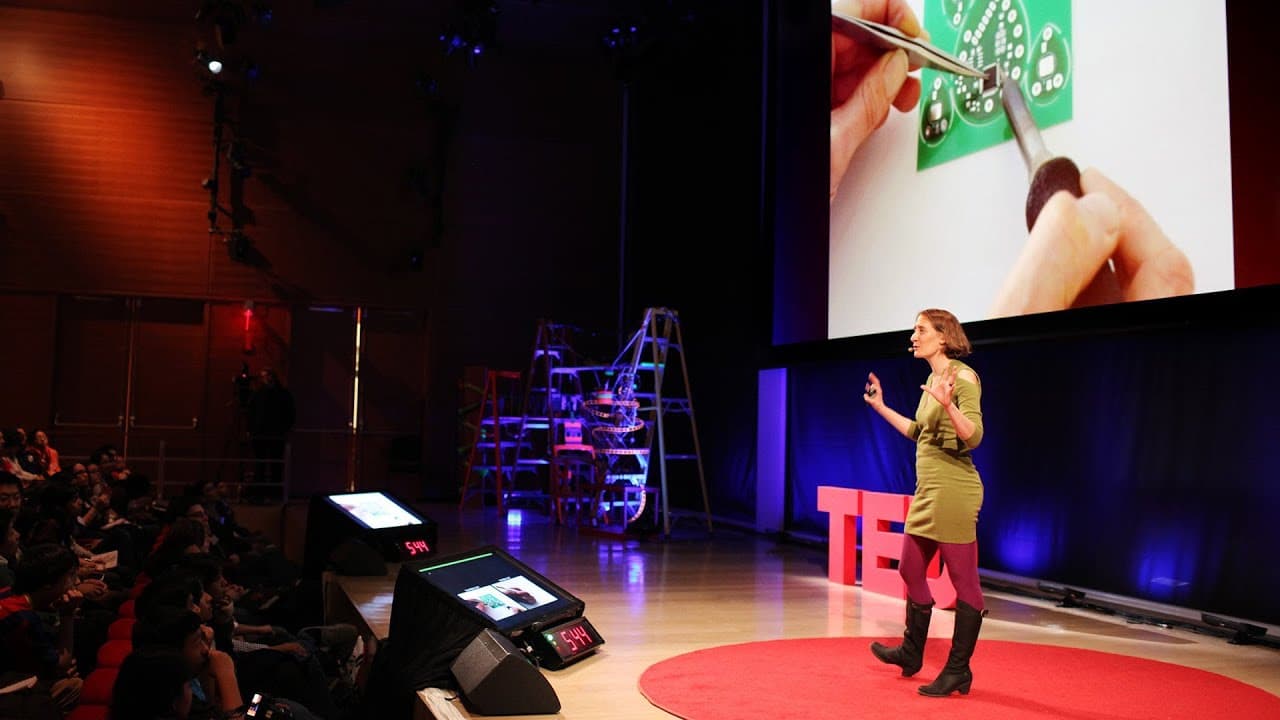
This content discusses the process of designing and building electronics and presents two projects exploring new possibilities in sketching electronics.
Transcript
Translator: Joseph Geni Reviewer: Thu-Huong Ha Today, I'm going to talk to you about sketching electronics. I'm, among several other things, an electrical engineer, and that means that I spend a good amount of time designing and building new pieces of technology, and more specifically designing and building electronics. And what I've found is that ... Read More
Key Insights
- 🔋 The process of designing and building electronics is slow, expensive, and limited, resulting in unattractive circuit boards.
- 💡 The speaker's team has developed tools and materials that allow for quick, inexpensive, and expressive electronic design and building.
- 📝 Magnetic electronic pieces and ferrous paper, along with a conductive pen, allow for sketching and creating electronic components.
- 📏 The possibilities for designing and building electronics are now unlimited, akin to what can be done with a pen and paper.
- 🎵 Music and intelligent microcontrollers can be integrated into the sketched electronic designs, adding another layer of creativity.
- 📚 Workshops are being taught to educate people on using these new tools and techniques for building and sketching with electronics.
- 🌍 Efforts are being made to make these electronic design tools accessible in the real world, allowing people to play and build in this new way.
- 🔜 In the near future, anyone will be able to participate in this fundamentally new way of designing and building electronics.
Install to Summarize YouTube Videos and Get Transcripts
Explore YouTube Video Summarizer or Get YouTube Transcript Extractor
Questions & Answers
Q: How does the speaker describe the traditional process of designing and building electronics?
According to the speaker, the traditional process of designing and building electronics is slow, expensive, and limited in terms of the outcome. Electronic circuit boards are small, square, flat, hard, and often not visually appealing.
Q: What is the main goal of the speaker and his team?
The main goal of the speaker and his team is to change and improve the process and outcome of designing electronics. They aim to make it faster, more cost-effective, and allow for a more fluid, expressive, and improvisational approach.
Q: How do the magnetic electronic pieces and ferrous paper contribute to the process?
The magnetic electronic pieces and ferrous paper, along with the conductive pen developed by the Lewis lab at UIUC, allow for the possibility of designing and building electronics in a way that is similar to sketching on paper. These materials and tools enable quick prototyping, adding intelligence with microcontrollers, and sketching interfaces.
Q: What are the speaker's plans for the future?
The speaker plans to teach workshops and educate people on how to use these new tools and techniques for sketching electronics. They also aim to make these tools, materials, and techniques widely available so that everyone can have the opportunity to play, build, and sketch with electronics in this innovative way.
Summary & Key Takeaways
-
The speaker is an electrical engineer who has found the process of designing and building electronics to be slow, expensive, and limited.
-
The speaker and their team have developed tools and materials that allow for quicker, cheaper, and more expressive design and building of electronics.
-
The speaker plans to teach workshops and distribute the tools and materials to allow others to sketch and build electronics in this new way.
Read in Other Languages (beta)
Share This Summary 📚
Summarize YouTube Videos and Get Video Transcripts with 1-Click
Try YouTube Summary with ChatGPT & Claude or YouTube Transcript Generator
Explore More Summaries from TED 📚


Summarize YouTube Videos and Get Video Transcripts with 1-Click
Try YouTube Summary with ChatGPT & Claude or YouTube Transcript Generator