Schering Bridge | Example Problems -1/2 | Electrical Instruments ( EIM ) | Lec - 52
TL;DR
This video explains calculating unknown capacitance and resistance using shearing bridge parameters.
Transcript
hi everyone in this video i am going to explain how to calculate the unknown values of capacitance and as well as resistance for the shearing bridge in the last video i have explained the shearing ridge concept how to calculate the unknown cans and non capacitance and as well as resistance we have taken the bridge balance recondition and got the eq... Read More
Key Insights
- 🌉 The shearing bridge method is essential for measuring unknown values of capacitance and resistance in electrical circuits.
- ❓ The analysis involves using known values and established relationships between components within the circuit to solve for unknown parameters systematically.
- 🌍 Real-world applications of these calculations can enhance the design and optimization of electronic systems and improve energy efficiency.
- 🧑🏭 The video emphasizes the importance of understanding frequency effects, as the given frequency impacts the calculations and results of both capacitance and dissipation factors.
- 🧑🏭 Methods for calculating the dissipation factor include employing the relationship between resistance and capacitance, showcasing fundamental AC circuit principles.
- 🫵 Using standard math and physical constants, viewers can understand bridge balance conditions to devise accurate electrical measurements.
- 🌍 Through example problems, the video illustrates not only theoretical understanding but also practical skills needed for implementing these calculations in real-world scenarios.
Install to Summarize YouTube Videos and Get Transcripts
Explore YouTube Video Summarizer or Get YouTube Transcript Extractor
Questions & Answers
Q: What is the main topic discussed in the video?
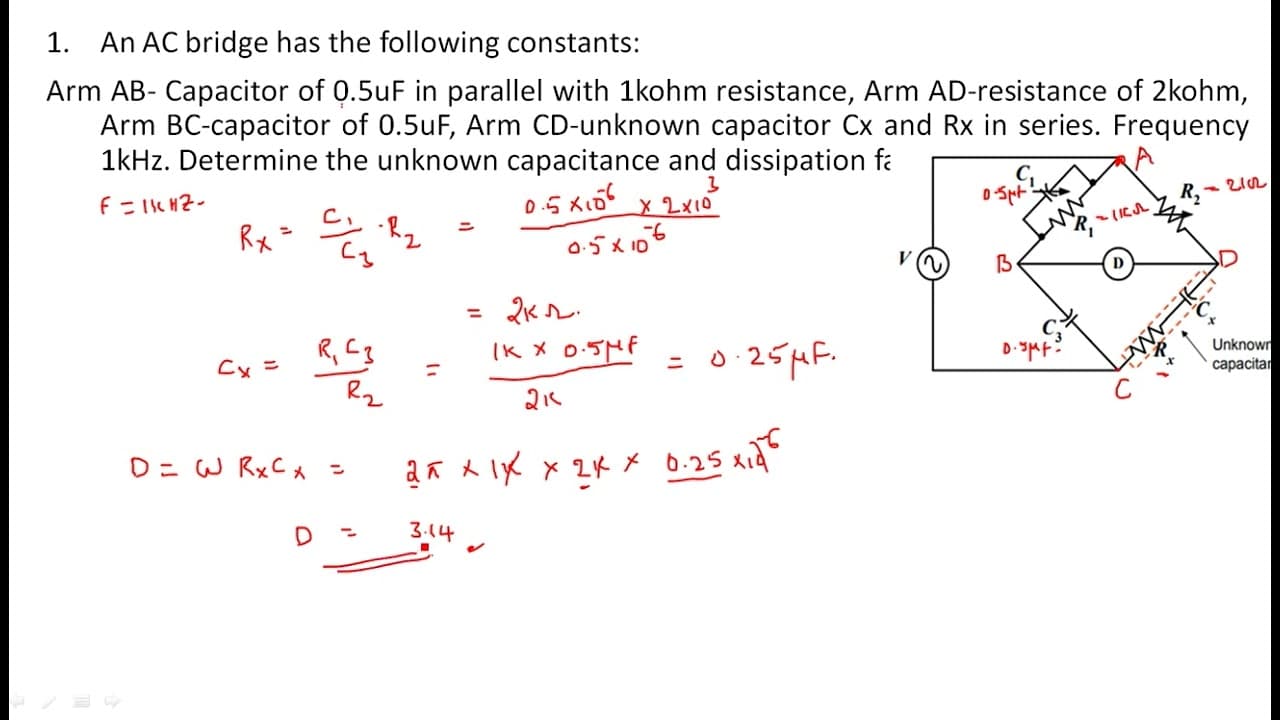
The video discusses how to calculate unknown values of capacitance and resistance in a shearing bridge circuit. It explains the formulas needed and provides examples to illustrate the calculations, ensuring viewers understand the fundamental concepts and applications of the shearing bridge method.
Q: What are the known parameters of the shearing bridge used in the video?
The known parameters discussed include a capacitor of 0.5 microfarads placed in parallel with a 1 kilo-ohm resistor. Other parameters are mentioned throughout the examples, such as operating frequency of 1 kilohertz, additional resistances, and capacitors across the different arms of the bridge, aiding in solving for unknowns.
Q: How is the unknown capacitance (Cx) calculated in the first problem?
In the first problem, Cx is calculated using the formula Cx = (R1 * C3) / R2. Substituting the values, R1 is 1 kilo-ohm and C3 is 0.5 microfarads, while R2 is 2 kilo-ohms. The calculation simplifies to yield an unknown capacitance of 0.25 microfarads.
Q: What is the significance of the dissipation factor in the shearing bridge circuit?
The dissipation factor is crucial as it indicates the efficiency of the circuit, reflecting how much of the energy is lost as heat rather than being stored as electrical energy. In this context, it is calculated using the relationship D = ω * Rx * Cx, providing insights into the bridge's performance under specific conditions.
Summary & Key Takeaways
-
The video focuses on methods to calculate unknown capacitance and resistance in a shearing bridge circuit, emphasizing formulas and parameters required for the calculations.
-
Two specific problems are presented, demonstrating the calculations for unknown components in the shearing bridge, including capacitance and dissipation factor using given values.
-
A step-by-step approach is taken, guiding viewers through the mathematical process, which includes rearranging equations for capacitance and resistance based on bridge conditions.
Read in Other Languages (beta)
Share This Summary 📚
Summarize YouTube Videos and Get Video Transcripts with 1-Click
Try YouTube Summary with ChatGPT & Claude or YouTube Transcript Generator