19: Neural Integrators - Intro to Neural Computation
TL;DR
Neural integrators are important models of short-term memory and are involved in tasks such as maintaining eye position and accumulating evidence during decision-making.
Transcript
MICHALE FEE: Today we're going to continue talking about the topic of neural-- recurrent neural networks. And last time, we talked about recurrent neural networks that give gain and suppression in different directions of the neural network space. Today we're going to talk about the topic of neural integrators. And neural integrators are currently a... Read More
Key Insights
- 🍉 Short-term memory relies on persistent firing of neurons, while long-term memory involves physical changes in connections between neurons.
- 😃 Neural integrators play a crucial role in short-term memory tasks by maintaining eye position and accumulating evidence during decision-making.
- ⚖️ The activity of neural integrators is governed by feedback connections within the network, which balance the intrinsic decay of the neurons.
- 💋 Retinal slip, or the motion of the image on the retina, can provide feedback to adjust the integrator's synaptic weights, ensuring the proper functioning of the network.
Install to Summarize YouTube Videos and Get Transcripts
Explore YouTube Video Summarizer or Get YouTube Transcript Extractor
Questions & Answers
Q: What is short-term memory and how does it differ from long-term memory?
Short-term memory refers to memory that lasts a short period of time, typically seconds to tens of seconds, with a small capacity. In contrast, long-term memory lasts for hours, days, or a lifetime, and has a larger capacity.
Q: What is the biophysical mechanism underlying short-term memory?
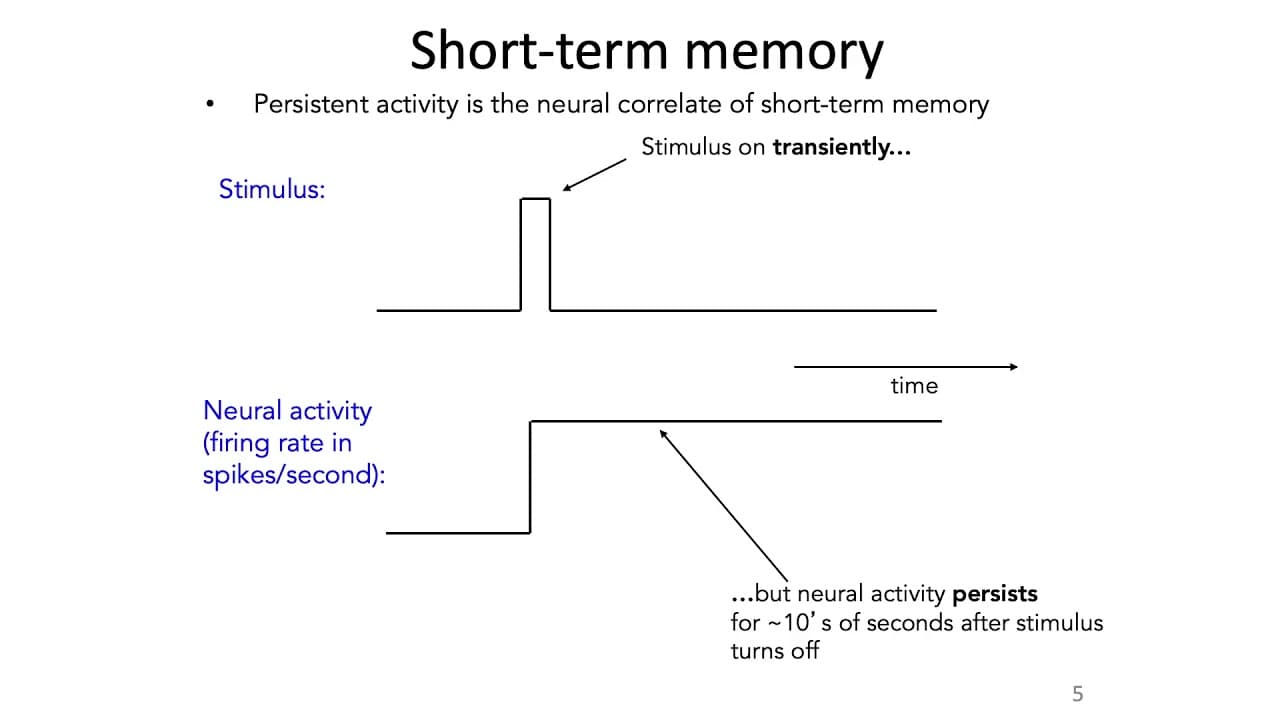
Short-term memories are believed to be associated with the persistent firing of neurons in a specific population responsible for holding that memory. On the other hand, long-term memories are thought to involve physical changes in the connections between neurons.
Q: How does the brain maintain short-term memory during a delay period?
Neurons in the prefrontal cortex exhibit persistently high firing rates during the delay period, signifying the neural basis for maintaining short-term memory. This persistent activity decreases once the animal no longer needs to remember the location.
Q: How do neural integrators integrate sensory information over time?
Neural integrators receive burst inputs, typically driven by saccades, and integrate them to produce persistent activity. The feedback connections within the network balance the intrinsic decay of the neurons, allowing the integrator to maintain a stable memory.
Q: How does the integration process in neural integrators relate to eye position control?
Neural integrators are responsible for maintaining eye position. By integrating burst inputs from saccades, the integrator produces a step in the eye position, which persists after the input is removed. This persistent activity allows the eyes to hold a specific position.
Summary & Key Takeaways
-
Short-term memory is memory that lasts a short period of time (seconds to tens of seconds) and has a small capacity, while long-term memory can last for hours, days, or even a lifetime.
-
Short-term memories involve persistent firing of neurons, while long-term memories involve physical changes in the connections between neurons.
-
A common short-term memory task involves maintaining fixation on a specific location and remembering the direction of a cue during a delay period.
-
Neural activity in prefrontal cortex neurons ramps up and maintains persistent activity during the delay period, acting as the neural basis for maintaining short-term memory.
Read in Other Languages (beta)
Share This Summary 📚
Summarize YouTube Videos and Get Video Transcripts with 1-Click
Try YouTube Summary with ChatGPT & Claude or YouTube Transcript Generator
Explore More Summaries from MIT OpenCourseWare 📚



Summarize YouTube Videos and Get Video Transcripts with 1-Click
Try YouTube Summary with ChatGPT & Claude or YouTube Transcript Generator