Safety guideline for COVID-19: Cumulative exposure time
TL;DR
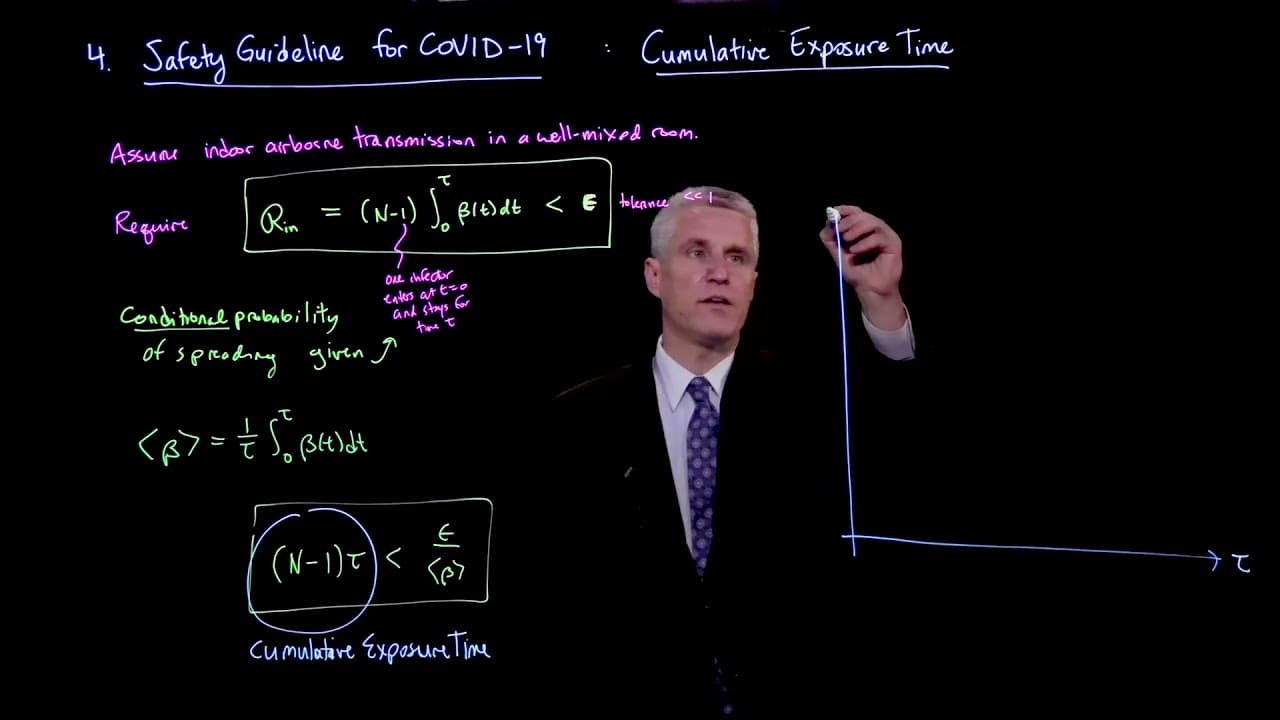
The professor discusses the need to formulate safety guidelines for indoor spaces to prevent the spread of COVID-19 based on the probability of transmission, occupancy, and time spent in the room.
Transcript
PROFESSOR: So now let's synthesize all of our models of aerosol generation and dynamics in a well-mixed indoor space and epidemiological models of spreading and transfer of disease in that space and formulate a safety guideline for COVID-19 assuming indoor airborne transmission in a well-mixed room. And so there's a number of ways we could go about... Read More
Key Insights
- 👾 Safety guidelines for COVID-19 transmission in indoor spaces should consider the probability of transmission, occupancy levels, and time spent in the room.
- ⌛ Fixed occupancy or time limits alone are not sufficient to prevent the spread of the disease effectively.
- ⌛ The concept of cumulative exposure time, which accounts for both occupancy and time, is essential in formulating comprehensive safety guidelines.
- ☠️ Safety guidelines should take into account transmission rate factors, such as ventilation, and the potential for interactions between individuals in well-mixed indoor spaces.
Install to Summarize YouTube Videos and Get Transcripts
Explore YouTube Video Summarizer or Get YouTube Transcript Extractor
Questions & Answers
Q: How does the professor propose formulating safety guidelines for COVID-19 transmission in indoor spaces?
The professor suggests that the indoor reproductive number should be less than a tolerance value, taking into account factors such as the number of infectors and the time spent in the room.
Q: How are existing safety guidelines for occupancy and time limits flawed?
Existing safety guidelines, such as fixed occupancy or time limits, do not consider transmission rate factors, occupancy levels, and the cumulative exposure time, which can lead to either overly conservative or risky situations.
Q: Why is it important to consider both occupancy and time in safety guidelines?
Considering both occupancy and time is crucial because a room with a low occupancy might still pose a risk if people stay for an extended period, and a room with a high occupancy can have a shorter transmission time due to increased interactions between individuals.
Q: How can safety guidelines be improved to effectively prevent the spread of COVID-19 in indoor spaces?
Safety guidelines should incorporate factors such as transmission rate, occupancy, time spent in the room, and ventilation to create a more comprehensive approach that minimizes the risk of transmission.
Summary & Key Takeaways
-
The professor suggests that the indoor reproductive number should be less than a tolerance value to prevent the spread of COVID-19 in well-mixed indoor spaces.
-
Safety guidelines should consider factors such as the number of infectors and the time spent in the room to control the spread of the disease effectively.
-
Existing safety guidelines, such as fixed occupancy or time limits, may be too conservative or not take into account transmission rate factors and occupancy levels.
Read in Other Languages (beta)
Share This Summary 📚
Summarize YouTube Videos and Get Video Transcripts with 1-Click
Try YouTube Summary with ChatGPT & Claude or YouTube Transcript Generator
Explore More Summaries from MIT OpenCourseWare 📚



Summarize YouTube Videos and Get Video Transcripts with 1-Click
Try YouTube Summary with ChatGPT & Claude or YouTube Transcript Generator