Products
Features
YouTube Video Summarizer
Summarize YouTube videos
Web & PDF Highlighter
Highlight web pages & PDFs
Chat with PDF
Ask any PDF questions with AI
Ask AI Clone
Chat with your highlights & memories
Audio Transcriber
Transcribe audio files to text
Glasp Reader
Read and highlight articles
Kindle Highlight Export
Export your Kindle highlights
Idea Hatch
Hatch ideas from your highlights
Integrations
Obsidian Plugin
Notion Integration
Pocket Integration
Instapaper Integration
Medium Integration
Readwise Integration
Snipd Integration
Hypothesis Integration
Apps & Extensions
Chrome Extension
Safari Extension
Edge Add-ons
Firefox Add-ons
iOS App
Android App
Discover
Discover
Ideas
Discover new ideas and insights
Articles
Curated articles and insights
Books
Book recommendations by great minds
Posts
Essays and notes from readers
Quotes
Inspiring quotes collection
Videos
Curated videos and summaries
Explore Glasp
Glasp Newsletter
Weekly insights and updates
Glasp Talk
Interview series with great minds
Glasp Blog
Latest news and articles
Glasp Use Cases
Learn how others use Glasp
Build & Support
Glasp API
Access Glasp's API for developers
MCP Connector
Connect Glasp to Claude & ChatGPT
Community
Glasp Reddit Community
Students
Student discount and benefits
FAQs
Frequently Asked Questions
AboutPricing
DashboardLog inSign up

What is a for Loop

15 views
•
August 5, 2023
by
Ekeeda
YouTube video player
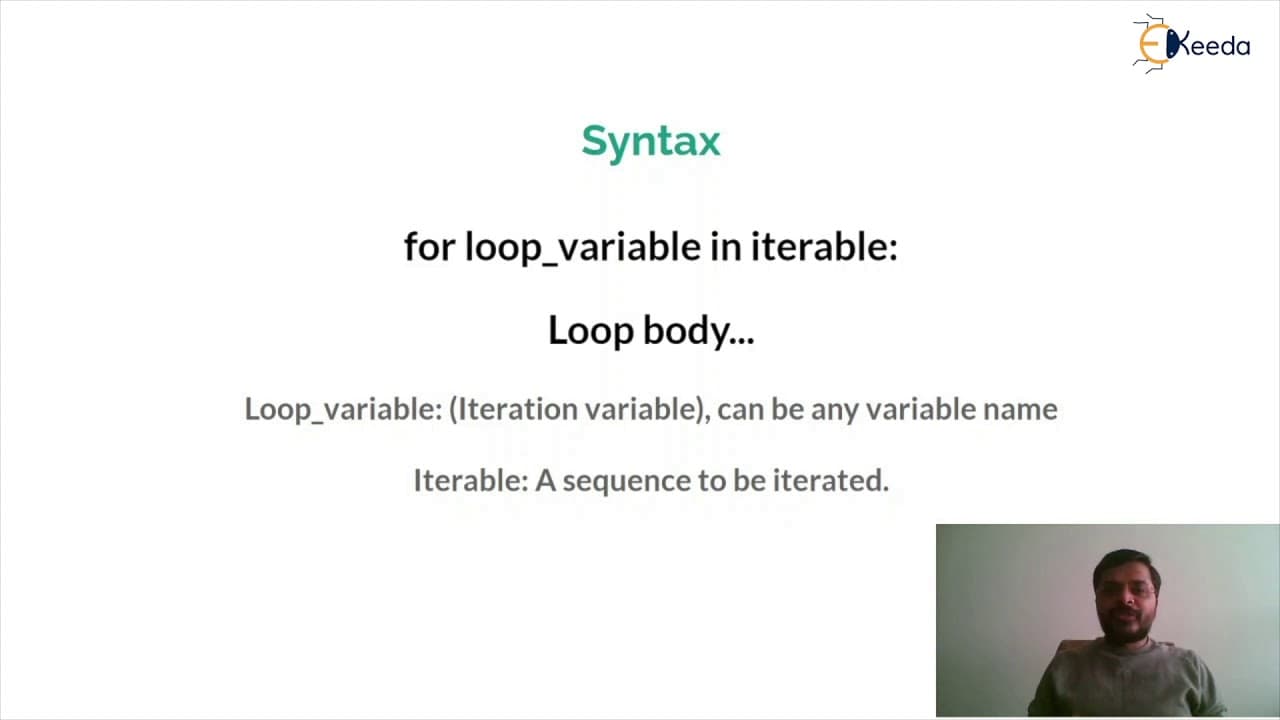
What is a for Loop

TL;DR

For loops iterate over sequences or iterables, processing each item individually.

Transcript

now let's see what is a for loop for loop is a loop that can be used to i thread over a sequence or an iterable a sequence or an iterable is an object which can return one of its elements at a time so the examples of the iterables are a sequence types like strings list tuples set it can also be a non-sequence types like dictionaries and files we wi... Read More

Key Insights

  • 🔁 For loops in Python are used to iterate over sequences or iterables by processing each item individually.
  • 🔁 The syntax of a for loop includes the for keyword, an iterable variable, and a sequence variable.
  • 🔁 For loops continue iterating until all items in the sequence or iterable have been processed.
  • 🅰️ Iterables can be sequence types like strings or non-sequence types like dictionaries and files.
  • 🔁 A for loop requires at least one item in the iterable to start processing.
  • 😒 For loops in Python use indentation to define the block of code executed for each item.
  • 🔁 Iterating over strings with a for loop processes each character individually.

Install to Summarize YouTube Videos and Get Transcripts

Explore YouTube Video Summarizer or Get YouTube Transcript Extractor

Questions & Answers

Q: What is the purpose of a for loop in Python?

A for loop in Python is used to iterate over sequences or iterables, processing each item one at a time.

Q: What is the syntax of a for loop in Python?

The syntax of a for loop includes the for keyword followed by an iterable variable, an in keyword, and the iterable or sequence variable.

Q: How does a for loop handle processing items from a sequence?

A for loop processes items from a sequence one at a time, executing a block of code for each item until all items have been processed.

Q: Can a for loop be used with non-sequence types in Python?

Yes, a for loop in Python can iterate over non-sequence types like dictionaries and files, not just sequence types like strings, lists, tuples, and sets.

Summary & Key Takeaways

  • For loops in Python iterate over sequences or iterables, executing a block of code for each item.

  • The syntax of a for loop includes the for keyword, an iterable variable, and a sequence or iterable variable.

  • Through examples with strings, the concept of iterating over individual characters using a for loop is demonstrated.


Read in Other Languages (beta)

English

Share This Summary 📚

Summarize YouTube Videos and Get Video Transcripts with 1-Click

Download browser extensions on:

Try YouTube Summary with ChatGPT & Claude or YouTube Transcript Generator

Explore More Summaries from Ekeeda 📚
Introduction to Simple Machines - Simple Machines - Engineering Mechanics thumbnail
Introduction to Simple Machines - Simple Machines - Engineering Mechanics
Ekeeda
Numerical on concept of Capillary rise thumbnail
Numerical on concept of Capillary rise
Ekeeda
Transient Response and Steady State Error Problem 1 - Time Response Analysis - Control Systems thumbnail
Transient Response and Steady State Error Problem 1 - Time Response Analysis - Control Systems
Ekeeda
Software Testing and Quality Assurance - Agile Testing | 12 November | 6 PM thumbnail
Software Testing and Quality Assurance - Agile Testing | 12 November | 6 PM
Ekeeda
Characteristics of Good Stone thumbnail
Characteristics of Good Stone
Ekeeda
Non   Homogeneous Linear Equations with Constant Coefficients thumbnail
Non Homogeneous Linear Equations with Constant Coefficients
Ekeeda

Summarize YouTube Videos and Get Video Transcripts with 1-Click

Download browser extensions on:

Try YouTube Summary with ChatGPT & Claude or YouTube Transcript Generator

Apps & Extensions

  • Chrome Extension
  • Safari Extension
  • Edge Add-ons
  • Firefox Add-ons
  • iOS App
  • Android App

Key Features

  • YouTube Video Summarizer
  • Web & PDF Summarizer
  • Web & PDF Highlighter
  • Chat with PDF
  • Ask AI Clone
  • Audio Transcriber
  • Glasp Reader
  • Kindle Highlight Export
  • Idea Hatch

Integrations

  • Obsidian Plugin
  • Notion Integration
  • Pocket Integration
  • Instapaper Integration
  • Medium Integration
  • Readwise Integration
  • Snipd Integration
  • Hypothesis Integration

More Features

  • APIs
  • MCP Connector
  • Blog & Post
  • Embed Links
  • Image Highlight
  • Personality Test
  • Quote Shots

Company

  • About us
  • Blog
  • Community
  • FAQs
  • Job Board
  • Newsletter
  • Pricing
Terms

•

Privacy

•

Guidelines

© 2026 Glasp Inc. All rights reserved.