DC Motor | Separately excited | Types of DC Machines | Lec-20
TL;DR
Separately excited DC motors convert electrical energy to mechanical energy, detailing input-output relationships and efficiency.
Transcript
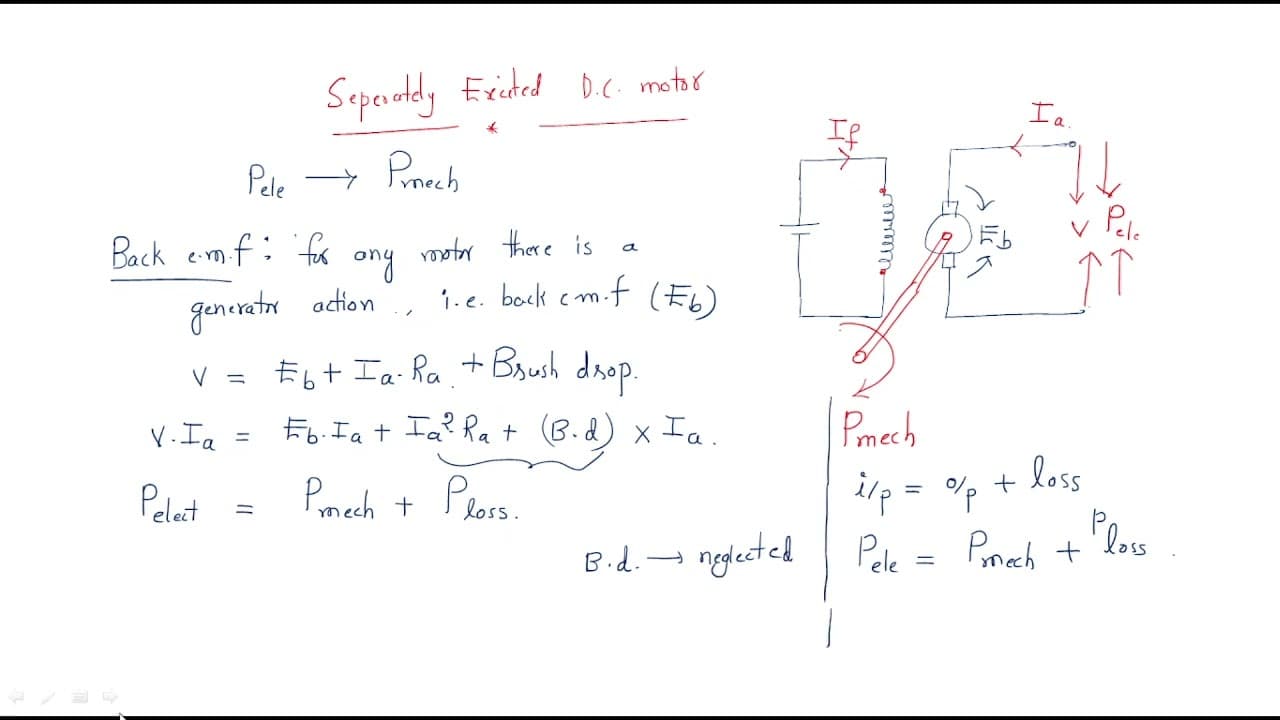
hello everyone in this session we will discuss about the separately excited dc motor in the last session we discussed about the separately excited bc generator okay so generally you know normal motor operation any dc motor you should take some electrical input and you should give some mechanical output so for the purpose for that purpose so it will... Read More
Key Insights
- 🧑🦼 Separately excited DC motors utilize external excitation for effective operation, differentiating them from other motor types.
- 🧑🦼 The back emf is a critical component, influencing current flow and efficiency while demonstrating a generator-like behavior in the motor.
- 👻 Understanding the input-output relationship allows for better performance analysis, with explicit equations illustrating the electrical and mechanical power dynamics.
- 🌸 Losses, particularly copper losses and brush drops, can significantly impact motor efficiency, urging focus on minimizing them.
- ✊ Achieving maximum mechanical power requires balancing armature current with supply voltage, illustrating the mathematical underpinnings of motor efficiency.
- 🧑🦼 The efficiency of separately excited DC motors can reach 50% at maximum mechanical power, emphasizing the importance of optimal conditions in motor design and application.
- ✊ Both input and output power calculations are vital to understanding motor operations and ensuring proper applications in engineering contexts.
Install to Summarize YouTube Videos and Get Transcripts
Explore YouTube Video Summarizer or Get YouTube Transcript Extractor
Questions & Answers
Q: What is the function of a separately excited DC motor?
A separately excited DC motor transforms electrical energy into mechanical energy by utilizing an external power supply to create a magnetic field. By applying voltage, electrical current generates a rotating magnetic flux, which in turn causes the motor's shaft to rotate, producing mechanical output. This type of motor provides precise control over speed and torque.
Q: How does back emf influence the performance of a DC motor?
Back emf is crucial for motor operation as it represents the voltage generated by the rotating armature. It opposes the applied voltage and affects the current flowing through the motor. Understanding back emf helps in analyzing motor efficiency, losses, and ensuring optimal operation, particularly since it varies with armature speed.
Q: What are the losses associated with separately excited DC motors?
Operators must consider various losses, including copper losses, which occur due to the resistance encountered by the armature current, and brush drop losses associated with the brushes in the motor. These losses reduce overall efficiency and should be mitigated for optimal motor performance.
Q: How is the maximum mechanical power developed determined in a DC motor?
The maximum mechanical power is found by differentiating the mechanical power output concerning armature current and setting the derivative to zero. This approach establishes the optimal armature current condition, leading to a mechanical power output expressed as v^2/4r_a, illustrating the relation between electrical input and mechanical output.
Summary & Key Takeaways
-
Separately excited DC motors rely on external excitation to generate the magnetic field, facilitating electrical input transformation into mechanical output. The armature current, voltage, and field excitation play crucial roles in motor functionality.
-
The relationship between supply voltage, back emf, and armature current is vital for understanding motor performance. The derived equations highlight input power, output power, and losses associated with the motor's operation, such as copper loss.
-
The conditions for achieving maximum mechanical power output involve differentiating mechanical power with respect to armature current, revealing the optimal armature current to maximize efficiency, estimated at 50%.
Read in Other Languages (beta)
Share This Summary 📚
Summarize YouTube Videos and Get Video Transcripts with 1-Click
Try YouTube Summary with ChatGPT & Claude or YouTube Transcript Generator