12. Testing Goodness of Fit (cont.)
TL;DR
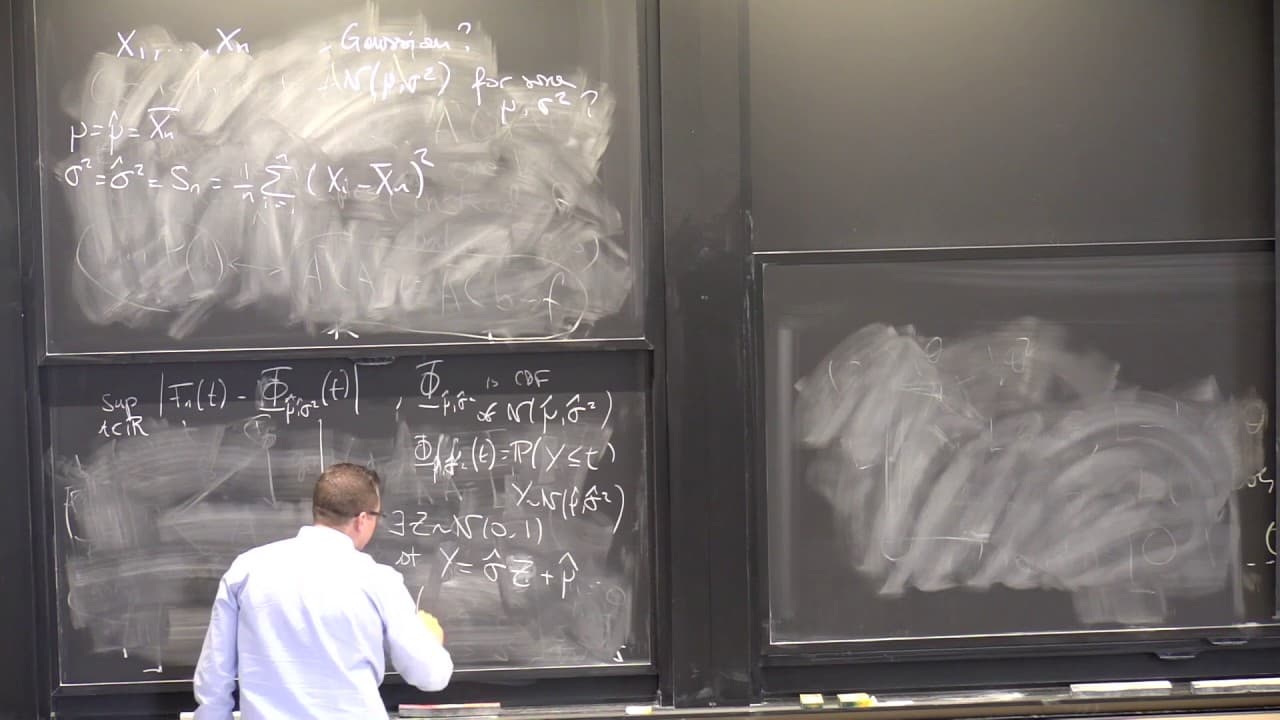
Goodness-of-fit tests are used to determine if data comes from a specific distribution. QQ plots are visual tools used to compare empirical data to a specific distribution.
Transcript
The following content is provided under a Creative Commons license. Your support will help MIT OpenCourseWare continue to offer high-quality educational resources for free. To make a donation or to view additional materials from hundreds of MIT courses, visit MIT OpenCourseWare at ocw.mit.edu. PHILIPPE RIGOLLET: We're talking about goodness-of-fit ... Read More
Key Insights
- 🏆 Goodness-of-fit tests help determine if data conforms to a particular distribution.
- ❓ QQ plots visually compare empirical quantiles to theoretical quantiles and assist in assessing data fit.
- 🙂 QQ plots can help identify if data has light or heavy tails compared to a reference distribution.
- 🏆 The choice of goodness-of-fit test depends on the specific data and the distribution being tested.
Install to Summarize YouTube Videos and Get Transcripts
Explore YouTube Video Summarizer or Get YouTube Transcript Extractor
Questions & Answers
Q: What do goodness-of-fit tests test for?
Goodness-of-fit tests determine if data comes from a specific distribution, such as the uniform distribution or the normal distribution.
Q: What is the most widely used goodness-of-fit test?
The Kolmogorov-Smirnov test is the most commonly used goodness-of-fit test, comparing the observed data to a theoretical distribution.
Q: How are QQ plots used in assessing data fit?
QQ plots compare empirical quantiles to theoretical quantiles, helping determine if data fits a particular distribution. They provide a visual diagnostic of how data deviates from the reference distribution.
Q: How do you determine if a distribution has light or heavy tails from a QQ plot?
In a QQ plot, if the empirical quantiles are above the theoretical quantiles in the tails, it indicates that the tails are lighter than the reference distribution. If the empirical quantiles are below the theoretical quantiles, it indicates that the tails are heavier.
Q: What is the relationship between the percentiles of a distribution and the quantiles in a QQ plot?
The percentiles of a distribution correspond to the quantiles in a QQ plot. For example, the 95th percentile corresponds to the 95th quantile in a QQ plot.
Q: How can a QQ plot help determine if data follows a specific distribution?
A QQ plot provides a visual comparison of empirical quantiles to theoretical quantiles. If the points in the QQ plot are close to the 45-degree line, it suggests that the data follows the reference distribution. If the points deviate significantly, it suggests a departure from the reference distribution.
Summary & Key Takeaways
-
Goodness-of-fit tests are used to determine if data follows a particular distribution, such as testing if zodiac signs of Fortune 500 CEOs are uniformly distributed.
-
The most widely used goodness-of-fit test is the Kolmogorov-Smirnov test, which compares the observed data to a theoretical distribution.
-
QQ plots are visual tools that compare empirical quantiles to theoretical quantiles, helping assess if data fits a distribution.
Read in Other Languages (beta)
Share This Summary 📚
Summarize YouTube Videos and Get Video Transcripts with 1-Click
Try YouTube Summary with ChatGPT & Claude or YouTube Transcript Generator
Explore More Summaries from MIT OpenCourseWare 📚



Summarize YouTube Videos and Get Video Transcripts with 1-Click
Try YouTube Summary with ChatGPT & Claude or YouTube Transcript Generator