What is a Process in an Operating System?
TL;DR
Processes in operating systems are units of work, representing programs loaded into memory, with different states and managed by the operating system for task execution.
Transcript
all right so in this first lecture we're going to see what actually is a process in an operating system so first if we take a look on the conceptual architecture of a computer we know that at the bottom we got the hardware which contains the cpu the memory and devices like peripherals and other external components on top of that we got the first so... Read More
Key Insights
- ❓ The operating system is a complex component responsible for various tasks, with task management being one of the crucial responsibilities.
- 💦 Processes are units of work represented as instances of programs in memory, managed by the operating system.
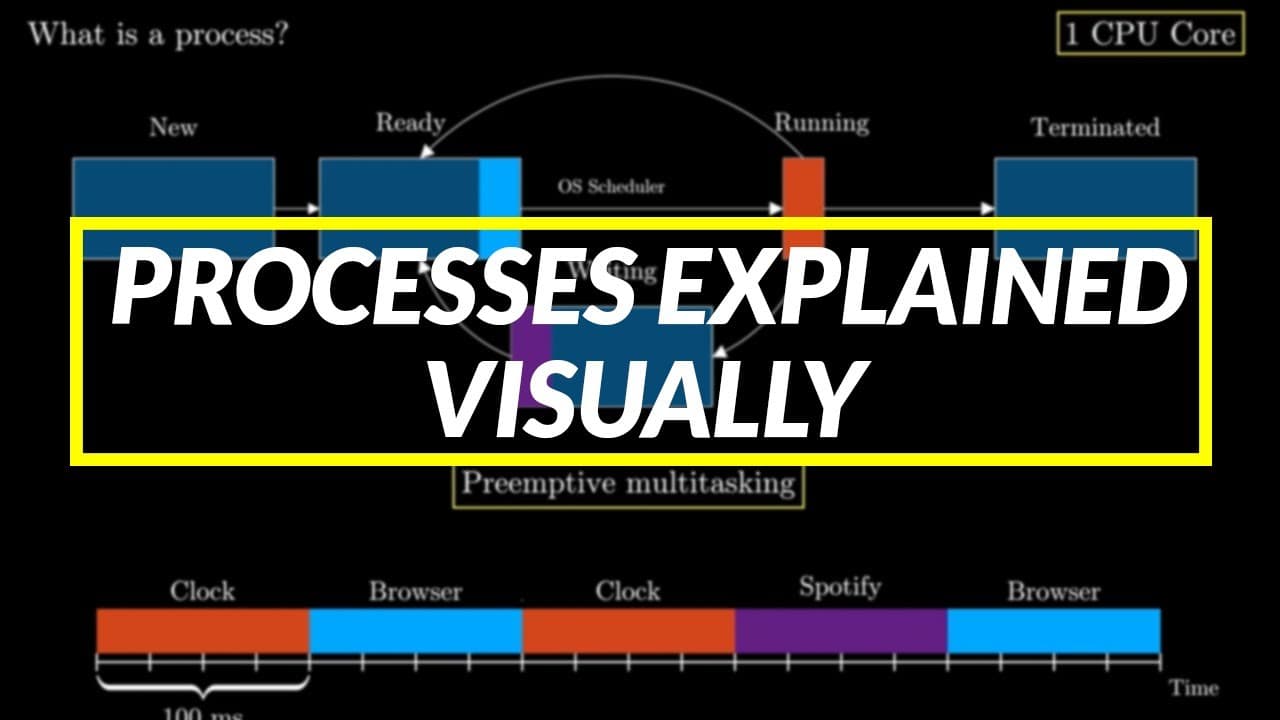
- 👶 Processes transition through different states, including new, ready, running, waiting, and terminated.
- ❓ The scheduler component of the operating system selects processes from the ready state for execution on the CPU.
- 👻 Preemptive multitasking allows multiple processes to be executed in parallel, improving system throughput but requiring a trade-off between responsiveness and performance.
- ⌛ Time slices are assigned to processes to limit their execution time on the CPU, facilitating fairness and multitasking.
- 💱 Context switching is the operation of changing processes on the CPU, with its impact on performance explored in subsequent lectures.
Install to Summarize YouTube Videos and Get Transcripts
Explore YouTube Video Summarizer or Get YouTube Transcript Extractor
Questions & Answers
Q: What is a process in an operating system?
A process is an instance of a program loaded into memory, representing a unit of work. It contains information about the execution of a particular program and can transition through different states.
Q: What is the role of the operating system in managing processes?
The operating system is responsible for creating and managing process objects, selecting processes for execution through the scheduler, and transitioning processes between different states based on their needs and availability of resources.
Q: How does preemptive multitasking work in handling multiple processes?
Preemptive multitasking assigns a time limit, known as a time slice, to each process, allowing small parts of processes to be executed at different times. It ensures responsiveness in user-oriented systems by allowing other processes to use the CPU while preventing a single process from monopolizing the resources.
Q: What information is stored in a process control block?
The process control block contains the current state of the process, a unique ID, privileges, pointers to the next instruction, data stored in CPU registers, scheduling information, memory allocation details, the parent process pointer, and information about file descriptors used.
Summary & Key Takeaways
-
An operating system sits between the hardware and applications layer in a computer, responsible for managing processes, including task management.
-
A process is an instance of a program loaded into memory, with different states such as new, ready, running, waiting, and terminated.
-
The scheduler component of the operating system selects processes from the ready state and places them on the CPU for execution.
Read in Other Languages (beta)
Share This Summary 📚
Summarize YouTube Videos and Get Video Transcripts with 1-Click
Try YouTube Summary with ChatGPT & Claude or YouTube Transcript Generator
Explore More Summaries from Visual Computer Science 📚
Summarize YouTube Videos and Get Video Transcripts with 1-Click
Try YouTube Summary with ChatGPT & Claude or YouTube Transcript Generator