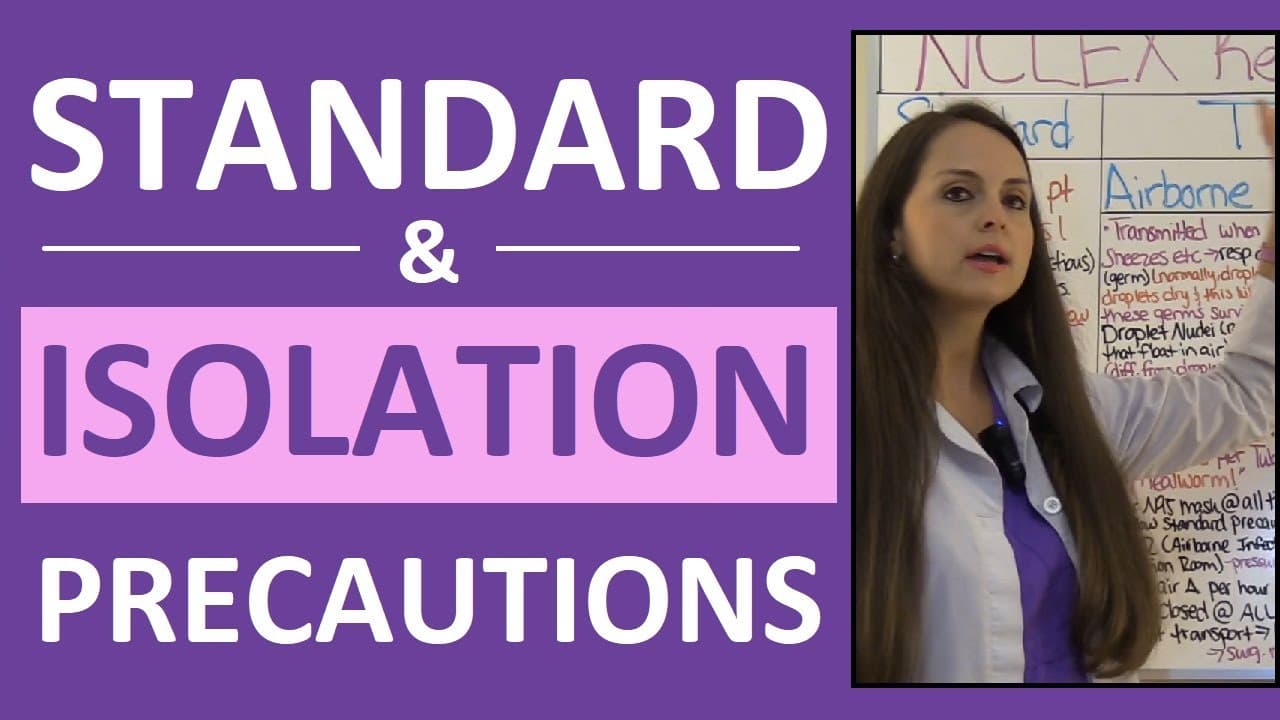
Standard & Isolation Precautions Nursing | Infection Control Contact, Droplet, Airborne PPE NCLEX
TL;DR
This video provides a comprehensive review of standard precautions and transmission-based precautions, including the diseases included in each category and the necessary personal protective equipment (PPE) for each.
Transcript
hey everyone is stares red sterner sorry and calm and in this video I'm going to be doing an inkless review over precautions specifically standard precautions and transmission based precautions and as always in the youtube description below or at the end of this video you can access the quiz that will test your knowledge on precautions so let's get... Read More
Key Insights
- ❓ Standard precautions are essential for all patients to prevent the spread of infection.
- 🛩️ Airborne diseases are transmitted through small respiratory droplets that remain in the air, requiring healthcare workers to wear an N95 mask and for the patient to be in a specially ventilated room.
- 💦 Droplet diseases are transmitted through large respiratory droplets, and healthcare workers should wear a surgical mask when providing care.
- 📁 Contact precautions are necessary for diseases transmitted through direct or indirect contact with the patient or their environment.
- 🤗 Hand hygiene is crucial in preventing the spread of infection, and soap and water should be used in specific instances.
- 🧑⚕️ Different diseases require different types of personal protective equipment (PPE) to ensure the safety of healthcare workers.
- ❓ Patients with chickenpox and disseminated herpes zoster require both airborne and contact precautions.
- 🏥 It is important to follow the appropriate precautions and protocols when transporting patients to other areas of the hospital.
Install to Summarize YouTube Videos and Get Transcripts
Explore YouTube Video Summarizer or Get YouTube Transcript Extractor
Questions & Answers
Q: What are standard precautions?
Standard precautions are a set of measures taken for every patient to protect healthcare workers and other patients. They include hand hygiene, wearing appropriate PPE, and following safety practices.
Q: How are airborne diseases transmitted?
Airborne diseases are transmitted through respiratory droplets that contain germs. Unlike droplet precautions, these droplets do not dry out and can remain in the air for inhalation. Examples of airborne diseases include chickenpox, tuberculosis, and disseminated herpes zoster.
Q: What personal protective equipment (PPE) is required for airborne precautions?
For airborne precautions, healthcare workers should wear an N95 mask at all times. This mask is necessary because the particles from airborne diseases are very small and can easily be inhaled.
Q: What diseases are included in droplet precautions?
Droplet precautions are used for diseases that are transmitted through large respiratory droplets, such as flu, meningococcal disease, whooping cough, scarlet fever, and German measles. Healthcare workers should always wear a surgical mask when providing care to patients in droplet precautions.
Summary & Key Takeaways
-
The video discusses the importance of standard precautions, which are necessary for all patients, and transmission-based precautions, which are added for patients with infectious diseases.
-
Standard precautions include hand hygiene, wearing appropriate PPE, injection safety practices, environmental cleaning, and respiratory hygiene.
-
Transmission-based precautions include airborne precautions for diseases like chickenpox, droplet precautions for diseases like whooping cough, and contact precautions for medication-resistant diseases and certain infections.
Read in Other Languages (beta)
Share This Summary 📚
Summarize YouTube Videos and Get Video Transcripts with 1-Click
Try YouTube Summary with ChatGPT & Claude or YouTube Transcript Generator
Explore More Summaries from RegisteredNurseRN 📚




Summarize YouTube Videos and Get Video Transcripts with 1-Click
Try YouTube Summary with ChatGPT & Claude or YouTube Transcript Generator