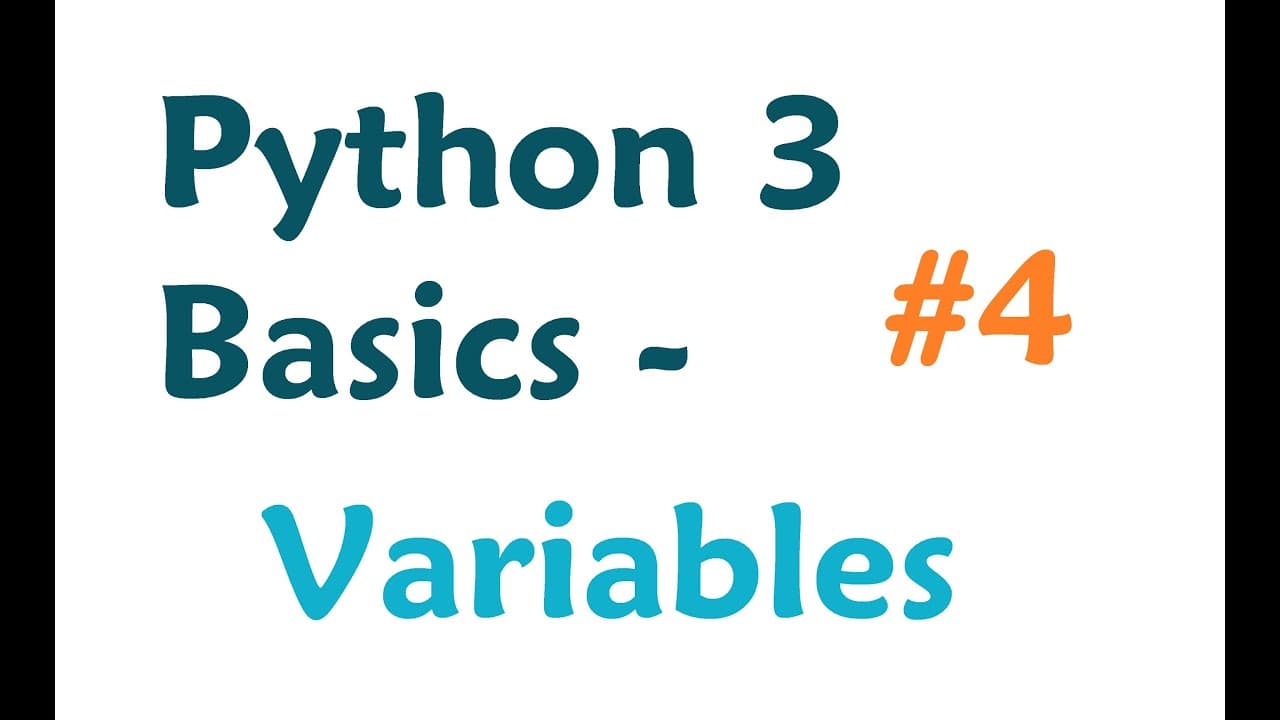
Python 3 Programming Tutorial: Variables
TL;DR
Learn about variables in Python 3, essential placeholders for data, with examples and tips for usage.
Transcript
hello everybody and welcome to my variables in Python 3 tutorial video in this video I will teach you guys about and girls about variables which you will quickly find yourself using extremely frequently pretty much in every single program you ever write variables act uh as a placeholder for whatever you place in them and they can be changed so they... Read More
Key Insights
- 💁 Variables in Python serve as placeholders for data and can store various types of information.
- 👲 Different naming conventions like camel casing or all caps with underscores can be used for variables.
- 🏪 Variables can store values, perform operations, and even contain functions.
- 👻 Variable unpacking in Python allows for efficient assignment of multiple values in one go.
- #️⃣ It is essential to unpack the same number of variables as there are elements in the sequence to avoid errors.
- ❓ Understanding variables is crucial for programming in Python and is a fundamental concept to grasp.
- 👨💻 Using variables properly can make code more readable, efficient, and maintainable.
Install to Summarize YouTube Videos and Get Transcripts
Explore YouTube Video Summarizer or Get YouTube Transcript Extractor
Questions & Answers
Q: What is the purpose of variables in Python?
In Python, variables act as containers to store data values. They provide a way to reference and manipulate data throughout a program, making code more dynamic and flexible.
Q: How can variables be defined in Python?
Variables in Python are defined by assigning a value to a name using the "=" operator. Different conventions like camel casing or all caps with underscores can be used.
Q: Can variables in Python store more than just values?
Yes, variables in Python can store not only simple values but also perform operations or even contain functions, making them versatile elements in programming.
Q: What is variable unpacking in Python?
Variable unpacking in Python allows you to assign multiple variables at once by unpacking a sequence like a list. It is essential to unpack the same number of variables as there are elements in the sequence to avoid errors.
Summary & Key Takeaways
-
Variables in Python act as placeholders for data and can be changed.
-
They can be defined using camel casing or other conventions.
-
Variables can store values, perform operations, and even contain functions.
Read in Other Languages (beta)
Share This Summary 📚
Summarize YouTube Videos and Get Video Transcripts with 1-Click
Try YouTube Summary with ChatGPT & Claude or YouTube Transcript Generator
Explore More Summaries from sentdex 📚
Summarize YouTube Videos and Get Video Transcripts with 1-Click
Try YouTube Summary with ChatGPT & Claude or YouTube Transcript Generator