What Does the 1775 Bible Reveal About Our Calendar?
TL;DR
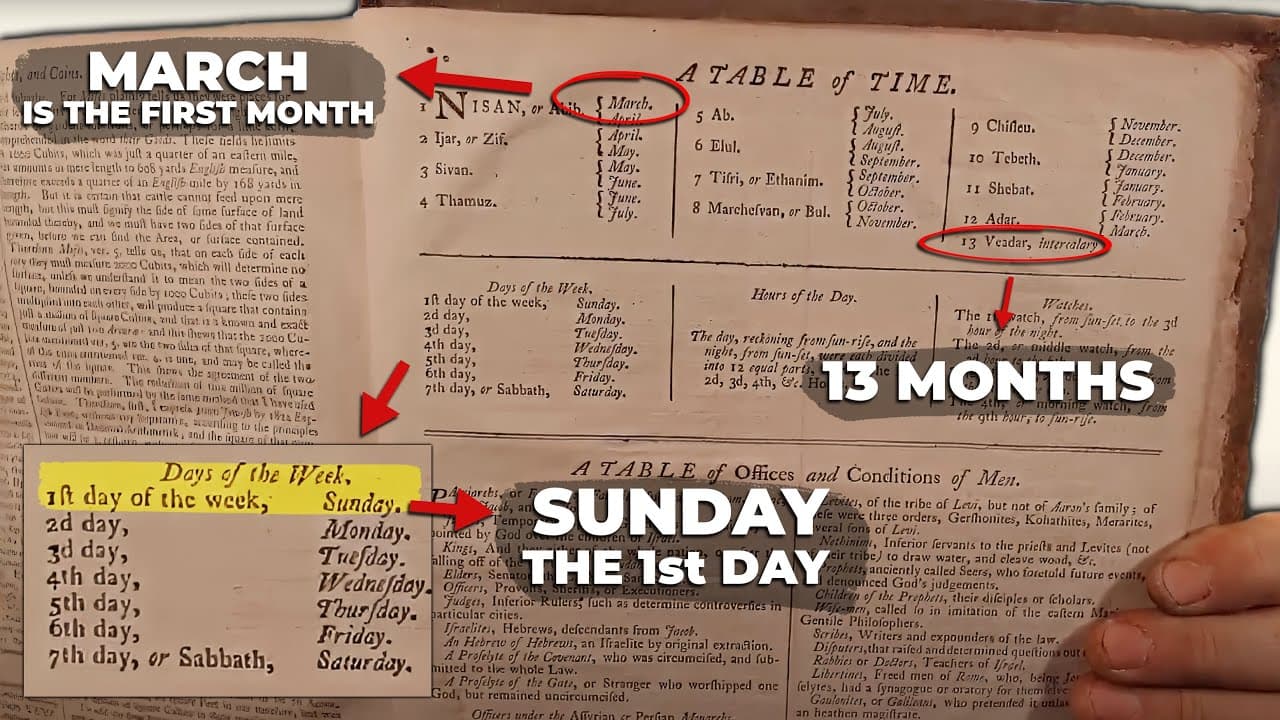
The 1775 Bible asserts that March is the first month of the year and identifies Sunday as the week's starting day, challenging present-day calendar norms. This suggests that many modern holidays, like Christmas and Easter, do not align with their original seasonal contexts, inviting a reevaluation of how we observe time in relation to ancient traditions.
Transcript
this 1775 Bible shows that March is actually the first month of the year and Sunday Yes you heard right is the first day of the week take a look and so this right here is the Bible from 1775 telling us at the time that we used to have 13 months the first month of the year is March look it all the way to the end guys there's 13 months 13 months firs... Read More
Key Insights
- 🥠 The 1775 Bible promotes a radically different perception of time, suggesting a calendar arrangement that is potentially more in tune with natural cycles.
- 🈷️ Recognizing March as the first month aligns with the vernal equinox, underscoring the importance of seasonal shifts in ancient agricultural societies.
- 🛟 The concept of a 13-month calendar reflects a lunar-based structure that may have been intentionally obscured to mitigate pagan influences on contemporary life.
- 🫵 Historical calendars were deeply intertwined with celestial movements, indicating that early civilizations viewed time as a direct reflection of cosmic rhythms.
- 🍻 Revisiting the timing of holidays like Christmas can reveal alternative spiritual narratives linked to ancient traditions.
- 🥺 The unexamined impact of shifting calendars could lead to a disconnect from natural rhythms, affecting societal practices like agriculture and spiritual observances.
- ⌛ The complexities of the transition from lunar to solar calendars demonstrate significant changes mandated by authorities, influencing how time is perceived today.
Install to Summarize YouTube Videos and Get Transcripts
Explore YouTube Video Summarizer or Get YouTube Transcript Extractor
Questions & Answers
Q: What evidence does the 1775 Bible provide regarding the calendar's structure?
The 1775 Bible presents a calendar where March is the first month and the year consists of 13 months. This challenges the modern understanding of time and highlights a connection to lunar cycles, implying that historical societies had a different relationship with the celestial patterns that governed their agricultural and spiritual lives.
Q: How does the idea of Sunday as the first day of the week impact contemporary religious practices?
If Sunday is recognized as the first day of the week according to the 1775 Bible, it prompts a reevaluation of traditional worship practices, which commonly observe Saturday as the Sabbath. This suggests that contemporary customs may not align with historical beliefs, potentially disrupting established routines in religious observance.
Q: What implications does the 1775 Bible have for celebrated holidays like Christmas?
The calendar proposed in the 1775 Bible questions the traditional December 25th date for Christmas. If a spring birth of Jesus aligns with the vernal equinox, it challenges the historical narrative around Christmas and its connection to pagan and agricultural cycles, suggesting a deeper spiritual significance that has been overlooked.
Q: What historical reasons contributed to the transition from a 13-month calendar to a 12-month Gregorian calendar?
The shift to a 12-month calendar was influenced by political and practical needs as Roman society became more complex. The need for a uniform system to manage agricultural cycles and taxation led to the adoption of the Gregorian calendar, which may have deliberately distanced itself from lunar associations that were often linked to pagan traditions.
Summary & Key Takeaways
-
The 1775 Bible indicates a 13-month calendar where March is the first month of the year, proposing a significant shift from the modern Gregorian calendar.
-
The identification of Sunday as the first day of the week challenges conventional religious observance and prompts a reconsideration of how we align with historical and celestial rhythms.
-
The exploration of this biblical calendar raises questions about the timing of modern holidays, particularly Christmas and Easter, and their alignment with ancient traditions and natural cycles.
Read in Other Languages (beta)
Share This Summary 📚
Summarize YouTube Videos and Get Video Transcripts with 1-Click
Try YouTube Summary with ChatGPT & Claude or YouTube Transcript Generator
Explore More Summaries from Video Advice 📚




Summarize YouTube Videos and Get Video Transcripts with 1-Click
Try YouTube Summary with ChatGPT & Claude or YouTube Transcript Generator