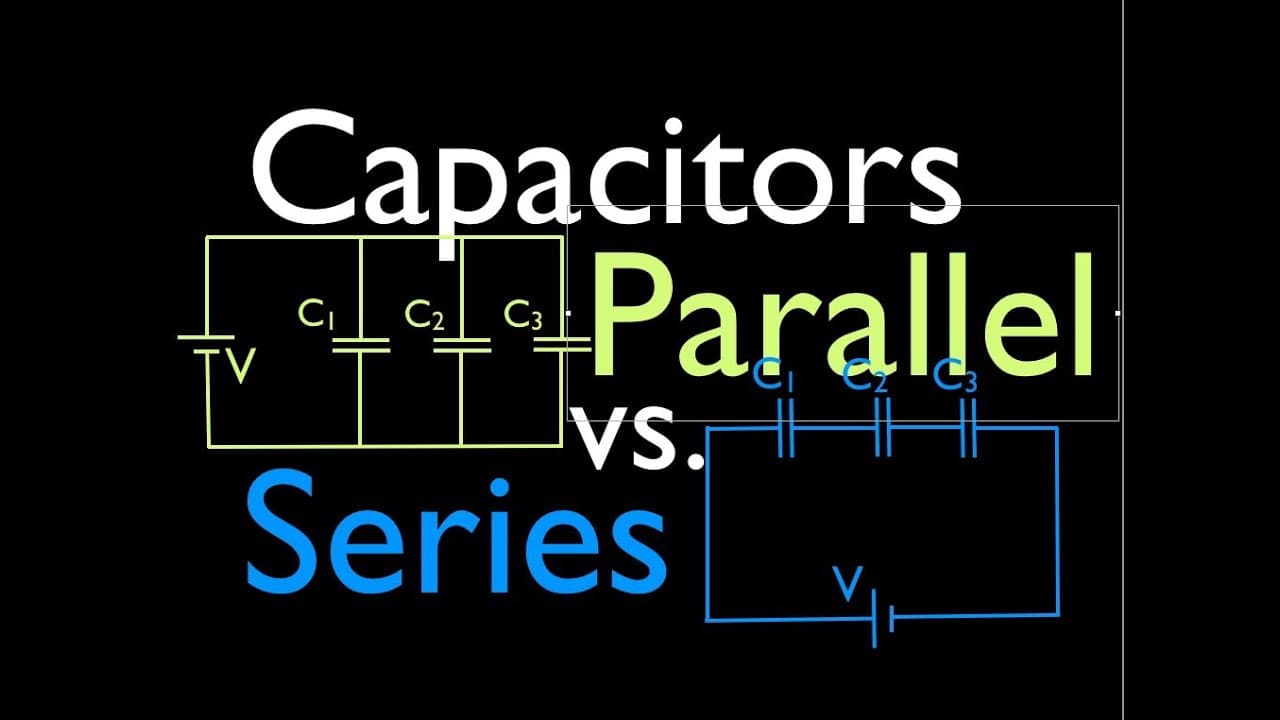
Capacitors (1 of 11) Series vs Parallel Circuits
TL;DR
Rules for charge and voltage in parallel and series capacitors explained with equations and examples.
Transcript
okay in today's video I am going to go over the rules for parallel in series capacitors all right now I'm not going to give an explanation about what the rules and the equations are I'm just going to state them and kind of point out how they are opposites of each other okay I made videos for each of these we are going to go through the charge we ar... Read More
Key Insights
- 🈂️ Parallel capacitors: Total charge is the sum of individual charges.
- 🈂️ Series capacitors: Total charge is the same across all capacitors.
- ⚡ Parallel capacitors: Voltage is equal across all capacitors.
- ⚡ Series capacitors: Total voltage is distributed across each capacitor.
- 🪜 Equivalent capacitance in parallel: Add individual capacitances for total capacitance.
- 🍹 Equivalent capacitance in series: Reciprocal sum of individual capacitances for total capacitance.
- 🈂️ Charge equation (Q=CV) applies to both parallel and series capacitors.
Install to Summarize YouTube Videos and Get Transcripts
Explore YouTube Video Summarizer or Get YouTube Transcript Extractor
Questions & Answers
Q: What are the key differences between charge rules for parallel and series capacitors?
In parallel capacitors, the total charge is the sum of individual charges, while in series capacitors, the total charge is the same across all capacitors.
Q: How does voltage behave in parallel and series capacitor setups?
In parallel capacitors, the voltage is equal across all capacitors, whereas in series capacitors, the total voltage is spread across each capacitor.
Q: How do you calculate total capacitance in parallel and series capacitor configurations?
Total capacitance in parallel capacitors is the sum of individual capacitances, while in series capacitors, it involves the reciprocal sum of individual capacitances.
Q: Can the charge equation be used for both parallel and series capacitors?
Yes, the charge equation Q=CV can be applied to both parallel and series capacitors, similar to how Ohm's law applies to resistors.
Summary & Key Takeaways
-
Explains rules for charge and voltage in parallel and series capacitors.
-
Demonstrates how total charge and voltage differ in parallel and series setups.
-
Provides equations for calculating equivalent capacitance in parallel and series configurations.
Read in Other Languages (beta)
Share This Summary 📚
Summarize YouTube Videos and Get Video Transcripts with 1-Click
Try YouTube Summary with ChatGPT & Claude or YouTube Transcript Generator
Explore More Summaries from Step by Step Science 📚

Summarize YouTube Videos and Get Video Transcripts with 1-Click
Try YouTube Summary with ChatGPT & Claude or YouTube Transcript Generator