Equivalent Fractions
TL;DR
Learn how to find missing numbers in equivalent fractions by identifying patterns and using multiplication and division.
Transcript
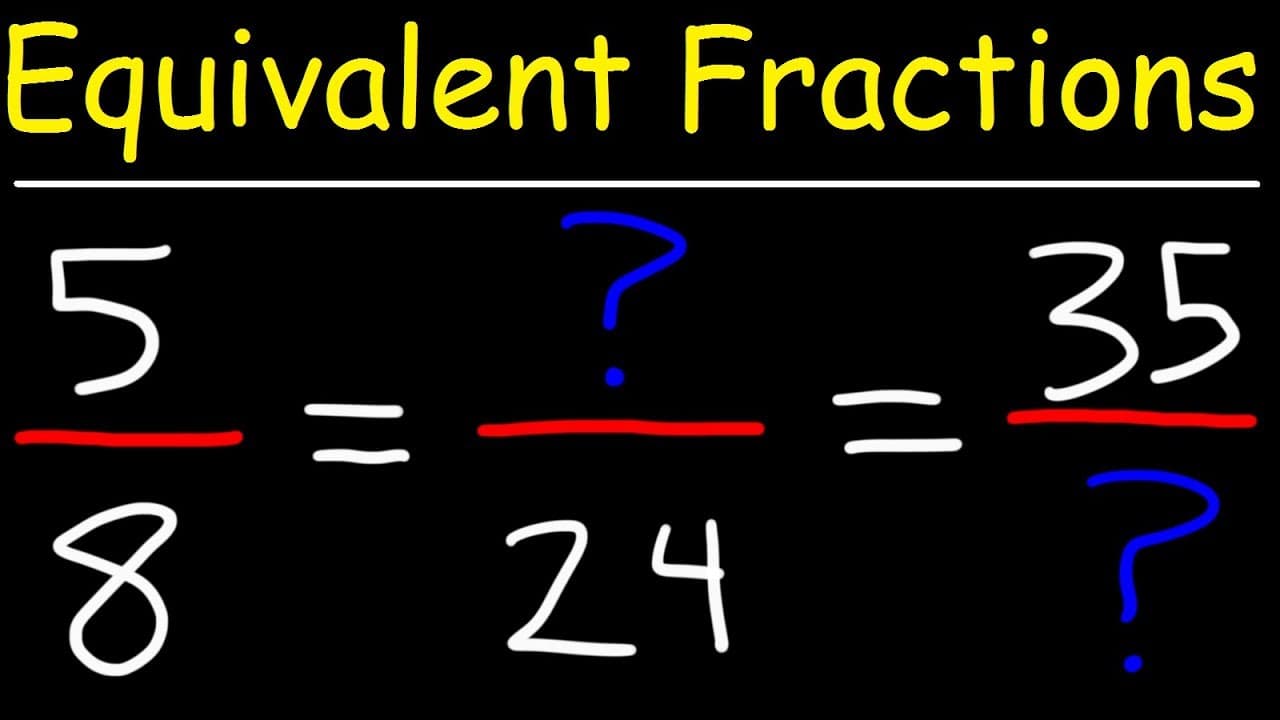
in this video we're going to focus on equivalent fractions equivalent fractions have the same value but they're represented by different numbers so let me give you an example so let's say if we have the fraction three over four and we wish to find an equivalent fraction with a denominator of eight what is the numerator of this equivalent fraction w... Read More
Key Insights
- ❓ Equivalent fractions have the same value but different representations.
- 🗂️ To find an equivalent fraction, multiply the numerator by the quotient of the desired denominator divided by the original denominator.
- #️⃣ When finding a missing number, divide the known numbers in the fractions and use the resulting quotient to find the missing number.
- 😵 The value of a variable in equivalent fractions can be determined using cross multiplication.
- 💪 Developing a strong understanding of equivalent fractions helps with solving mathematical problems.
- ✖️ Multiplying the numerator and denominator of a fraction by the same nonzero number results in an equivalent fraction.
- ➗ Division is used to find missing numbers in equivalent fractions.
Install to Summarize YouTube Videos and Get Transcripts
Explore YouTube Video Summarizer or Get YouTube Transcript Extractor
Questions & Answers
Q: What are equivalent fractions?
Equivalent fractions have the same value but are represented by different numbers. For example, 3/4 and 6/8 are equivalent fractions.
Q: How can we find an equivalent fraction with a specific denominator?
Multiply the numerator of the original fraction by the quotient of the desired denominator divided by the original denominator. For example, to find an equivalent fraction of 3/4 with a denominator of 8, multiply 3 by 2 to get 6, resulting in 6/8.
Q: How do we find a missing number that will make two fractions equivalent?
Divide the known numbers in the fractions and use the resulting quotient to determine the missing number. For example, if 5 times what number is 15, divide 15 by 5 to get 3. Then, multiply 6 by 3 to find the missing number of 18.
Q: How can we calculate the value of a variable in equivalent fractions?
Use the process of cross multiplication. Multiply the known fraction by the unknown variable and set it equal to the product of the other known fractions. Solve for the variable by dividing both sides of the equation by the coefficient of the variable.
Summary & Key Takeaways
-
Equivalent fractions have the same value but are represented by different numbers.
-
To find an equivalent fraction with a given denominator, multiply the numerator by the quotient of the desired denominator and the original denominator.
-
To find a missing number that will make two fractions equivalent, divide the known numbers and use the resulting quotient to determine the missing number.
Read in Other Languages (beta)
Share This Summary 📚
Summarize YouTube Videos and Get Video Transcripts with 1-Click
Try YouTube Summary with ChatGPT & Claude or YouTube Transcript Generator
Explore More Summaries from The Organic Chemistry Tutor 📚


Summarize YouTube Videos and Get Video Transcripts with 1-Click
Try YouTube Summary with ChatGPT & Claude or YouTube Transcript Generator