What Are the Key Metrics for Binary Classification?
TL;DR
The key metrics for binary classification include accuracy, precision, recall, F1 score, AUC, and log loss. Accuracy measures correct predictions; precision quantifies true positives against total predicted positives; recall captures true positives among actual positives; F1 score balances precision and recall; AUC assesses model performance in distinguishing classes, while log loss evaluates probability prediction accuracy. These metrics can be implemented easily using scikit-learn.
Transcript
hello everyone and welcome to another episode of my applied machine learning series in this episode I'm going to talk about binary classification metrics and then we are going to implement them in our machine learning framework that we are building so to start with in binary classification I mean there are many metrics but most important ones are s... Read More
Key Insights
- 💯 Binary classification metrics, such as accuracy, precision, recall, F1 score, AUC, and log loss, are essential for evaluating model performance.
- 💄 These metrics can be calculated using scikit-learn functions, making implementation easier.
- 🧑💻 AUC represents how well a model distinguishes between positive and negative samples, while log loss measures the accuracy of probability predictions.
- 📈 Implementing a custom classification metrics class allows for flexibility in using different metrics and libraries.
Install to Summarize YouTube Videos and Get Transcripts
Explore YouTube Video Summarizer or Get YouTube Transcript Extractor
Questions & Answers
Q: What is the definition of accuracy in binary classification?
Accuracy is the ratio of correct predictions to the total number of samples. It can be calculated as (true positives + true negatives) / (true positives + true negatives + false positives + false negatives).
Q: How is precision calculated in binary classification?
Precision measures how precise the model is in predicting positive instances. It is calculated as true positives / (true positives + false positives). Higher precision indicates fewer false positives.
Q: What is the importance of recall in binary classification?
Recall measures the ability of the model to find all positive instances. It is calculated as true positives / (true positives + false negatives). Higher recall indicates fewer false negatives.
Q: How is the F1 score calculated and what does it represent in binary classification?
The F1 score is a weighted average of precision and recall. It is calculated as 2 * (precision * recall) / (precision + recall). The F1 score considers both false positives and false negatives and provides a single metric to evaluate the model's performance.
Q: Can you explain the concept of AUC in binary classification?
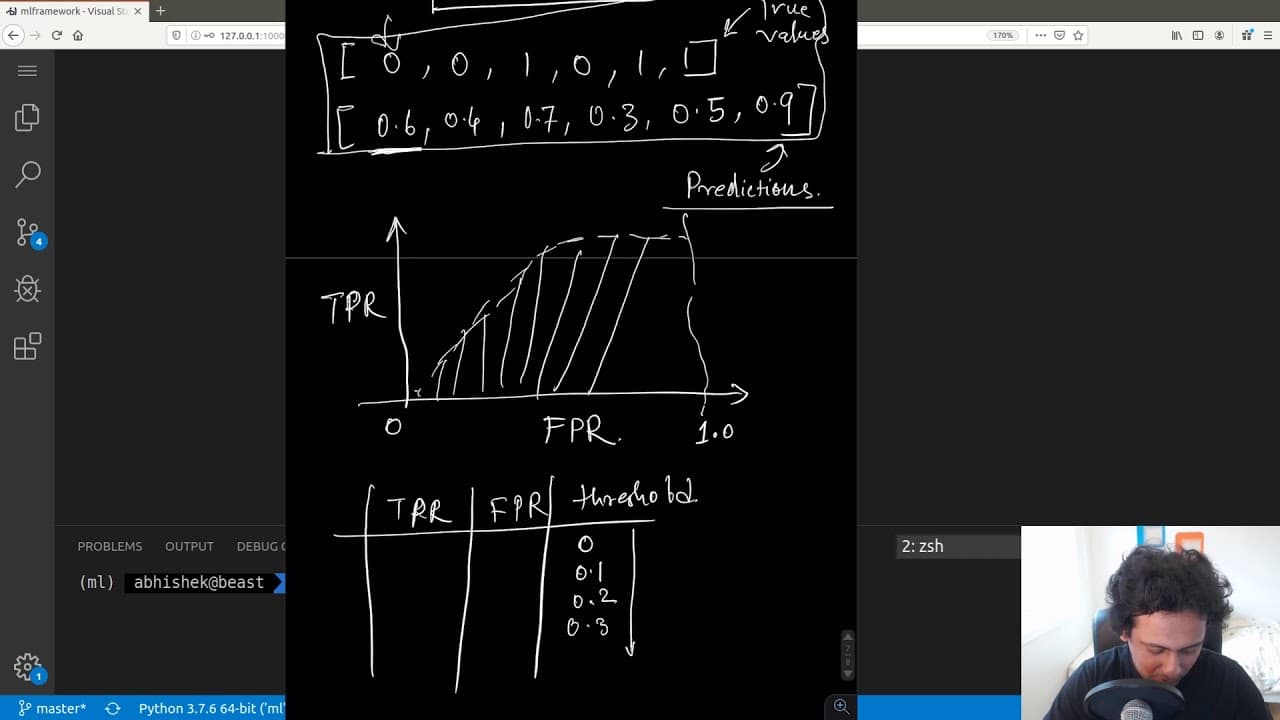
AUC (Area Under the ROC Curve) measures the performance of a classification model across various thresholds. It is a plot of the true positive rate (TPR) against the false positive rate (FPR). A higher AUC value indicates a better model. It represents the probability that a randomly chosen positive sample will rank higher than a randomly chosen negative sample.
Q: How is log loss defined and when is it used in binary classification?
Log loss is a measure of how well a model predicts the probabilities of different classes. It penalizes large errors by using logarithmic calculations. Log loss is used in binary classification and multi-class classification problems. It represents the average negative log-likelihood of the predicted probabilities compared to the true class labels.
Summary & Key Takeaways
-
The video introduces important binary classification metrics: accuracy, precision, recall, F1 score, AUC, and log loss.
-
These metrics are defined and explained using terms such as true positives, true negatives, false positives, and false negatives.
-
The video demonstrates the implementation of these metrics in a machine learning framework using scikit-learn, showcasing code examples.
Read in Other Languages (beta)
Share This Summary 📚
Summarize YouTube Videos and Get Video Transcripts with 1-Click
Try YouTube Summary with ChatGPT & Claude or YouTube Transcript Generator
Explore More Summaries from Abhishek Thakur 📚

Summarize YouTube Videos and Get Video Transcripts with 1-Click
Try YouTube Summary with ChatGPT & Claude or YouTube Transcript Generator