Data sufficiency maths tricks | Reasoning | Blood relation | Part-05 | Bharath Kumar
TL;DR
This content discusses data sufficiency in blood relation questions.
Transcript
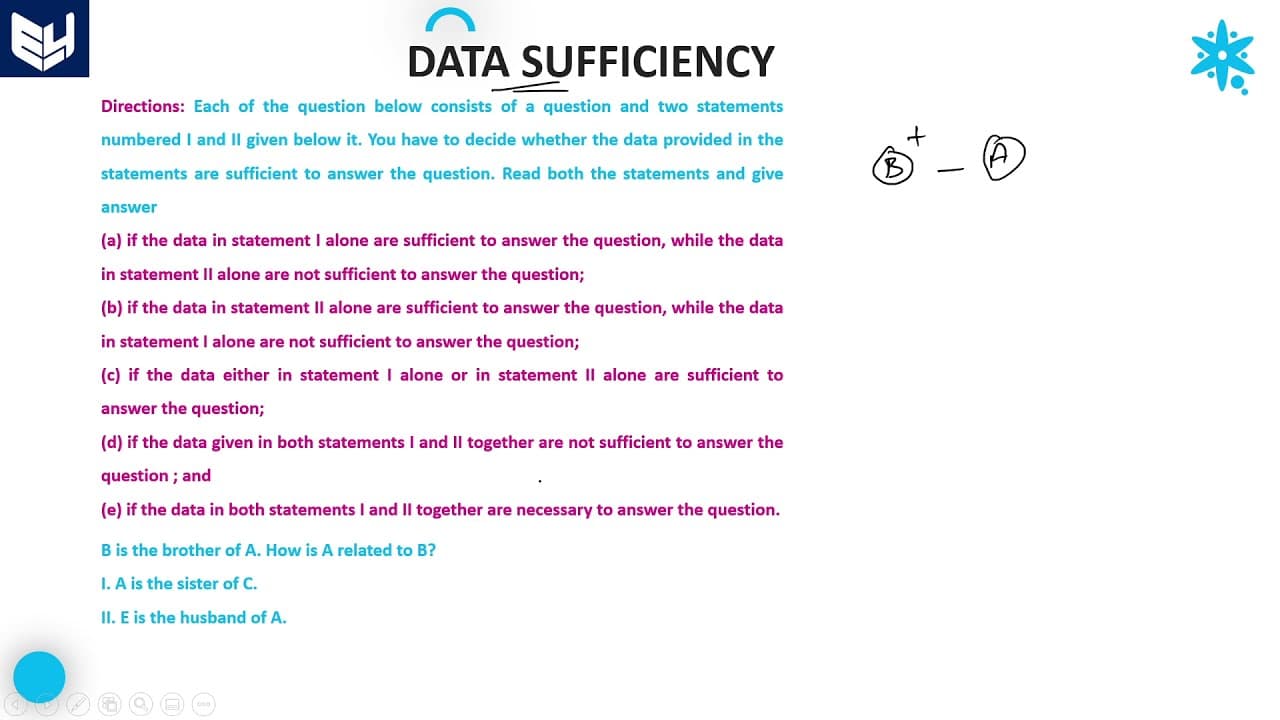
hi everyone welcome back in this session i am continuing data sufficiency let's see one more uh one more session on uh pro blood relations uh let's see the first question in this session see here b is brother of a this is common for both the statements b is brother of a b is brother of a how is a related to b how is a related to b definitely either... Read More
Key Insights
- 🩸 Data sufficiency in blood relations requires careful analysis of each statement provided to draw conclusions.
- 🫥 Understanding sibling relationships is fundamental in solving blood relation questions, often the simplest cases involve confirming direct familial ties.
- 💄 Interpretation of statements must account for ambiguity, particularly regarding gender, to avoid making inaccurate assumptions.
- ❓ Each statement must be evaluated for its sufficiency on its own, rather than relying on combined data for an answer.
- 🍉 The clarity of relationship terms significantly impacts the accuracy of answers, necessitating a clear grasp of familial roles.
- 🥺 Reviewing examples where inference leads to clear answers helps solidify understanding of how to approach blood relationship questions effectively.
- 🥺 Mistaking familial terms or relationships due to preconceived ideas about names may lead to errors in interpreting relationships.
Install to Summarize YouTube Videos and Get Transcripts
Explore YouTube Video Summarizer or Get YouTube Transcript Extractor
Questions & Answers
Q: What is the main focus of the session?
The session focuses on data sufficiency in solving blood relation problems. It examines how to determine the relationships between individuals based on provided statements, clarifying ambiguities surrounding familial connections and the necessary inference to arrive at correct conclusions.
Q: How does the content advise viewers to handle gender assumptions?
The content emphasizes the importance of not making gender assumptions based solely on names. It suggests that readers should rely on relationships described in the problem rather than preconceived notions, highlighting the need for careful analysis to avoid errors in conclusions about familial ties.
Q: What conclusion can be drawn from the first example involving A, B, and C?
In the first example, it is established that A is the sister of B, identified as siblings through the information given. This illustrates that one statement can suffice in determining the familial relationship, showcasing the primary goal of providing clear and logical deductions in blood relation questions.
Q: Why was statement one alone sufficient for the relationship between M and N?
Statement one alone indicates that M and N are the children of the same parent (P), therefore confirming that they are siblings. This clear relationship allows the question to be answered accurately without needing additional information, highlighting the principle of sufficiency in data analysis.
Q: Why is it not possible to determine Tanya's relation from the statements given?
The information provided does not clarify Tanya's gender, which is crucial for establishing her relationship to the man in the photograph. Although the statements describe familial connections, they lack the necessary details to draw definitive conclusions about Tanya's relation, illustrating the importance of complete data for interpretation.
Q: What mistake do people commonly make when interpreting blood relation questions?
People often mistakenly fixate on assumed genders based on names rather than focusing on relationships or pronouns given in the statements. This oversight can lead to incorrect conclusions, making it vital to carefully analyze the specific relationships mentioned to avoid incorrect assumptions.
Summary & Key Takeaways
-
The session explores data sufficiency in blood relation problems, emphasizing how to determine relationships through given statements.
-
It demonstrates how to interpret relationships using statements about siblings, spouses, and grandparents to derive accurate answers.
-
The importance of gender-neutral language is highlighted to ensure clarity when establishing familial connections, addressing common misconceptions.
Read in Other Languages (beta)
Share This Summary 📚
Summarize YouTube Videos and Get Video Transcripts with 1-Click
Try YouTube Summary with ChatGPT & Claude or YouTube Transcript Generator