The Truth About 'Truth Serum'
TL;DR
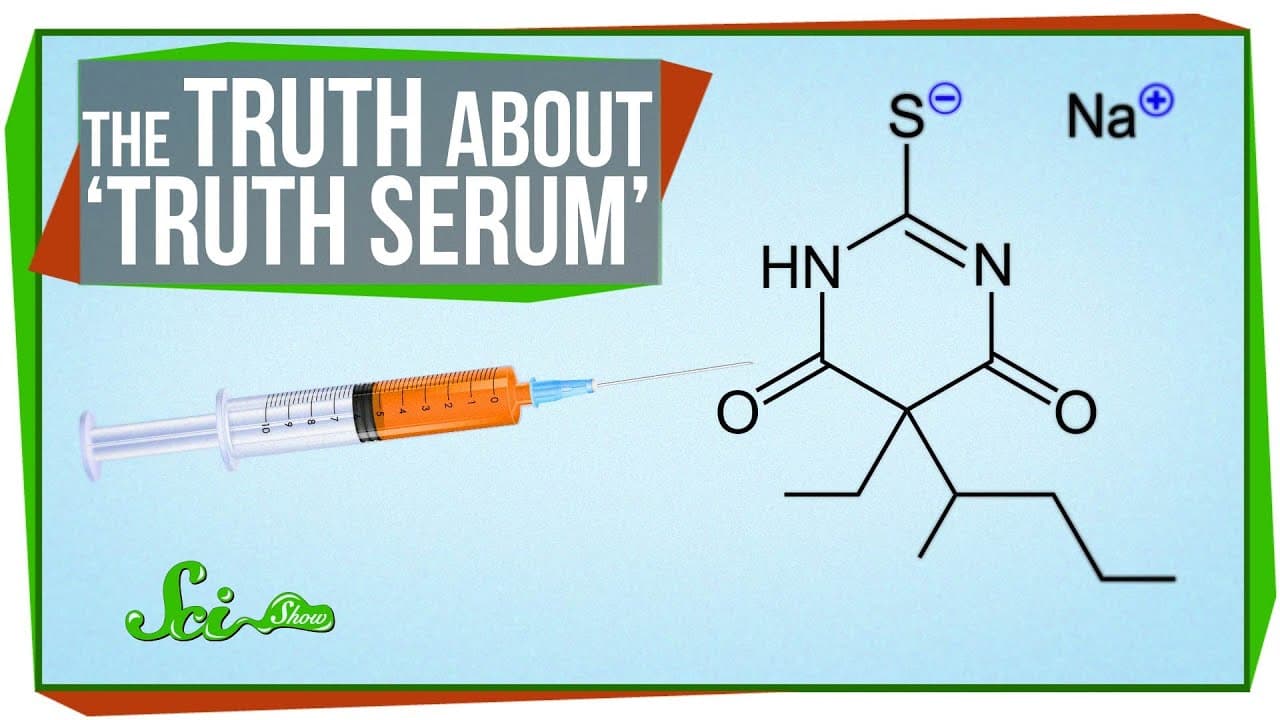
- Sodium Thiopental, known as Sodium Pentothal, is a barbiturate that induces a trance-like state but does not guarantee truth-telling.
Transcript
You've probably seen it on TV or in a movie; A suspect is being interrogated about some crime and everybody knows he did it, but he won't confess. So an old man in glasses and a lab coat comes in with a syringe of, like, bright orange stuff and pokes it in there and the guy starts spilling the beans on everything from the crime all the way to that ... Read More
Key Insights
- ❓ Sodium Thiopental, known as Sodium Pentothal, was intended as a painkiller but is now mainly used as a quick knock-out drug.
- ☺️ The drug induces a relaxed state in small doses, making it challenging for individuals to carry out complex cognitive tasks effectively.
- 🥺 Sodium Thiopental can make individuals talkative, but it does not necessarily lead to truthful confessions.
- 🧠 The drug's mechanism in the brain reduces higher brain functions, including the ability to decide what to say and discern between truths and lies.
- 🙊 Sodium Thiopental's history as a possible "truth serum" stems from World War II experiments aiming to help traumatized soldiers speak candidly.
- 🥺 While Sodium Thiopental may increase suggestibility, it does not guarantee truth-telling and can lead to false confessions.
- 🥰 Individuals under the influence of Sodium Thiopental may say things they believe interrogators want to hear, rather than the actual truth.
Install to Summarize YouTube Videos and Get Transcripts
Explore YouTube Video Summarizer or Get YouTube Transcript Extractor
Questions & Answers
Q: Is Sodium Thiopental really a truth serum?
While Sodium Thiopental induces a trance-like state, it does not guarantee truth-telling. People under its influence may say what they believe their interrogators want to hear.
Q: How does Sodium Thiopental affect brain function?
Sodium Thiopental binds to Gaba receptors in the brain, reducing higher brain functions and making it hard for individuals to carry out complex thought processes effectively.
Q: Can Sodium Thiopental make unwilling subjects confess?
Unwilling subjects may not confess under the influence of Sodium Thiopental, as individuals with personality disorders may continue to lie despite the drug's effects.
Q: Why can't Sodium Thiopental guarantee truthful confessions?
While Sodium Thiopental reduces complex thinking and induces talkativeness, individuals may still provide false information or confess to crimes they didn't commit.
Summary & Key Takeaways
-
Sodium Thiopental, a so-called "truth drug," was discovered in 1936 but is not as effective in revealing the truth as commonly believed.
-
It induces relaxation in small doses and does not necessarily lead to truthful confessions.
-
The drug's mechanism in the brain reduces higher brain functions, making complex thought processes difficult.
Read in Other Languages (beta)
Share This Summary 📚
Summarize YouTube Videos and Get Video Transcripts with 1-Click
Try YouTube Summary with ChatGPT & Claude or YouTube Transcript Generator
Explore More Summaries from SciShow 📚


Summarize YouTube Videos and Get Video Transcripts with 1-Click
Try YouTube Summary with ChatGPT & Claude or YouTube Transcript Generator